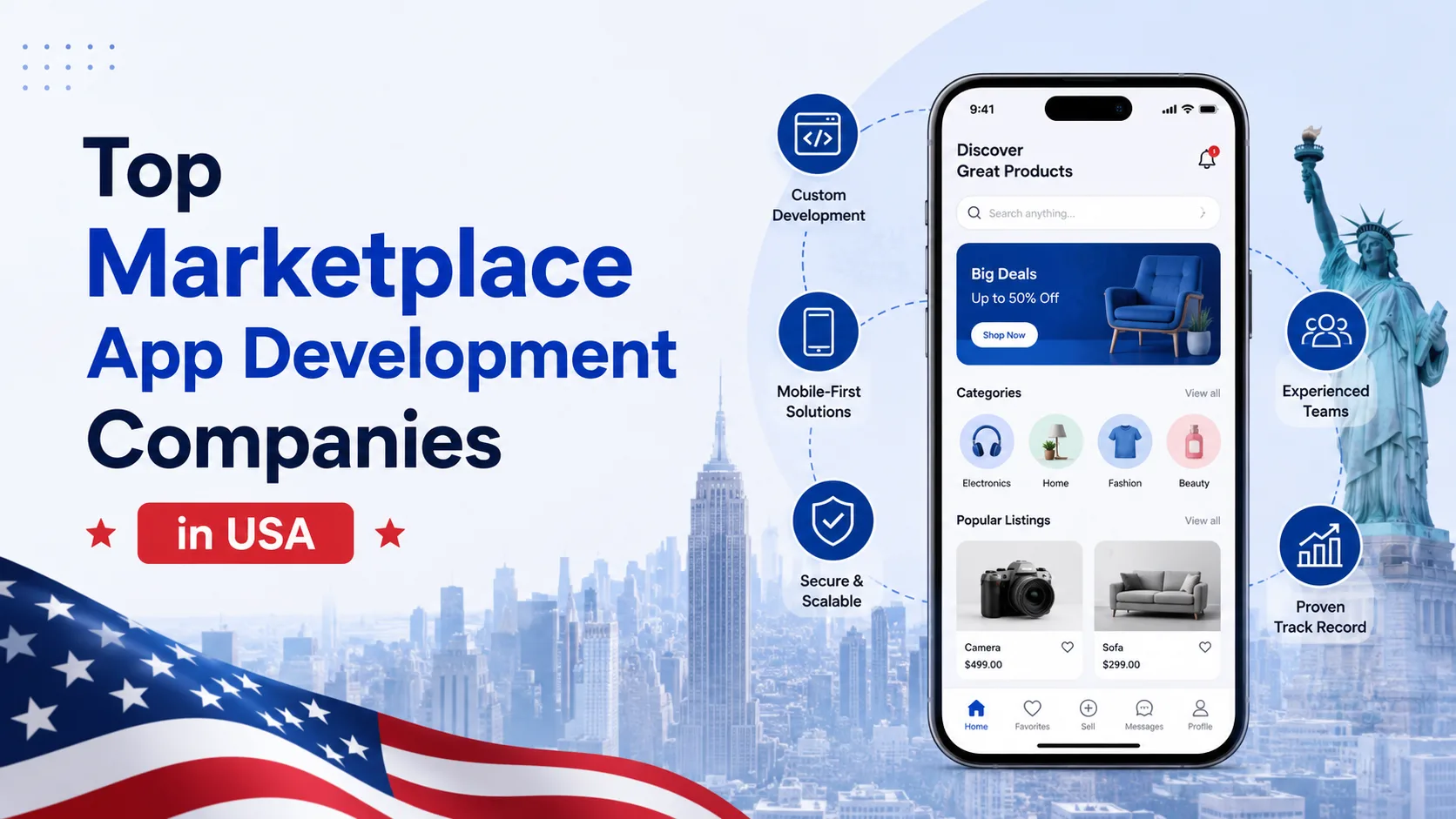
Building a marketplace app is fundamentally different from building a standard ecommerce store. A marketplace must serve three audiences simultaneously: buyers, sellers or service providers, and the platform owner. That expanded scope means user onboarding, seller verification, listings, search, payments, commissions, reviews, disputes, logistics, analytics, fraud prevention, and scalable infrastructure all become table stakes, not nice-to-haves.
The opportunity justifies that complexity. The global ecommerce platform market is estimated at USD 9.40 billion in 2026 and projected to reach USD 45.60 billion by 2033. The consumer-to-consumer segment alone is expected to grow from USD 1.78 trillion in 2026 to USD 7.91 trillion by 2030. For startups, this creates room for niche platforms that incumbents overlook. For enterprises, it creates pressure to modernize commerce systems, procurement portals, and service platforms before competitors do.
The companies listed below represent a practical shortlist of marketplace app development firms in the USA suited for both startups and enterprises. This is not an absolute ranking. Selection is based on marketplace-relevant capabilities: mobile and web development, product strategy, UX/UI, cloud architecture, API integrations, AI features, ecommerce experience, enterprise delivery, and long-term support.
1. Apptunix
Apptunix is a strong option for companies that want full-cycle digital product engineering. With 3,000+ digital products delivered and 500+ legacy systems modernized across 35 industries, the company brings broad delivery experience to both new builds and complex overhauls. Its mobile app development capabilities cover iOS, Android, Flutter, React Native, cross-platform engineering, UI/UX, security, and enterprise scalability.
As a marketplace app development company, Apptunix is well positioned to serve two distinct client profiles. Startups benefit from its MVP planning and go-to-market experience, while enterprises can lean on its strength in complex integrations, cloud infrastructure, and legacy modernization. That range makes it a practical choice whether the goal is launching a first platform or rebuilding one that has outgrown its foundation.
2. Litslink
Litslink is a strong fit for businesses that need cloud-native engineering and long-term scalability. The company specializes in cloud infrastructure, MACH architecture, data engineering, AI, application development, and digital experience. Its mobile capabilities cover native, hybrid, and cross-platform development across major platforms.
What makes Litslink particularly relevant for marketplace projects is its depth in the technical layers that marketplaces depend on most. Its marketplace app development services span API-first architecture, DevOps, data pipelines, recommendation engines, payment integrations, and high-availability infrastructure, making it a practical choice for platforms that expect to scale fast and handle significant transactional load.
3. ValueAppz
ValueAppz is best suited for enterprises that prioritize customer experience and product quality above all else. With roots in digital product development going back to 2008, the company brings nearly two decades of delivery experience combined with enterprise-scale capabilities across customer experience, modernization, trust, and safety.
That foundation makes ValueAppz a strong candidate for retail marketplaces, service booking apps, loyalty platforms, and high-traffic customer-facing products. Its experience also extends into emerging commerce models, including nft marketplace app development, giving it relevance for enterprises exploring blockchain-based ownership, digital asset trading, and tokenized loyalty ecosystems alongside their core platform work.
4. Essence Solusoft
Essence Solusoft is a U.S.-focused mobile app development company specializing in custom iOS, Android, and AI-powered mobile applications, alongside enterprise software, backend architecture, integrations, and long-term support. The company serves startups, enterprises, healthcare organizations, and growing businesses that need applications built for security and scale from the ground up.
Its online marketplace app development experience covers a practical range of platform types, including multi-vendor marketplaces, booking platforms, ecommerce apps, internal enterprise marketplaces, and mobile-first service platforms. That breadth makes Essence Solusoft a grounded choice for organizations that need a development partner capable of handling both the product layer and the technical infrastructure behind it.
5. Innowise
Innowise is a full-service digital agency covering strategy, mobile apps, AI, enterprise web, branding, design, research, and backend development. Its client roster includes Google, The New York Times, and Mayo Clinic, which signals experience operating at the level of quality and complexity that large-scale digital products demand.
As a marketplace app development agency, Innowise is particularly well suited for platforms where design and user experience are not secondary concerns but direct drivers of business performance. Its strength lies in the touchpoints that determine whether a marketplace converts and retains users: onboarding flows, search and discovery, checkout experience, and the trust signals that make buyers and sellers confident enough to transact.
Key Features a Marketplace App Development Partner Should Understand
A serious marketplace app development company should understand the mechanics of marketplace liquidity, not just how to build mobile screens. At minimum, the product roadmap should cover user registration, seller onboarding, product and service listings, advanced search and filters, secure checkout, split payments and commission logic, messaging, ratings, reviews, dispute management, push notifications, admin dashboards, analytics, and fraud controls.
Enterprise marketplace development demands a deeper scope. Depending on the platform, that can mean multi-region deployment, role-based access, vendor compliance workflows, tax rules, document management, data warehouses, AI-powered recommendations, and integrations with existing enterprise systems. The right development partner will do more than execute a feature list. They will challenge unclear requirements, help simplify the first release, and design an architecture that allows the platform to scale without requiring a full rebuild down the line.
How to Choose the Right Marketplace App Development Company
The best marketplace app development company for your project depends on your stage, budget, and technical complexity.
Startups should prioritize product discovery, MVP discipline, UX clarity, cost control, and fast iteration. A first release should focus on the essentials: buyer and seller onboarding, listings, search, messaging, payments, reviews, admin controls, and analytics. Resist the temptation to overbuild before validating supply, demand, and monetization. A lean first version that proves the model is worth more than a full-featured platform that has not yet found its market.
Enterprises should prioritize architecture, cybersecurity, compliance, integrations, scalability, governance, SLAs, and post-launch support. At this level, marketplace platforms typically require SSO, role-based access, ERP and CRM integration, vendor management, audit logs, advanced reporting, data privacy controls, and cloud cost governance. The stakes of a poor vendor choice are higher, and the recovery cost is significant.
Before signing with any development partner, ask for relevant marketplace case studies, technical architecture samples, delivery methodology, team structure, code ownership terms, QA process, and post-launch support model. Third-party review platforms such as Clutch are also worth consulting, as they maintain verified service provider profiles, client reviews, and pricing signals that help B2B buyers make more informed comparisons.
Final Verdict
Choosing the right marketplace app development company is one of the more consequential decisions a startup or enterprise will make when entering the digital commerce space. The right partner brings technical depth and a genuine understanding of marketplace dynamics, user behavior, and the operational realities that separate platforms that scale from those that stall.
For startups, the right development partner accelerates the path from idea to a functional MVP without overcomplicating the first release. Speed, cost discipline, and a focus on the features that validate the core model matter more at this stage than building for every future scenario.
For enterprises, the priorities shift toward architecture integrity, system integration, security, compliance, and the ability to support large user bases without performance degradation. At this scale, a development partner that understands governance and long-term maintainability is as valuable as one that writes clean code.
The platforms that succeed are rarely the ones that launched with the most features. They are the ones built on a foundation that could absorb growth, adapt to market feedback, and evolve without requiring a rebuild every two years. That starts with choosing a partner whose thinking goes beyond the initial delivery.