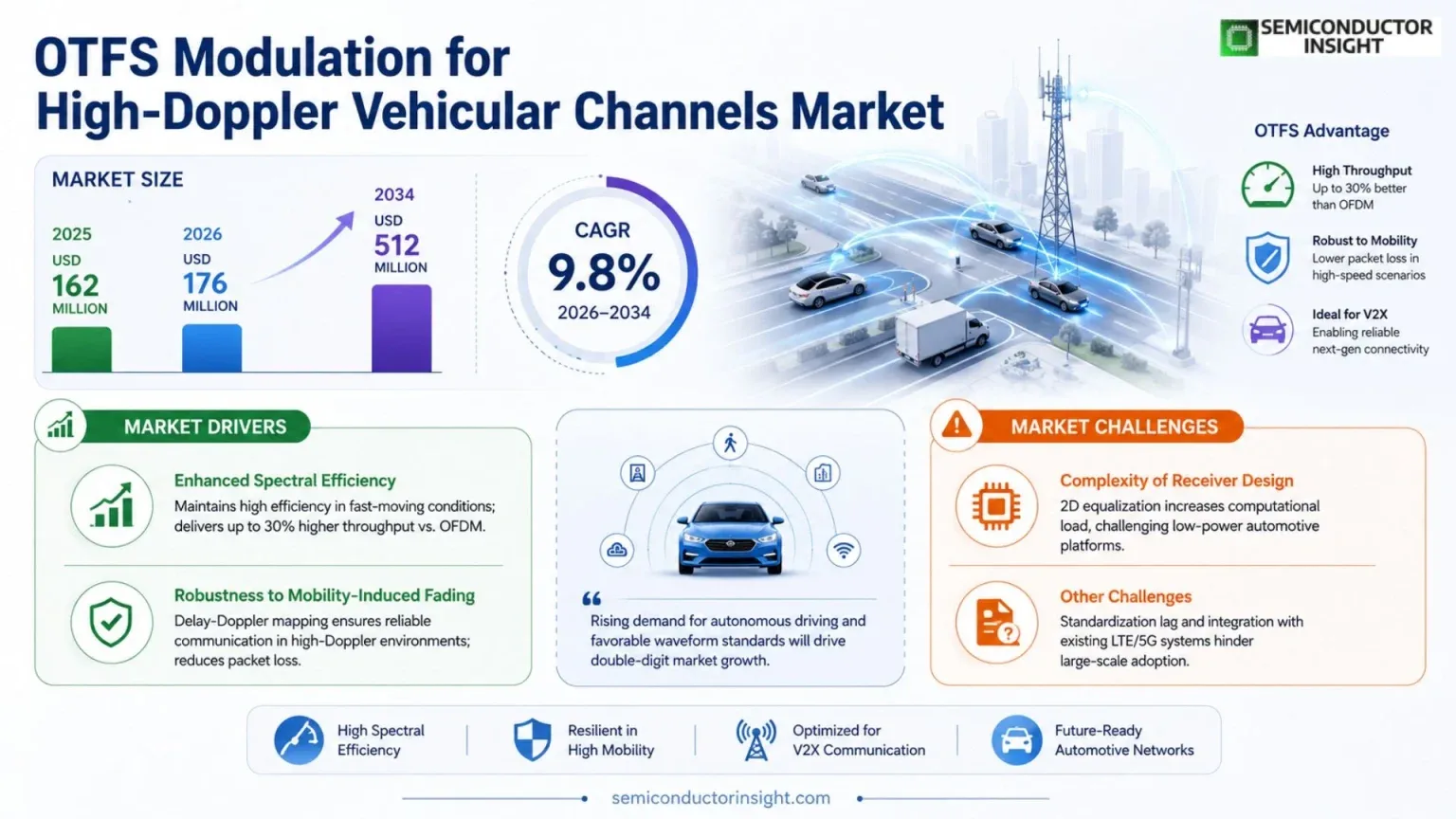
OTFS modulation for high-Doppler vehicular channels Market size is projected to grow from USD 176 million in 2026 to USD 512 million by 2034, exhibiting a CAGR of 9.8% during the forecast period.
Any Questions About the Report? Ask Us Now!
OTFS modulation for high-Doppler vehicular channels Market Insights
Global OTFS modulation for high-Doppler vehicular channels market size was valued at USD 162 million in 2025. The market is projected to grow from USD 176 million in 2026 to USD 512 million by 2034, exhibiting a CAGR of 9.8% during the forecast period.
OTFS (Orthogonal Time Frequency Space) modulation is a two‑dimensional waveform that maps information symbols onto the delay‑Doppler domain, providing inherent resilience against severe Doppler spreads typical of vehicular environments. By exploiting channel sparsity, OTFS enables reliable high‑mobility communications for connected‑car and V2X applications.
The market is accelerating because automotive manufacturers are integrating advanced driver‑assistance systems that demand robust high‑speed links, while telecom vendors such as Qualcomm, Nokia and Ericsson are investing in chipset prototypes and standardization efforts. Furthermore, recent collaborations,e.g., Nokia’s partnership with a leading automotive OEM in March 2024 to pilot OTFS‑based V2X,are expected to broaden adoption across global fleets.
List of Key OTFS Modulation for High‑Doppler Vehicular Channels Companies Profiled
- Qualcomm
- Ericsson
- Huawei
- Renesas
- STMicroelectronics
- Marvell
- Texas Instruments
- Fujitsu
- ZTE
- Rohde & Schwarz
Click Here to Read More About Report
Segment Analysis:
Segment CategorySub-SegmentsKey InsightsBy Type
- Single‑Carrier OTFS
- Multi‑Carrier OTFS
Single‑Carrier OTFS
- Offers a streamlined transceiver architecture that aligns well with automotive ASIC design cycles.
- Provides robust resilience to Doppler spread while maintaining low computational overhead.
- Favoured by early‑stage prototype programs seeking rapid integration into vehicle platforms.
By Application
- Connected‑Car Services
- V2X Safety Messaging
- Infotainment Streaming
- Autonomous Driving Control
V2X Safety Messaging
- Leverages OTFS’s delay‑Doppler mapping to maintain link reliability even at extreme vehicle speeds.
- Enables timely exchange of collision‑avoidance data across heterogeneous vehicle fleets.
- Forms a strategic pillar for emerging cooperative‑aware driving ecosystems.
By End User
- Automotive OEMs
- Telecom Infrastructure Providers
- System Integrators
Automotive OEMs
- Prioritize OTFS for its ability to sustain high‑throughput links in fast‑moving scenarios without excessive hardware complexity.
- Integrate OTFS within next‑generation vehicle platforms to future‑proof connectivity for autonomous functions.
- Collaborate closely with chipset vendors to co‑design reference designs that meet automotive safety standards.
By Deployment Scenario
- Urban Dense Environments
- Highway High‑Speed Corridors
- Rural Sparse Networks
Highway High‑Speed Corridors
- OTFS’s Doppler‑resilient waveform ensures continuous link quality when vehicles travel at very high velocities.
- Supports seamless handover between macro‑cellular and edge‑computed nodes along long stretches of roadway.
- Facilitates consistent V2X safety exchanges critical for platooning and coordinated lane‑changing maneuvers.
By Technology Integration
- Chipset Implementation
- Software‑Defined Radio (SDR) Platforms
- Edge Computing Enablement
Chipset Implementation
- Industry leaders embed OTFS directly into baseband ASICs to minimise latency and power consumption.
- Enables tight integration with existing 5G NR stacks, easing the path toward unified vehicular communication standards.
- Provides a scalable foundation for future enhancements such as joint radar‑communication functions.
Click Here to Read More About Report
Regional Analysis: North America
Europe
Europe exhibits steady growth in OTFS modulation for high-Doppler vehicular channels Market. Stringent data privacy regulations and a strong focus on sustainable transportation are key market characteristics. The region’s automotive industry is prioritizing connectivity solutions that align with European standards and environmental objectives. While the pace of adoption might be slightly slower compared to North America, the long-term outlook remains positive. The emphasis on secure and reliable communication is driving demand for advanced OTFS systems.
Asia-Pacific
Asia-Pacific represents a high-growth potential market for OTFS modulation in the vehicular sector. Rapid urbanization, increasing vehicle ownership, and government initiatives promoting smart mobility are contributing to significant market expansion. The region’s automotive industry is experiencing robust growth, particularly in countries like China and India, driving demand for advanced connectivity solutions. The adoption of OTFS technology is expected to accelerate as automotive manufacturers seek to enhance vehicle safety and performance.
South America
South America presents a nascent but promising market for OTFS modulation for high-Doppler vehicular channels. Growing urbanization and increasing disposable incomes are driving vehicle sales in the region. The automotive industry is gradually adopting advanced communication technologies, but the market is still in its early stages of development. Government initiatives to improve transportation infrastructure and promote connected vehicles are expected to spur market growth.
Any Questions About the Report? Ask Us Now!
FREQUENTLY ASKED QUESTIONS:
What is the current market size of OTFS modulation for high-Doppler vehicular channels Market?
-> OTFS modulation for high-Doppler vehicular channels Market was valued at USD 162 million in 2025 and is expected to reach USD 512 million by 2034.
Which key companies operate in OTFS modulation for high-Doppler vehicular channels Market?
-> Key players include Qualcomm, Nokia, Ericsson, among others.
What are the key growth drivers?
-> Key growth drivers include integration of advanced driver‑assistance systems by automotive manufacturers, telecom vendors investing in chipset prototypes and standardization, and collaborations to pilot OTFS‑based V2X solutions.
Which region dominates the market?
-> North America and Europe exhibit strong adoption due to high automotive OEM concentration, while Asia‑Pacific is emerging as a fast‑growing market.
What are the emerging trends?
-> Emerging trends include 5G‑enabled V2X deployments, AI‑assisted channel estimation for OTFS, and increased standardization efforts across automotive and telecom alliances.