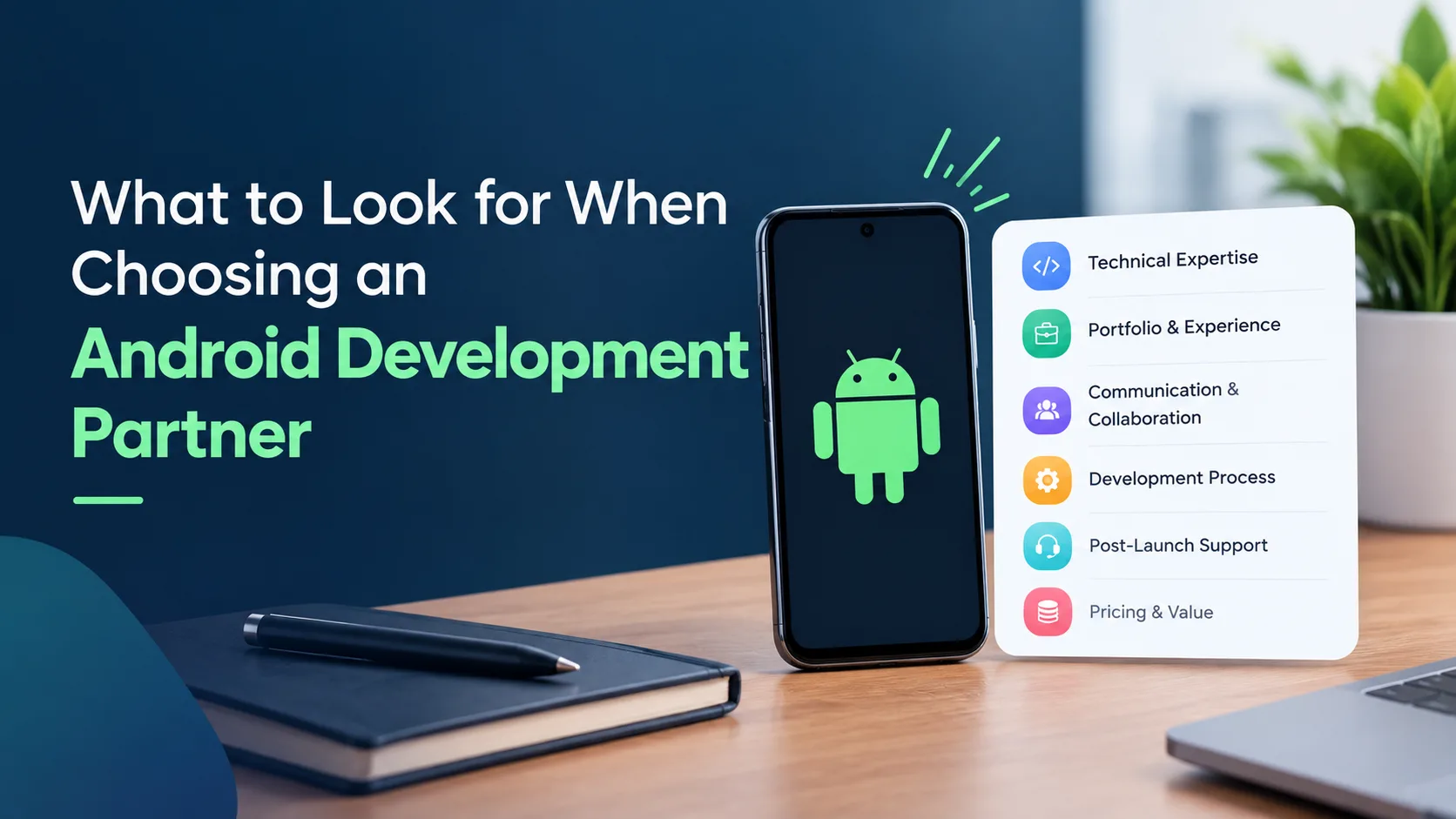
Your Android development partner can directly influence how quickly your product reaches the market, how efficiently it scales, and how easily your team can maintain it over time. A weak partnership can turn early technical decisions into costly business constraints later.
For founders, CEOs, and CTOs, choosing a partner requires more than comparing portfolios and project quotes. Evaluate their Android expertise, experience with similar products, development and QA processes, security practices, communication model, ownership terms, and post-launch support. These factors help determine whether a partner can support your product from initial development through long-term growth.
In this guide, we’ll cover the key factors to assess before choosing an Android development partner, from technical expertise and portfolio credibility to delivery processes, security, pricing, ownership, and post-launch support. If you’re planning to hire Android developers for a new product or an existing application, you’ll also find practical questions to ask potential partners and red flags to consider before making a decision.
Things to Look for in an Android Development Partner
Focus on the factors that reveal whether an Android development partner can deliver reliably, scale with your product, and provide long-term support when you hire the best mobile app developers for your project.
Relevant Android Development Experience
Start by checking whether the partner has built products with requirements similar to yours. Look for experience with comparable features, integrations, user volumes, business models, and technical complexity.
A company may have dozens of Android projects in its portfolio, but that does not automatically mean it has experience with your product requirements. Review relevant case studies and live Google Play apps where available.
Also ask what the company's actual role was in each project. There is an important difference between delivering an entire product and contributing to one part of it.
Modern Android Technical Expertise
Your development partner should understand the technologies and architecture required for a production-ready Android application. This may include Kotlin, Android SDK, Jetpack, Jetpack Compose, API integration, application architecture, performance optimization, and device compatibility.
Do not evaluate technical expertise only by counting technologies listed on a website. Ask the team to explain why a particular architecture or technology approach fits your product.
A capable partner should be able to connect technical decisions with business requirements such as scalability, performance, development speed, and future feature expansion.
A Portfolio You Can Verify
A portfolio is useful only when you can verify what it demonstrates. Instead of looking only at screenshots, examine live applications, functionality, user reviews, release history, and the product's overall experience.
Ask potential partners:
- Which projects are most similar to ours?
- What did your team build?
- Which parts were handled internally?
- Can you provide live app links or relevant case studies?
- Can we speak with a previous client?
This approach helps separate genuine delivery experience from broad portfolio claims.
A Clear Development and QA Process
A reliable Android partner should have a defined process covering discovery, requirements, development, testing, release, and ongoing improvements. Ask how the team handles code reviews, automated and manual testing, regression testing, real-device testing, performance testing, and Google Play releases.
Android applications need to work across different devices, screen sizes, operating system versions, and hardware configurations. A strong QA process should account for this variation before the application reaches production.
The key question is not simply whether the company performs testing. Ask how it determines that the product is ready for release.
Security and Scalability
Security should be considered during architecture and development rather than added before launch. Ask how the partner approaches authentication, authorization, secure API communication, data protection, permissions, and sensitive information storage.
Scalability matters just as much. The architecture should support increasing users, transactions, integrations, and features without creating unnecessary technical debt. The right partner should be able to explain how today's technical decisions affect the product six months or several years from now.
Transparent Communication, Scope, and Pricing
A development proposal should make the commercial and delivery expectations clear. Look for defined milestones, deliverables, timelines, team responsibilities, assumptions, and change-request processes.
Do not compare vendors only by hourly rates or initial project quotes. A lower estimate can become more expensive when requirements, dependencies, revisions, or additional features are not clearly defined.
Also clarify how communication will work. Understand who your primary contact will be, how frequently you will receive progress updates, how decisions will be documented, and how technical or delivery issues will be escalated.
Post-Launch Support and Product Ownership
Launching the app is only one stage of its lifecycle. Your Android development partner may need to handle bug fixes, Android OS updates, performance improvements, security patches, monitoring, new features, and future releases.
Clarify what post-launch support includes and whether it is covered by a maintenance agreement or charged separately.
You should also establish ownership of the source code, intellectual property, documentation, design assets, deployment credentials, and other project deliverables before development begins. A long-term product partner should make ownership and handover requirements clear from the beginning.
Questions to Ask Before Hiring an Android Development Partner
Before selecting a partner, ask questions that reveal how the team actually works:
- Which Android products similar to ours have you delivered?
- What was your team's specific contribution to those products?
- Who will work on our project, and what is their experience?
- What Android architecture would you recommend and why?
- How will you handle device and Android version compatibility?
- What does your QA and release process include?
- Who owns the source code and intellectual property?
- What support will you provide after launch?
The answers should give you enough evidence to compare partners on delivery capability rather than sales presentations alone.
Android Development Partner Red Flags to Watch For
Certain warning signs deserve closer attention during vendor evaluation. A portfolio containing only screenshots without live applications can make experience difficult to verify. Vague technical proposals may indicate that the partner has not properly understood your product requirements. Similarly, unclear ownership terms can create problems when you need to change vendors or take development in-house.
Other warning signs include an unusually low quote without clear assumptions, no named project team, an undefined QA process, inconsistent communication, and limited post-launch support.
When you identify a red flag, ask for evidence rather than making assumptions. For example, if a company claims extensive Android experience, ask for relevant live applications, case studies, or client references.
Final Thoughts
Choosing an Android development partner is a long-term product decision, not simply a vendor selection. When evaluating a mobile app development company, look beyond pricing and portfolio size to assess relevant experience, technical depth, delivery processes, communication, security, ownership, and post-launch support.
At RipenApps, the focus is on helping businesses turn product requirements into scalable digital solutions through structured development, technical expertise, and ongoing support. A thorough evaluation upfront can reduce delivery risks and create a stronger foundation for building, launching, and scaling your Android app.
FAQs
1. How do I choose the right Android development partner?
Evaluate relevant experience, modern Android expertise, portfolio evidence, development and QA processes, security practices, communication, pricing transparency, ownership terms, and post-launch support.
2. What skills should an Android development company have?
Look for expertise in Kotlin, Android SDK, modern Android architecture, Jetpack, API integration, testing, performance optimization, security, and Google Play deployment.
3. What should I ask an Android development company before hiring?
Ask about similar projects, the assigned team, architecture recommendations, development methodology, QA, security, milestones, source-code ownership, pricing, and post-launch support.
4. Should I choose an Android specialist or a full-service app development company?
It depends on your product requirements. An Android specialist may fit an Android-focused project, while a full-service partner may be useful when you also need backend, UI/UX, cloud, AI, or ongoing product development.
5. How can I verify an Android development company's portfolio?
Check live Google Play applications, review their functionality and user feedback, ask about the company's specific contribution, and request relevant case studies or client references.