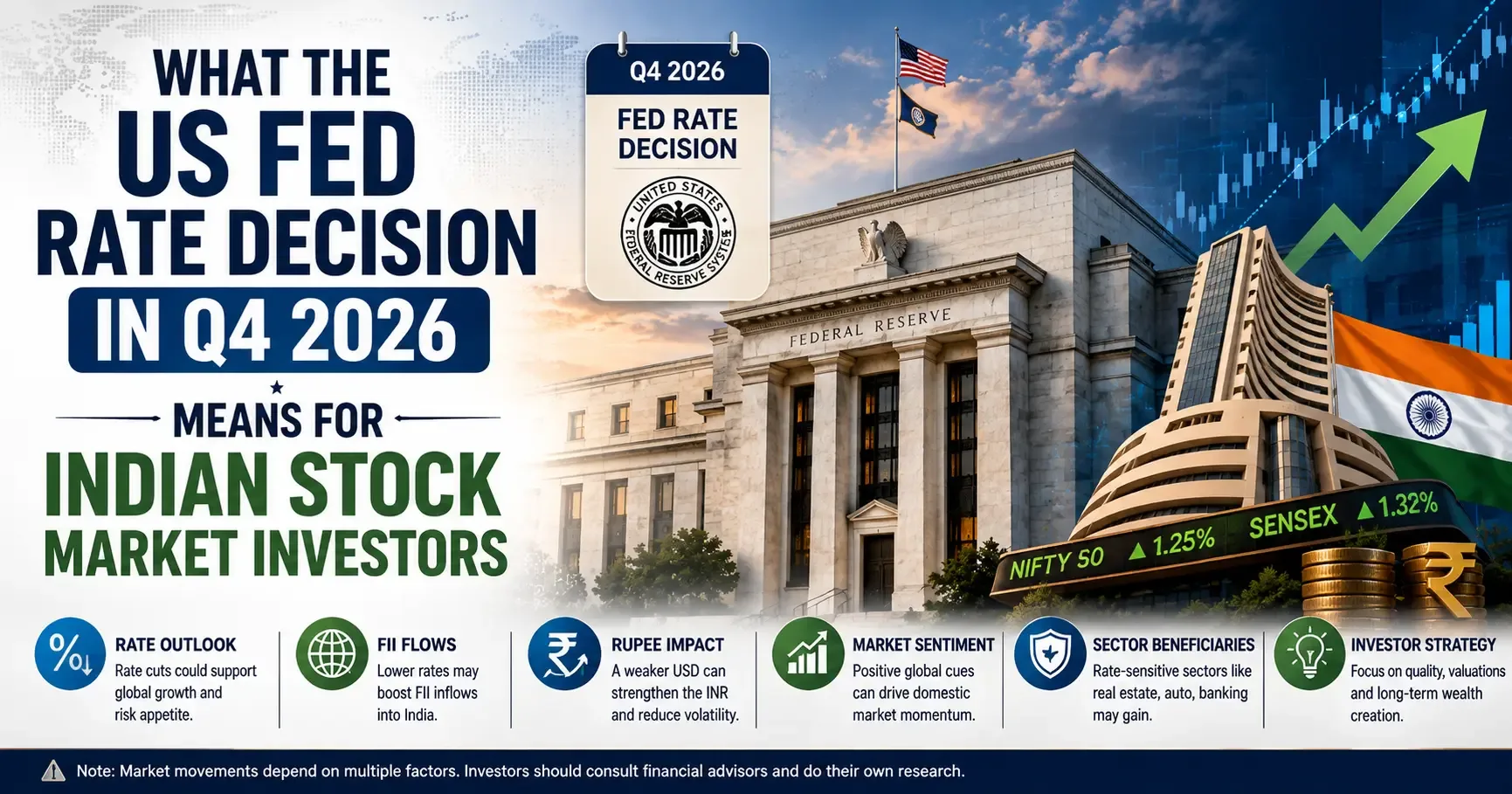
Investors in Indian stocks are keeping a close eye on the US Federal Reserve as the last quarter of 2026 progresses. Interest rate policies have an effect on global money flows, the rupee, borrowing, and investor sentiment in emerging countries like India.
In September, the US Fed increased its benchmark interest rate by 0.25 percentage points, making it 3.75% to 4%. Upcoming policy meetings for the US Fed are scheduled for October 27-28 and December 8-9.
What Happens If the Fed Keeps Rates High?
If the Fed continues with the high interest rates for longer than expected by investors, there would be uncertainty in the Indian stock markets.
There may come a situation where foreign investors may become apprehensive of stocks from developing countries. The US dollar may also pose challenges to the Indian currency. Importing will become expensive, especially with oil prices remaining high in international markets.
The effect may not only apply to companies that borrow in dollars or use imported goods but also to companies that rely on financing from foreign investors. However, leaving rates may have minimal impact on the market if the action had been foreseen by investors.
What If the Fed Cuts Interest Rates?
A reduction in interest rates may make investment more favorable by reducing the appeal of dollar-denominated investments compared to other options available to investors.
In the case of India, reduced interest rates can encourage foreign investments in the stock market as well as ease off some pressure on the rupee.
The motive behind the reduction in interest rates is important. In case the interest rates are reduced due to the fact that there is a slowdown in inflation and the economy is stable, the financial markets may react favorably. However, if the interest rate is being reduced due to an extreme weakness in the US economy, the demand and earnings of companies can work against the move.
Thus, investors should focus on the rationale for the Fed's move and not the actual move.
Which Indian Sectors Could Be Affected?
The impact will vary across industries.
IT services: A healthier US economy can support spending by American clients, while currency movements can affect companies earning revenue in dollars.
Banking and financial services: Changes in global risk appetite and foreign investment flows can influence share prices, although domestic interest rates and loan growth remain important.
Export-oriented businesses: Currency movements and demand from overseas customers can affect earnings.
Real estate and other interest-sensitive sectors: Borrowing costs and investor confidence can influence valuations and demand.
Oil-dependent businesses: Crude prices and rupee movements may affect input costs and profit margins.
These are possible effects, not guaranteed outcomes. Company-specific performance still matters.
What Should Indian Investors Watch in Q4?
Rather than trying to predict every Fed move, investors can monitor a few important signals:
- The Fed's October and December policy statements.
- US inflation and employment reports.
- The dollar's movement against the rupee.
- Foreign investors buying and selling in Indian equities.
- Crude oil prices and India's domestic inflation.
- Quarterly earnings and management guidance from Indian companies.
India also has its own monetary policy challenges. The Reserve Bank of India raised its repo rate in October amid inflation concerns, showing that domestic interest rate conditions may not follow the Fed in the same direction.
Conclusion
The US Fed's Q4 2026 decisions could influence Indian stock markets through foreign investment flows, currency movements, and global risk appetite. A more supportive policy outlook may improve sentiment, while higher-for-longer rates could create pressure.
Still, the Fed is only one part of the market story. Investors should focus on business fundamentals, reasonable valuations, diversification, and their investment time horizon instead of making decisions based on a single announcement.
For more detailed analysis on different stock market topics, you can join multiple online forums such as Strategic Alpha’s “The Conviction Club.” These are a kind of membership program that helps you understand the stock market in depth.
If you need guidance on how to start your stock market journey, how much capital is enough to begin with, how to do smart investing, or how to take informed stock market decisions, you can join Strategic Alpha’s ‘The Conviction Club’. This is a membership program, especially curated to help investors become aware and knowledgeable about stock market trends, news, and technical aspects, so that they can become their own experts.
Our YouTube channel, weekly webinars, and digital resources available on the website can help you learn the basics of the stock market. For regular updates on trends, one-to-one sessions with experts, and detailed learning modules, you can join the Conviction Club, which is the online community of like-minded investors sharing knowledge and thoughts to grow together.
Subscribe to the Strategic Alpha Newsletter now to get the latest updates about weekly webinars.
Join Me On My Telegram Channel Where I Share Much More Value Adding Knowledge Of Investing/ Trading: Click Here
Also, Don’t Forget To Follow Us On Our Social Media Accounts:
Facebook: https://www.facebook.com/strategicalpha/
Instagram: https://www.instagram.com/strategicalpha/
Twitter: https://twitter.com/suyog_dhavan
YouTube: https://bit.ly/2IIqztO
Disclaimer: Strategic Alpha and Suyog Dhavan are not SEBI-registered investment advisor. The content provided is purely for educational purposes and should not be construed as financial or investment advice. Viewers are encouraged to conduct their own research or consult with a SEBI-registered professional before making any investment decisions.