
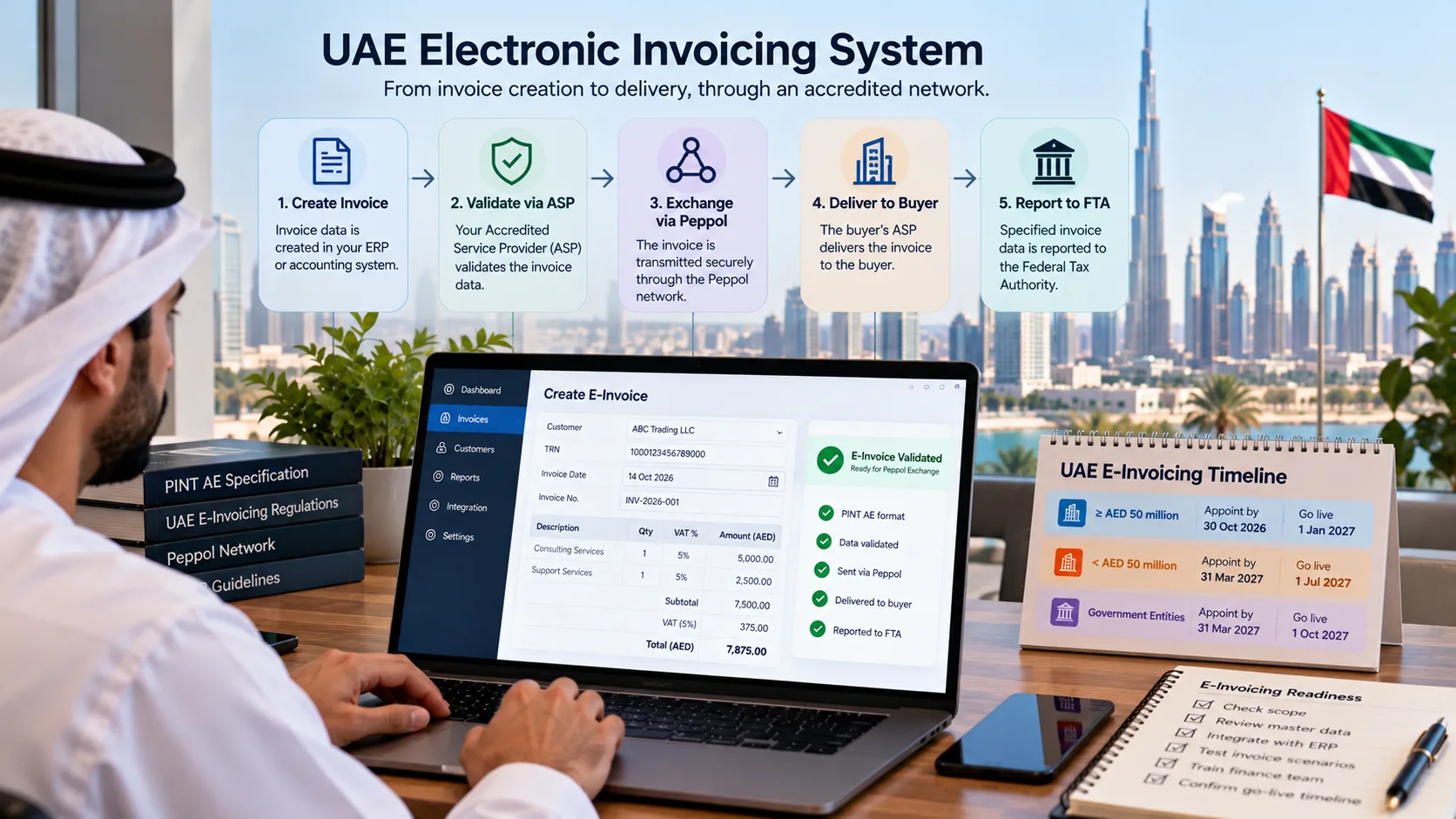
For most businesses, issuing an invoice is a routine step: generate a document, send it and wait for payment. A regulator rarely sees it, and the buyer’s system rarely questions it. That routine is about to change for companies that trade with other businesses and government bodies in the UAE.
The change comes from the Ministry of Finance, which issued two Ministerial Decisions in September 2025 setting the scope and timelines for e-invoicing. Invoices will move as structured data, not as PDFs or paper, and both issuers and recipients must work through an Accredited Service Provider (ASP).
This article explains how the UAE electronic invoicing system works in practice and what it changes in day-to-day invoicing, so you can judge where your own processes need attention.
Who Falls Within the System
What Is in Scope
According to the Ministry of Finance, the system applies to all persons conducting business in the UAE for business-to-business (B2B) and business-to-government (B2G) transactions, except where specific exclusions apply. Business-to-consumer (B2C) transactions are currently excluded. Businesses outside the mandatory scope may still choose to issue and exchange electronic invoices voluntarily.
Why Receiving Matters Too
Recipients are required to process e-invoices and electronic credit notes through the system. Even a business that issues few invoices must therefore be ready to receive them from suppliers.
How an Invoice Travels Through the System
The Peppol-Based Model
The system is built on the OpenPeppol standard. In simple terms, the supplier’s ASP sends the structured invoice across the network to the buyer’s ASP, which delivers it to the buyer. Neither party sends the invoice directly. Reports on the framework also indicate that the Federal Tax Authority has access to the data flowing through the system.
What Your ASP Handles
Your ASP validates the invoice data, transmits it and receives invoices on your behalf. Your own accounting or ERP system still creates the invoice data, so the quality of that data remains your responsibility.
What Changes Compared With Today
The table below compares the familiar process with the new one.
AreaTraditional invoicingUnder the systemFormatPDF, paper or email attachmentStructured data file in the required formatDeliverySent directly to the buyerExchanged through ASPs on the Peppol networkCheckingReviewed manually by the buyerValidated through the ASP before deliveryCorrectionsHandled by phone or emailHandled through electronic credit notes and defined processesOversightVisible mainly through returns and auditsData accessible to the tax authority through the systemCredit Notes Become Part of the Flow
An electronic credit note is required in cases such as cancellations, refunds, price adjustments or numerical errors. Teams that currently fix mistakes informally will need a clear process for issuing and referencing credit notes.
What This Means for Your ERP and Data
Invoice Data Must Be Complete
Electronic invoices must contain the data fields and particulars prescribed by the Ministry of Finance. Incomplete customer records, inconsistent item descriptions and missing tax details are easy to overlook on a PDF, but they can cause problems when the invoice is validated as data. Reviewing your master data early is one of the most practical preparation steps.
Connecting Your ERP
Because invoice data starts in your ERP, the connection to your provider deserves careful planning. Ask how data will flow, who maintains the mapping and how rejected invoices return to your team. As one example of how vendors describe this, Webtel’s page on e-invoicing integration with Microsoft Dynamics 365 and SAP also lists S/4HANA, SAP ECC 6 and Oracle ERP among the systems it works with. Details like these help you shortlist, but your own version and customisations still need to be tested.
Timeline at a Glance
Based on Ministry of Finance announcements and advisory summaries, the current schedule is:
- Businesses with annual revenue of AED 50 million or more: appoint an ASP by 30 October 2026 (extended from 31 July 2026) and go live on 1 January 2027.
- Businesses with annual revenue below AED 50 million: appoint an ASP by 31 March 2027 and go live on 1 July 2027.
- In-scope government entities: appoint an ASP by 31 March 2027 and go live on 1 October 2027.
A pilot programme began on 1 July 2026 for a selected group of taxpayers. Dates can change, so confirm your own phase on the official Ministry of Finance portal.
Frequently Asked Questions
Do I need e-invoicing if I am not VAT registered?
Published FAQs state that the mandate applies to business transactions regardless of VAT registration status. Check the Ministry’s guidance to confirm how it applies to your situation.
Are sales to consumers covered?
B2C transactions are currently excluded from the system. Only transactions involving businesses and government entities fall within the mandatory scope.
Can I still send invoices as PDFs by email?
A PDF alone does not meet the requirement for in-scope transactions, because invoices must be issued and exchanged as structured data through the system.
Final Thoughts
The UAE electronic invoicing system changes what an invoice is, how it travels and who can see it. Start by confirming whether your transactions are in scope and which deadline applies, then look at your invoice data and ERP connection. Those two areas decide how smooth go-live will be, long before the first invoice moves through the network.