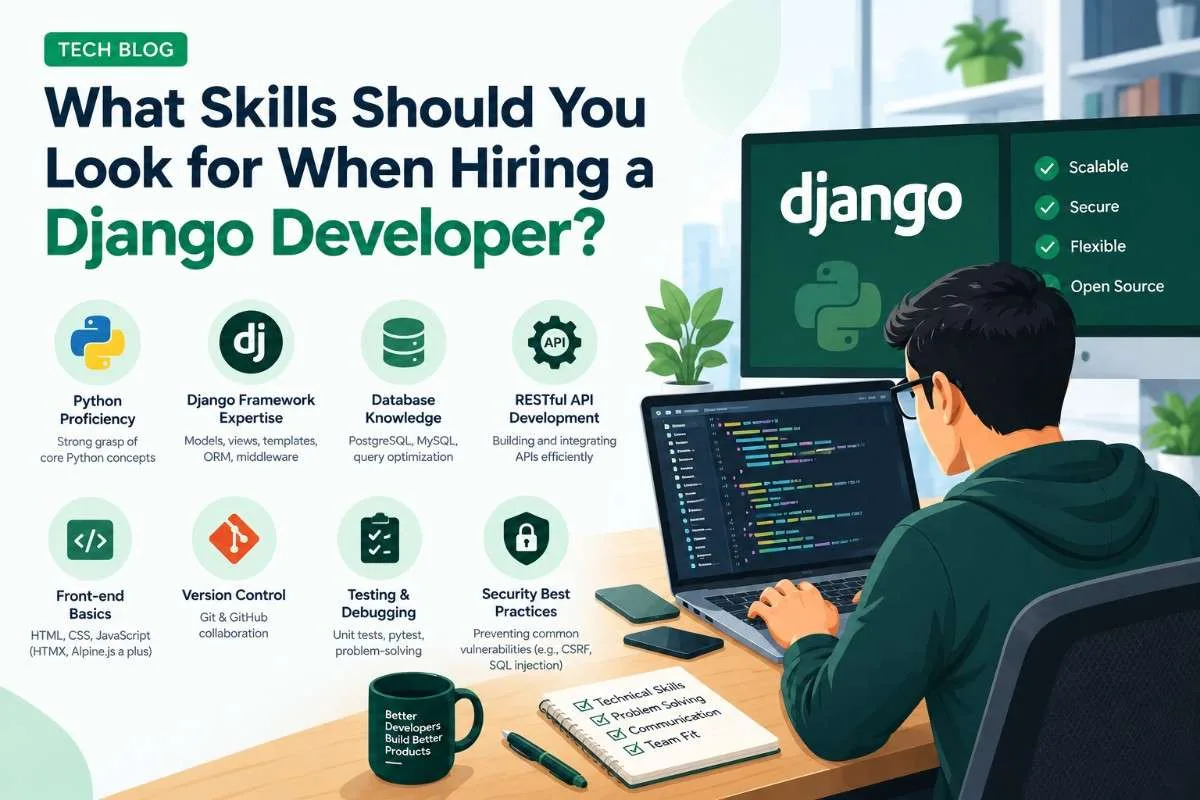
Finding a Django developer can look simple on paper. Search for Python experience, check whether Django appears on the resume, review a few projects, and move on. In practice, it is rarely that straightforward.
Django is a powerful Python framework, but building a reliable application with it requires more than knowing how to create models and views. Developers also need to understand databases, APIs, security, testing, performance, deployment, and the business requirements behind the application.
We have seen how two developers can have similar years of experience but approach the same problem very differently. One may focus on making the feature work today, while another thinks about how that feature will behave six months later when users, data, and requirements increase.
That difference matters.
When hiring a Django developer, we should therefore look beyond framework familiarity. The goal is to understand whether the developer can build software that is secure, maintainable, scalable, and practical for real-world business needs.
So, what skills should we actually look for?
1. Strong Python Fundamentals
Django is built with Python, so Python knowledge should be one of the first things we evaluate.
A developer should understand Python fundamentals such as:
- Variables and data structures
- Functions and modules
- Object-oriented programming
- Exception handling
- File handling
- Iterators and generators
- Decorators
- Virtual environments
- Package management
Strong Python fundamentals make it easier for developers to understand what Django is doing underneath the framework.
This becomes particularly important when debugging unexpected behavior. A developer who only knows Django's shortcuts may struggle when an issue comes from Python itself.
We should therefore look for developers who can explain why their code works—not just demonstrate that it works.
2. Solid Understanding of Django
Knowing Python is necessary, but it is not the same as knowing Django.
A capable developer should understand the framework's core architecture, including:
- Models
- Views
- Templates
- URL routing
- Forms
- Middleware
- Authentication
- Django Admin
- Django ORM
- Migrations
- Signals
- Management commands
They should also understand how Django applications are organized and how individual components communicate.
During an interview, instead of asking only whether someone has worked with Django, we can ask them to explain how they would structure a new application.
Their answer can reveal much more than a simple list of technologies.
3. Database and ORM Knowledge
Django developers frequently work with databases, so database knowledge should not be treated as an optional extra.
Look for experience with relational databases such as PostgreSQL or MySQL and an understanding of:
- Database relationships
- Schema design
- Primary and foreign keys
- Indexing
- Transactions
- Migrations
- Query optimization
- Django ORM
A developer should know how Django ORM queries translate into database operations.
For example, retrieving a few records is easy. Retrieving thousands of related records efficiently is where things become more interesting—and sometimes much less fun.
Understanding concepts such as select_related() and prefetch_related() can help developers avoid unnecessary database queries.
Good database skills also become increasingly important as an application grows.
4. API Development and Integration
Modern applications rarely operate alone.
A Django application may need to communicate with payment gateways, CRM platforms, mobile applications, frontend frameworks, analytics platforms, or other business systems.
That makes API development an important skill.
A developer should ideally have experience with:
- REST APIs
- Django REST Framework
- Authentication
- Authorization
- Serialization
- Validation
- Pagination
- API versioning
- Error handling
- Third-party API integration
We should also evaluate whether the developer understands how to design APIs that remain maintainable as requirements change.
A functional API is useful. A well-structured API that other systems can reliably consume is much more useful.
5. Security Awareness
Security should never be treated as something we remember five minutes before deployment.
Django includes several security features, but developers still need to understand how to use them correctly.
A Django developer should have awareness of common web security concerns, including:
- SQL injection
- Cross-site scripting (XSS)
- Cross-site request forgery (CSRF)
- Clickjacking
- Authentication vulnerabilities
- Authorization problems
- Session security
- Password management
- Secret and environment-variable management
They should also understand permissions and access control.
This becomes particularly important for applications handling customer information, financial data, employee records, or other sensitive business information.
When evaluating candidates, security-related questions can reveal whether someone thinks about protection as part of development or as an afterthought.
6. Frontend and Full-Stack Understanding
A Django developer does not necessarily need to be a frontend specialist.
However, understanding how the frontend communicates with the backend can be extremely valuable.
Basic knowledge of:
- HTML
- CSS
- JavaScript
- REST APIs
- JSON
- React
- Next.js
can help developers collaborate more effectively with frontend teams.
It can also make debugging easier.
For example, when a dashboard fails to display data, the problem may exist in the frontend, API, authentication layer, or database query. A developer who understands the complete request flow can investigate the issue more efficiently.
The goal is not to find someone who does everything. It is to find someone who understands where their work fits within the larger application.
7. Testing and Debugging Skills
Code that works once is not necessarily reliable software.
Testing helps developers verify that applications continue working as features change.
Look for experience with:
- Unit testing
- Integration testing
- Django testing tools
- API testing
- Regression testing
- Test-driven development where appropriate
- Debugging production issues
More importantly, evaluate how a developer approaches a bug.
Do they immediately change random lines until the error disappears?
Or do they reproduce the problem, identify the root cause, understand the impact, and then implement a controlled fix?
The second approach is much easier to maintain.
Good developers know that debugging is part of software development—not a punishment handed out by the project manager.
8. Performance Optimization
An application that performs well with 100 users may behave very differently with thousands of users.
Django developers should understand the basic principles of application performance.
This can include:
- Database query optimization
- Caching
- Pagination
- Efficient ORM usage
- Static file optimization
- Background processing
- Asynchronous workloads
- Application profiling
Developers should also understand the difference between genuine optimization and premature optimization.
There is little value in optimizing something that is not causing a problem. At the same time, ignoring an obvious performance bottleneck can create serious problems later.
The right developer knows when performance matters and how to investigate it.
9. Deployment and DevOps Knowledge
Development does not end when the code works on a local machine.
Django applications eventually need to run in production, which makes deployment knowledge valuable.
Depending on the project, useful experience may include:
- Linux
- Nginx
- Gunicorn
- Uvicorn
- WSGI
- ASGI
- Docker
- CI/CD
- Cloud platforms
- Environment configuration
- Monitoring and logging
A developer does not necessarily need to replace a dedicated DevOps engineer.
However, understanding how Django applications are deployed and monitored can make collaboration significantly smoother.
It also helps developers build with production requirements in mind.
10. Git and Team Collaboration
Modern software development is rarely a one-person activity.
Django developers should be comfortable using Git and working within a collaborative development workflow.
Look for experience with:
- Branching
- Pull requests
- Code reviews
- Merge conflicts
- Commit management
- Release workflows
Meaningful commit messages and organized branches may seem like small details, but they become important when multiple developers work on the same codebase.
A developer who writes good code but cannot work effectively within a team can still create unnecessary project friction.
Software development is a team sport. Unfortunately, there is no referee to blow the whistle when someone creates a 400-line pull request on Friday evening.
11. Problem-Solving and Analytical Thinking
Technical knowledge tells us what a developer knows.
Problem-solving ability tells us how they use it.
This is one of the most important areas to evaluate when hiring.
Give candidates practical scenarios such as:
- A Django page has suddenly become slow. How would they investigate it?
- An API works locally but fails in production. What would they check?
- A database query is creating thousands of records unexpectedly. How would they find the issue?
- A customer cannot access a specific feature. How would they investigate permissions?
There does not always need to be one perfect answer.
We should pay attention to the process.
Does the developer ask clarifying questions? Do they break the problem into smaller parts? Do they consider logs, database behavior, application code, and infrastructure?
Those habits often tell us more than memorized interview answers.
12. Communication Skills
Technical ability is only one part of successful software development.
Django developers often need to communicate with:
- Project managers
- Designers
- QA engineers
- Frontend developers
- Backend developers
- Business stakeholders
- Clients
A developer should be able to explain technical decisions without turning every conversation into a conference about server architecture.
Clear communication helps teams understand project risks, dependencies, timelines, and technical limitations.
We should also look for developers who ask questions when requirements are unclear.
Silently making assumptions may feel faster at first. Later, those assumptions can become expensive changes.
13. Scalability and Maintainability
A developer should think beyond the immediate feature.
For example, a simple application may begin with a few users and a small database. Over time, it could become a SaaS platform with thousands of users and complex workflows.
This is where maintainability becomes important.
Look for knowledge of:
- Modular architecture
- Reusable components
- Clean code
- Database scalability
- Caching
- Background workers
- Service integrations
- Application monitoring
The developer should understand that technical decisions made today can affect development speed and maintenance costs later.
A quick solution is not always a cheap solution.
14. Business and Project Understanding
Great development is not only about writing technically correct code.
The developer should understand what the application is supposed to accomplish.
For example, a CRM, ERP, healthcare platform, marketplace, or SaaS application may have completely different workflows and priorities.
A developer should be able to translate business requirements into technical functionality.
They should ask questions such as:
- Who will use this feature?
- What problem does it solve?
- What happens when something fails?
- What data needs to be stored?
- Which systems need to communicate?
- How might this feature evolve later?
This type of thinking helps connect development decisions with actual business objectives.
15. How to Evaluate a Django Developer During Hiring
A strong hiring process should use more than a resume.
Resume Review
Look for actual projects rather than only technology lists.
Pay attention to the developer's responsibilities, application complexity, integrations, and contributions.
Technical Interview
Cover:
- Python
- Django
- Databases
- APIs
- Security
- Testing
- Performance
- Deployment
Practical Assessment
A small practical task can reveal how the developer actually works.
For example, candidates could be asked to:
- Build a small Django API.
- Create related database models.
- Add authentication.
- Debug an existing issue.
- Optimize a slow query.
Project Discussion
Ask candidates to explain one of their previous projects from beginning to end.
What problem did it solve?
What architecture did they use?
What challenges appeared?
What would they change today?
The last question is particularly useful because experienced developers usually recognize that software can always be improved.
16. Red Flags to Watch For
When evaluating candidates, several warning signs deserve attention.
These can include:
- Weak Python fundamentals
- Limited understanding of Django architecture
- Poor database knowledge
- No practical API experience
- Weak security awareness
- Difficulty debugging problems
- No testing experience
- Poor Git practices
- Inability to explain previous projects
- Reliance on copy-paste solutions
- Difficulty understanding business requirements
One weak area does not automatically mean a candidate cannot succeed.
However, several gaps together may indicate that additional training or supervision will be required.
17. Django Developer Skills Checklist
Before making a hiring decision, we can use a simple checklist:
- Python fundamentals
- Django framework knowledge
- Django ORM
- PostgreSQL or MySQL
- REST API development
- Django REST Framework
- Authentication and authorization
- Web security
- Testing
- Debugging
- Performance optimization
- Git
- Deployment
- Docker or cloud fundamentals
- Problem-solving
- Communication
- Business understanding
- Scalability and maintainability
The importance of each skill will naturally depend on the project.
A small internal application may not require the same deployment expertise as a large SaaS platform. Likewise, an API-heavy application may place greater emphasis on Django REST Framework experience.
Conclusion
Choosing a Django developer is about more than finding someone who has Django listed on a resume.
We should look at the complete skill set—from Python and Django fundamentals to databases, APIs, security, testing, deployment, and performance. Just as importantly, we should evaluate problem-solving, communication, collaboration, and business understanding.
The right evaluation process should reflect the actual needs of the project. A developer working on a small internal tool may need a different combination of skills than someone building a large-scale SaaS platform.
Ultimately, Django provides the framework and the tools. The developer brings the engineering judgment needed to use those tools effectively.
And that is usually where the difference between “the feature works” and “the application works well” begins.
FAQs
What skills should a Django developer have?
A Django developer should have strong Python and Django knowledge along with database, API, security, testing, Git, debugging, and problem-solving skills. Deployment and cloud knowledge can also be valuable depending on the project.
Is Python knowledge enough to become a good Django developer?
No. Python provides the foundation, but developers also need practical knowledge of Django architecture, ORM, databases, APIs, security, testing, and application development.
Should a Django developer know Django REST Framework?
Django REST Framework is particularly useful for projects that require REST APIs. Developers working on API-driven applications should generally understand authentication, serializers, validation, permissions, pagination, and API design.
What database skills should we look for in a Django developer?
Look for knowledge of relational databases, schema design, relationships, migrations, indexing, transactions, Django ORM, and query optimization. PostgreSQL and MySQL are commonly used with Django applications.
Should a Django developer have DevOps knowledge?
A developer does not necessarily need advanced DevOps expertise, but knowledge of deployment environments, Linux, Docker, application servers, CI/CD, logging, and cloud infrastructure can be valuable.
How can we test a Django developer's skills during an interview?
Use a combination of technical questions, practical coding tasks, debugging scenarios, database exercises, API questions, and discussions about previous projects. This provides a broader view of both knowledge and practical problem-solving.
What are common red flags when hiring a Django developer?
Common warning signs include weak Python fundamentals, limited database knowledge, poor debugging skills, lack of security awareness, no testing experience, difficulty explaining previous work, and an inability to understand project requirements.
How important are soft skills for a Django developer?
Soft skills are important because Django development usually involves collaboration with developers, designers, QA teams, project managers, and business stakeholders. Clear communication and good collaboration can directly affect project execution.