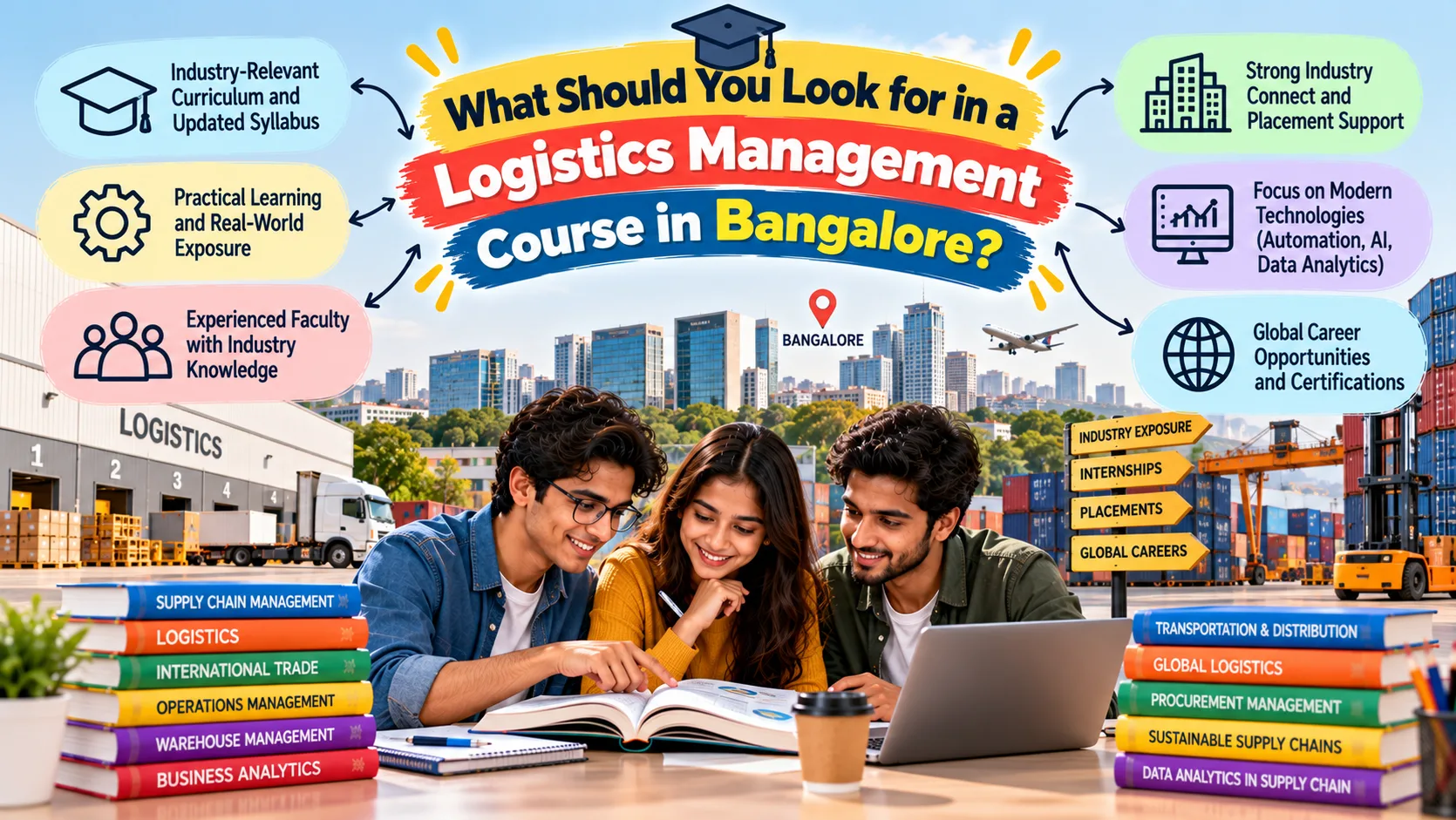
Choosing a management programme is an important decision, especially when the field involves a fast-changing industry such as logistics and supply chain management.
Students searching for a Logistics Management Course Bangalore should not select a programme based only on its title. The curriculum, practical exposure, learning environment, industry interaction, and career preparation can all influence the value of the experience.
Start With the Curriculum
The first thing students should examine is what the programme actually teaches.
A useful logistics programme may cover areas such as:
- Supply chain management
- Procurement
- Inventory management
- Warehousing
- Transportation
- Operations management
- Demand planning
- Supply chain analytics
- Distribution management
Students should look for a curriculum that connects these topics rather than treating them as isolated subjects.
Understand the Difference Between Logistics and Supply Chain
Logistics generally focuses on the movement and storage of goods.
Supply chain management covers a broader network that can include sourcing, procurement, production, inventory, logistics, distribution, and customer fulfilment.
A modern programme should help students understand this complete picture.
This broader understanding can be useful for students who eventually want to move into management positions.
Look for Practical Learning
Logistics is a practical field.
Reading about warehouse operations is useful, but analysing an actual supply chain problem can provide a different kind of learning experience.
Students can look for programmes that include:
- Business case studies
- Industry projects
- Simulations
- Internships
- Presentations
- Field exposure
- Practical assignments
These activities can help students understand how classroom concepts work in real situations.
Technology Should Be Part of the Conversation
Technology is changing logistics rapidly.
Modern supply chains may use automation, real-time tracking, data analytics, cloud systems, and artificial intelligence.
Students should therefore understand how technology is changing supply chain decisions.
A programme that introduces students to the relationship between technology and operations can help them build more relevant knowledge.
Analytics Is Becoming Important
A logistics manager may need to analyse delivery times, inventory levels, supplier performance, transportation costs, and demand.
This makes analytical thinking increasingly useful.
Students should consider whether the programme helps them develop basic data interpretation and decision-making skills.
They do not need to become data scientists, but they should be comfortable using information to solve business problems.
Industry Exposure Can Add Value
Logistics operates in the real world.
Companies deal with suppliers, transport providers, warehouses, customers, regulations, and unexpected disruptions.
Interaction with industry professionals can help students understand these challenges more clearly.
Guest sessions, internships, projects, and industry visits can expose students to different perspectives.
Consider the Faculty and Learning Environment
Faculty members play an important role in management education.
Students can explore whether instructors combine academic knowledge with practical business understanding.
They can also consider the learning environment, classroom activities, project work, and opportunities for discussion.
The objective should be to develop understanding rather than simply memorising concepts.
Think About Career Development
Students should also ask how the programme supports career preparation.
Useful areas can include:
- Communication skills
- Presentation skills
- Interview preparation
- Resume development
- Professional networking
- Internship opportunities
- Industry interaction
These skills can complement academic knowledge.
Don't Choose Only Based on a Placement Claim
Career outcomes matter, but students should evaluate them carefully.
Instead of looking only at a placement headline, they can examine available information about roles, recruiters, internships, job functions, and the kind of career support provided.
A realistic understanding is more useful than choosing a programme based on one promotional number.
How AIMS IBS Can Fit Into Your Search
AIMS IBS Business School focuses on practical business education, industry exposure, professional skills, and learning through projects.
Students exploring management education can consider how such an approach fits their individual career goals and learning preferences.
The right programme will ultimately depend on the student's interests, strengths, and long-term career direction.
Questions to Ask Before Enrolling
Before selecting a Logistics Management Course Bangalore, students can ask themselves:
- Does the programme match my career interests?
- Does it cover both logistics and supply chain management?
- Will I get practical exposure?
- Does it include technology and analytics?
- Are internships available?
- How does the institution support career development?
- Can I learn from industry professionals?
Taking time to answer these questions can make the decision more informed.
Final Thoughts
Logistics is no longer simply about transporting goods.
It involves planning, technology, data, procurement, inventory, operations, risk, and customer expectations.
Therefore, the right management programme should prepare students to understand the entire business process.
When evaluating a Logistics Management Course Bangalore, look beyond the programme name and focus on what you will actually learn, practise, and experience.