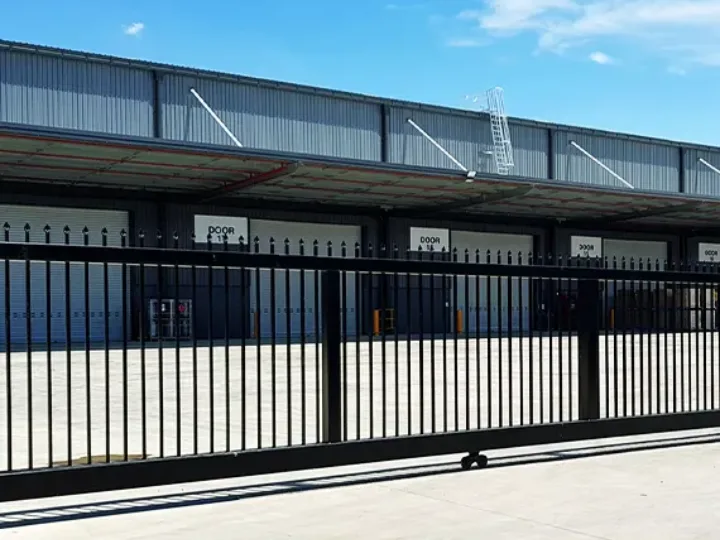
Security planning for critical infrastructure requires careful consideration of how vehicles, personnel and authorised deliveries enter and leave a site. When evaluating a data centre gate, organisations need to consider access control, physical strength, traffic volumes and the operational requirements of the facility rather than treating the gate as a standalone perimeter feature.
Assess the Security Requirements
A commercial or government data centre may contain critical digital infrastructure, sensitive information and high-value equipment. The gate therefore needs to form part of a wider physical security strategy.
Before selecting a gate, project teams should assess:
- The level of security required
- Expected vehicle and pedestrian traffic
- Operating hours and access patterns
- Emergency access requirements
- Integration with access control systems
- Site layout and available space
- Maintenance and inspection requirements
A risk assessment can help determine whether a site requires standard controlled access or a more robust gate configuration designed for higher security environments.
Consider Gate Construction and Durability
Materials and Structural Strength
Gate materials should be selected according to the site’s risk profile, environmental conditions and expected usage. Heavy-duty steel construction may be appropriate for facilities exposed to frequent vehicle movements or increased security risks.
The supporting posts, hinges, tracks, locking mechanisms and foundations are equally important. A strong gate can still create a security weakness if its supporting components are poorly designed or unsuitable for repeated operation.
Protection Against Environmental Conditions
Commercial infrastructure can remain operational for decades, so environmental exposure should be considered during specification. Corrosion resistance, drainage, surface treatment and material selection can influence the service life of the gate.
Sites located in areas exposed to heavy rainfall, coastal conditions, dust or extreme temperatures may require additional consideration when selecting materials and protective finishes.
Integrate Access Control Systems
Modern critical infrastructure commonly requires controlled entry rather than simple physical closure. Gates may need to work alongside electronic access systems, vehicle identification technology, intercoms, security monitoring and automated locking mechanisms.
Manage Different Access Levels
Not every vehicle or individual should necessarily have the same level of access. A well-planned entry system can distinguish between employees, contractors, delivery vehicles, emergency services and other authorised users.
Access permissions should also be reviewed periodically to reduce the risk of outdated credentials remaining active.
Evaluate Traffic and Operational Requirements
Gate selection should reflect how the facility operates every day. A site receiving regular deliveries may need wider vehicle access and a configuration that minimises congestion.
Vehicle turning circles, queuing space, delivery schedules and emergency vehicle access should be considered during the design stage. A gate that creates bottlenecks can affect both security and operational efficiency.
For larger infrastructure projects, the relationship between the gate and the wider data centre fence should also be assessed. The perimeter should operate as a coordinated system, with the gate providing controlled access without creating an obvious weak point.
Consider Visibility and Monitoring
Security personnel and surveillance systems need suitable visibility around access points. Gate positioning, surrounding fencing, lighting and camera placement should be considered together.
Blind spots near entry and exit points can make monitoring more difficult. Where appropriate, the gate design should allow security teams and surveillance equipment to identify vehicles and individuals approaching the controlled area.
Plan for Maintenance and Long-Term Operation
A security gate is a working component of the facility, not simply a physical barrier. Regular inspections can identify deterioration, mechanical faults, damaged components and access control issues before they affect site security.
Maintenance planning should consider:
- Gate movement and alignment
- Hinges, tracks and rollers
- Locks and electronic controls
- Structural connections
- Corrosion and surface deterioration
- Emergency release systems
Government and commercial projects should also consider how maintenance activities will be performed without unnecessarily disrupting critical operations.
Frequently Asked Questions
What is the most important factor when selecting a data centre gate?
The most important factor is whether the gate meets the site’s assessed security and operational requirements. Structural strength, access control, traffic flow and emergency access should all be considered together.
How does a data centre fence work with a gate?
A data centre fence establishes the site’s wider physical boundary, while the gate controls designated access points. Both should be designed as part of one integrated security strategy.
Should access control be integrated into a data centre gate?
Where controlled entry is required, integrating the gate with access control technology can help manage authorised access and maintain better records of site movements.
How often should a data centre gate be inspected?
Inspection frequency should reflect usage, environmental exposure, security requirements and the manufacturer’s maintenance recommendations. High traffic gates may require more frequent checks.
Can a data centre gate support government infrastructure security?
Yes. Gate selection can be incorporated into the broader physical security planning of government infrastructure, particularly where controlled vehicle and personnel access is required.