
Introduction
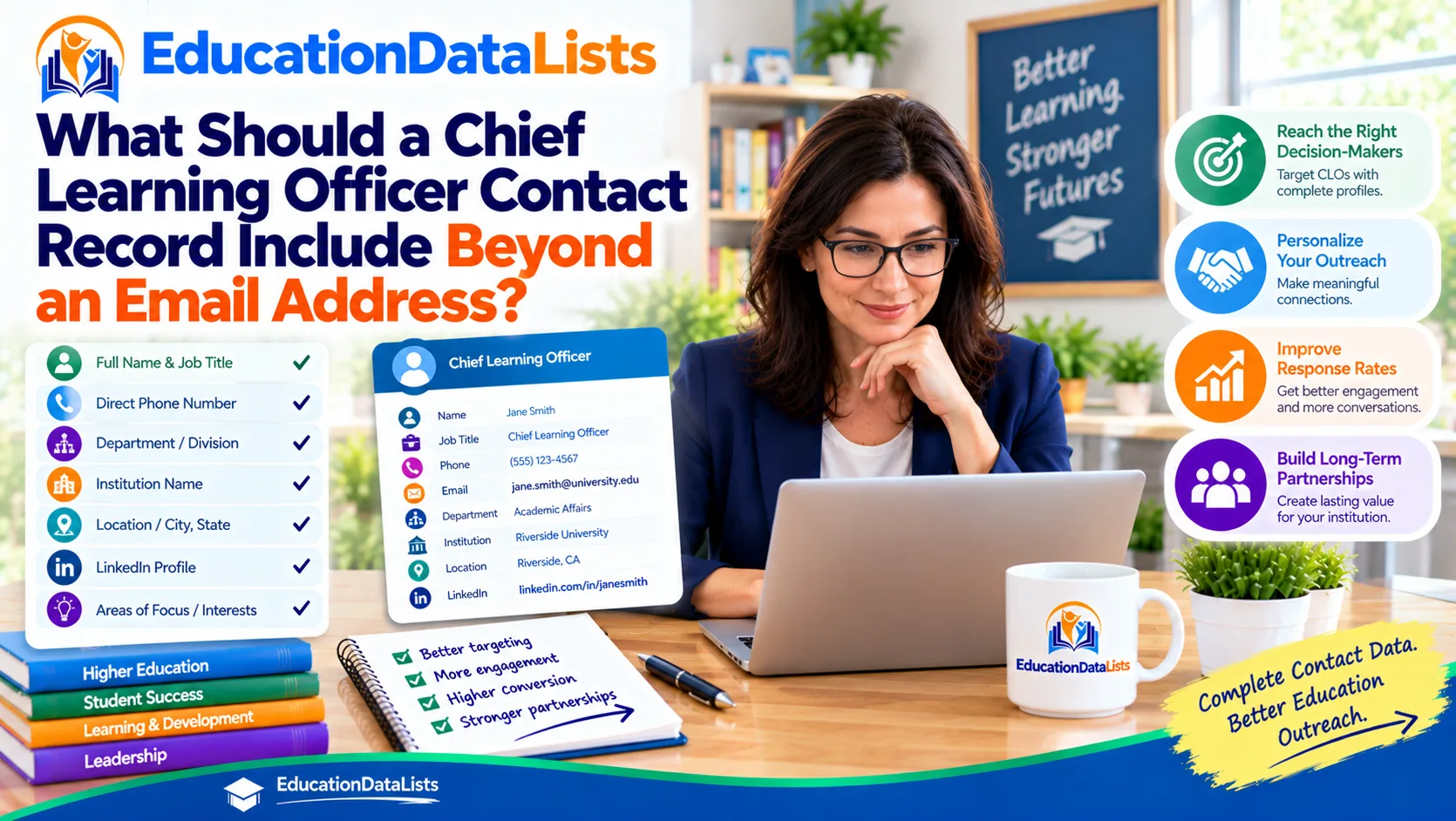
A Chief Learning Officer (CLO) contact record should provide more than a name and email address. It should help sales and marketing teams understand the executive’s responsibilities, identify the organization’s learning priorities, and determine whether their solutions are relevant. This is increasingly important as businesses invest in workforce development while facing skills gaps and pressure to demonstrate the value of training.
According to the Association for Talent Development’s 2026 State of the Industry report, organizations delivered an average of 16.7 formal learning hours per employee in 2025, up from 13.7 hours in 2024. However, direct learning expenditure fell from $1,254 to $846 per employee. These findings suggest that learning providers must understand both organizational needs and budget realities before approaching decision-makers. A well-maintained Chief Learning Officer Email List can support that process when each record includes accurate, useful context.
1. Verified Professional Identity and Current Job Title
The foundation of a useful contact record is an accurate professional identity. An email address may remain active even after an executive changes roles, moves to another employer, or takes on a different set of responsibilities.
A CLO record should include:
- Full name and preferred professional name
- Current job title and seniority level
- Employer or institution name
- Professional email address
- Public professional profile or source URL, where appropriate
- Date the title and employer were last verified
- Verification status and confidence level
Job titles require particular care. Organizations may use titles such as Chief Learning Officer, Chief Learning and Development Officer, Vice President of Learning, or Head of Talent Development for roles with overlapping responsibilities. However, these titles are not interchangeable in every organization.
LinkedIn’s 2025 Workplace Learning Report found that 49% of learning and talent development professionals said their executives were concerned that employees lacked the skills required to execute business strategy. This highlights the strategic importance of learning functions, but it does not mean every learning leader controls the same budget or purchasing decisions.
Practical implication: Store the executive’s verified title separately from a standardized role category. This allows teams to segment contacts consistently without losing the original information.
2. Organization Details and Business Context
A contact record becomes more valuable when it connects the individual to a clearly identified organization. Without company-level information, a marketer may know who the CLO is but not whether the organization fits the target market.
Include these organization attributes:
- Organization name and official website
- Industry or sector
- Headquarters and relevant office locations
- Organization type, such as corporation, university, school network, or public agency
- Approximate employee or workforce size, with a source and date
- Parent company, subsidiary, or business-unit relationship, where relevant
- Geographic markets served
- Organization identifier, where available
The National Center for Education Statistics (NCES) offers an example of why standardized organization information matters. Its 2025–26 preliminary Common Core of Data directory files include public-school and local education agency identifiers, addresses, operational status, grade ranges, and selected organizational characteristics. These records are designed for public education entities rather than every corporate employer, but they demonstrate the value of consistent identifiers and source-backed organization attributes.
For providers selling learning platforms, training services, or workforce development programs, organization size and structure can help distinguish a small employer from a multinational business with multiple learning teams.
3. Responsibilities, Decision-Making Authority, and Buying Role
A senior title alone does not establish whether a person is the correct contact for a particular offer. Some CLOs oversee enterprise-wide learning strategy; others concentrate on leadership development, employee onboarding, compliance training, or specific business units.
A useful Chief Learning Officer Email Database should therefore record role context, including:
- Primary responsibilities
- Learning and development functions overseen
- Geographic or departmental scope
- Relationship to HR, talent management, and business leadership
- Likely role in purchasing: decision-maker, influencer, evaluator, or end-user
- Relevant internal stakeholders, when publicly documented
These details help sales teams distinguish between an executive who sets learning strategy and a specialist who evaluates a particular learning management system or training solution.
The 2025 Workplace Learning Report from LinkedIn Learning also found that only 36% of organizations qualified as “career development champions,” defined in the report by their maturity in career-development practices. The report links structured career development with organizational outcomes, illustrating why a provider’s message should relate to the prospect’s actual remit rather than simply their seniority.
Practical implication: Treat buying-role labels as informed hypotheses unless confirmed through direct conversations or reliable public evidence. Do not assume every CLO independently approves budgets.
4. Learning Priorities, Skills Needs, and Technology Context
A contact record should help teams answer a key question: Why might this executive be interested in our solution now?
Relevant fields may include:
- Learning priorities, such as leadership development or technical reskilling
- Publicly announced training initiatives
- Workforce skills or capability priorities
- Learning delivery preferences, if verified
- Learning technology environment, where publicly documented
- Relevant organizational changes, such as expansion or digital transformation
- Source URL and date for each significant signal
These fields make personalization more meaningful. A company announcing an AI transformation initiative may have different learning needs from an organization focused on regulatory training or frontline employee development. However, a public announcement indicates a possible area of relevance, not confirmed purchasing intent.
Recent ATD findings reinforce the importance of this distinction. Its 2026 State of the Industry report says the average number of formal learning hours per employee rose to 16.7 in 2025, while direct expenditure per employee declined to $846. The combination suggests that providers should investigate both the type of learning required and the financial constraints that may shape a purchase.
For example, a vendor offering leadership coaching could prioritize contacts whose organizations have announced management-development initiatives. A learning platform provider might instead focus on organizations with publicly documented digital training programs.
5. Contact Freshness, Verification, and Data Provenance
Even a detailed record loses value if its information is outdated. Contact databases need a process for tracking when information was collected, what was checked, and which fields remain uncertain.
Recommended fields include:
- Date added to the database
- Date of last verification
- Verification method or source
- Email status and last validation date
- Employment and title status
- Data provider or original source
- Confidence rating for key fields
- Next review date
- Suppression or do-not-contact status
The scale of the data-quality problem is clear in Validity’s State of CRM Data Management in 2025 report, based on 602 CRM users and stakeholders. Seventy-six percent of respondents said less than half of their organization’s CRM data was accurate and complete, while 37% reported revenue losses linked to poor data quality. These are survey findings across CRM users, not measurements specific to CLO contacts, but they demonstrate the business risk of relying on incomplete records.
A practical data-quality process should distinguish between different checks. An email validation result does not confirm that a person still holds a job title, while a current professional profile does not guarantee that an email address can receive messages.
6. Outreach Preferences, Consent, and Suppression Status
A record should also help teams determine whether and how they can contact an individual. Do not treat the existence of a professional email address as proof of consent or permission to send every type of marketing message.
Depending on the applicable laws and the way the data was obtained, useful fields may include:
- Consent or lawful-basis information, where applicable
- Source and date of consent, if collected
- Communication preferences
- Unsubscribe date and status
- Do-not-contact or suppression flag
- Applicable regional compliance notes
- Retention or review date
For commercial email in the United States, the Federal Trade Commission explains that the CAN-SPAM Act applies to commercial messages, including business-to-business email. Requirements include accurate sender information, non-deceptive subject lines, a valid physical postal address, and a functioning opt-out mechanism. Businesses must honor opt-out requests within the legally required timeframe.
Email infrastructure matters too. Google’s sender guidelines require all senders to Gmail accounts to meet baseline authentication requirements, and bulk senders must meet additional requirements, including SPF, DKIM, and DMARC authentication and one-click unsubscribe for applicable marketing messages. Google also advises senders to keep reported spam rates below 0.1% and avoid reaching 0.3% or higher. These are Gmail-specific requirements and guidance, not universal thresholds for every email provider.
Good recordkeeping helps teams respect preferences, maintain suppression lists, and avoid repeatedly contacting people who have opted out.
7. How to Build a More Useful Chief Learning Officer Email List
The objective is not to collect the maximum number of fields. It is to maintain enough reliable information to support relevant segmentation, responsible outreach, and measurable results.
A practical workflow includes:
- Define the ideal customer profile. Identify target industries, organization sizes, locations, and learning needs before sourcing contacts.
- Verify identity and employment. Check the current title, employer, and available professional sources.
- Add organizational context. Link the individual to the correct company, institution, or business unit.
- Record evidence and dates. Store source details and timestamps for key information instead of relying on undated assumptions.
- Validate contact channels. Check email deliverability separately from job-title and employer accuracy.
- Apply suppression and compliance rules. Keep unsubscribe and do-not-contact information accessible across relevant systems.
- Review performance and refresh records. Monitor bounces, replies, conversions, and outdated contacts to determine which fields need improvement.
For marketing and sales teams evaluating a Chief Learning Officer Mailing List, these steps provide a consistent way to assess whether records are suitable for a campaign. EducationDataLists can be considered as a resource for education-sector contact research and list-building workflows, with the same due diligence applied to any data provider: verify the fields needed for the campaign, review available sourcing and freshness information, and confirm that planned outreach complies with applicable requirements.
Actionable Takeaways for Sales and Marketing Teams
- Prioritize accuracy over volume. A smaller set of verified contacts can be more useful than a large list with uncertain job titles.
- Capture company context. Industry, workforce size, business structure, and learning priorities help teams determine relevance.
- Separate facts from assumptions. Label buying authority and intent as unconfirmed unless supported by reliable evidence.
- Track freshness and provenance. Every important field should have a source or verification method and a review date.
- Build compliance into the workflow. Store opt-outs and suppression status centrally, and maintain appropriate email authentication and sending practices.
Conclusion
A high-quality CLO contact record combines professional identity, organizational context, role responsibilities, learning priorities, data provenance, and outreach preferences. These details help teams identify relevant prospects and develop messages around business needs instead of relying on a title and email address alone.
Current research shows that organizations continue to invest in learning while navigating skills gaps and budget pressures. For providers of learning technology, workforce development, leadership training, and related services, that makes contextual data especially valuable. A well-maintained Chief Learning Officer Email List should therefore be treated as a continuously updated business resource, not a static spreadsheet. By validating contacts, documenting sources, respecting communication preferences, and measuring outcomes, sales and marketing teams can build more relevant, accountable, and effective outreach programs.
Frequently Asked Questions
1. What should a Chief Learning Officer contact record include?
It should include the executive’s full name, current title, employer, professional email, responsibilities, organization details, relevant learning priorities, verification dates, source information, and outreach-suppression status. The exact fields should reflect the campaign’s purpose and compliance requirements.
2. Why is company information important in a Chief Learning Officer Email List?
Company information helps teams determine whether an organization fits their target market and whether the offered product or service is relevant. Details such as industry, workforce size, location, and organizational structure can improve segmentation and message relevance.
3. How often should Chief Learning Officer contact data be verified?
There is no single interval suitable for every database. Review high-priority contacts before campaigns, monitor email bounces and role changes, and schedule periodic checks based on data age, campaign frequency, and the reliability of the original source.
4. Does a valid email address mean the contact data is accurate?
No. Email validation assesses aspects of whether an address may accept messages, but it does not independently confirm a person’s current employer, job title, responsibilities, or purchasing authority. Those details need separate verification.
5. What is the difference between a Chief Learning Officer Mailing List and an email database?
A mailing list is often organized for campaign targeting and distribution, while an email database may contain additional fields such as company details, job functions, source information, and verification history. In practice, providers use these terms differently, so buyers should assess the actual fields and data-maintenance process.
6. How can teams personalize outreach to Chief Learning Officers?
Use verified information about the organization’s learning priorities, workforce challenges, or publicly announced initiatives to establish relevance. Avoid implying knowledge of internal budgets or purchasing plans unless those details have been confirmed.
7. What compliance considerations apply to B2B email outreach?
Requirements depend on the recipient’s location, the data source, and the type of communication. In the United States, CAN-SPAM applies to commercial B2B email; teams should also review applicable privacy and marketing laws in other jurisdictions, maintain suppression records, and follow their email provider’s sender requirements.
Research Sources
- Association for Talent Development — 2026 State of the Industry
- LinkedIn Learning — 2025 Workplace Learning Report
- Validity — The State of CRM Data Management in 2025
- National Center for Education Statistics — 2025–26 CCD Preliminary Directory Files
- Federal Trade Commission — CAN-SPAM Act Compliance Guide
- Google — Email Sender Guidelines