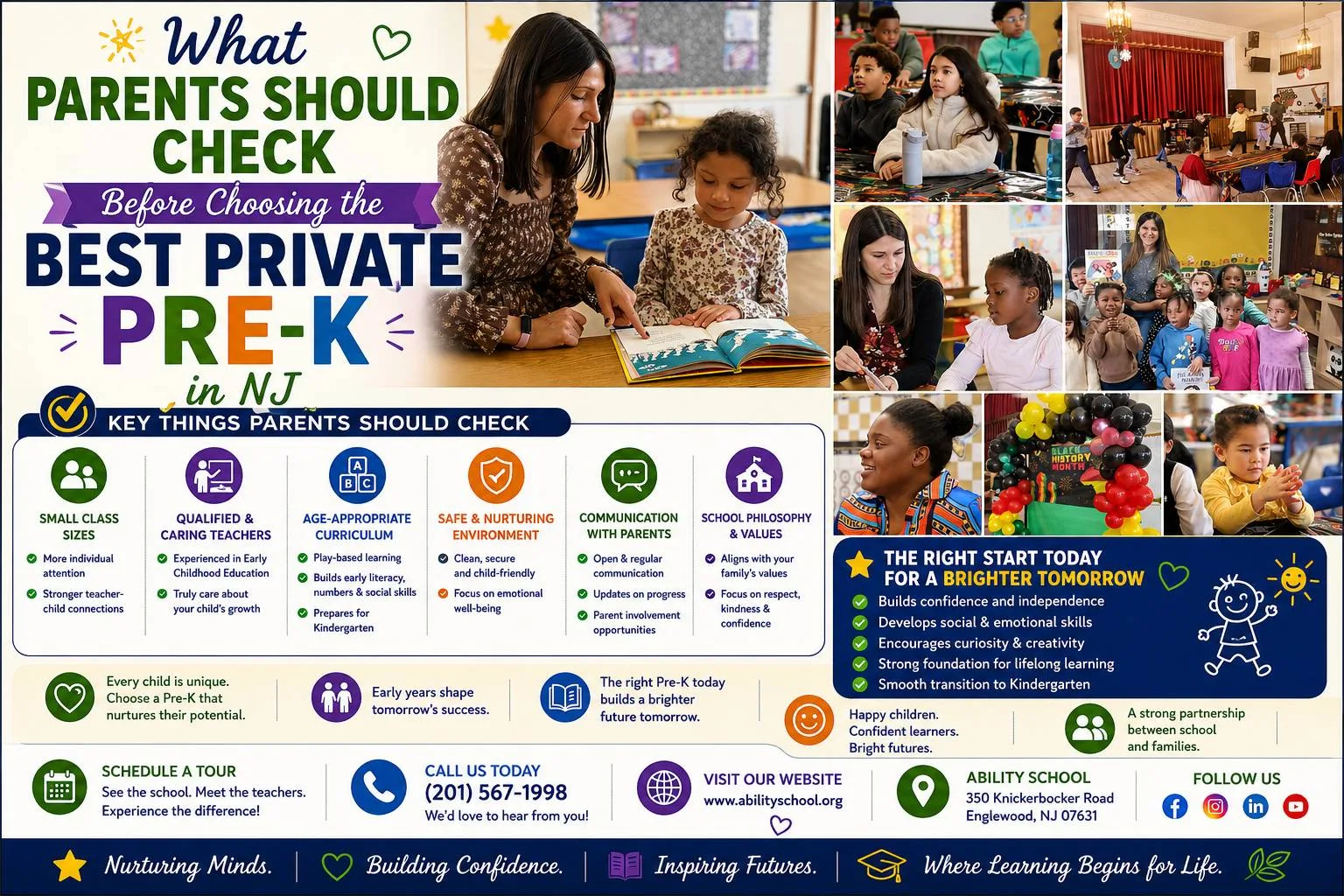
Could a polished school tour hide a weak preschool program? It can. Fresh paint and friendly staff may impress parents, yet none of that shows how a child will be taught on an ordinary Tuesday. Families comparing the best private pre-k in NJ need to look past appearances. They should also check the New Jersey preschool age rules, teaching method, schedule, and placement process before enrollment.
Start With the Child, Not the School Brochure
A useful preschool program begins with one question: what can this child do today?
Some children enter Pre-K recognizing short words. Others know letters but struggle to connect sounds. One may count confidently but avoid holding a pencil. A fixed weekly lesson plan rarely responds well to such differences.
Ask how the school identifies a child’s current level. Does the teacher observe reading readiness, number work, listening, handwriting, and task completion? What happens after that observation?
Ability School creates an individual program around each student’s present skills and pace. Progress should come from demonstrated learning, not from moving the whole class forward because another week has ended.
Parents searching for the best private pre-k in NJ should request examples of lesson changes. A detailed answer will describe classroom decisions. A weak answer returns to broad claims about care and enrichment.
Check How Teachers Respond to Confusion
Young children rarely announce that they misunderstood an instruction. They may copy another student, guess, or refuse the task. A capable teacher notices the difference.
Ask what teachers do when a child cannot follow a direction or misunderstands a word. Do they repeat the explanation, or locate the point where confusion began? This affects reading, math, behavior, and participation.
The New Jersey preschool age may place children in the same group, but it does not make their learning needs identical. Smaller classes can help, although class size alone proves little. Parents should ask how teachers document progress, provide individual help, and communicate concerns.
A private preschool in Bergen County should explain its teaching process without hiding behind educational language. Parents need to know what the teacher does when learning stops.
Compare the Schedule With the Child’s Stamina
A five-day schedule may suit one four-year-old and overwhelm another. Half days can offer a gentler beginning, but they may provide less time for group routines or enrichment. There is no single correct schedule.
Before choosing a program, compare:
- Half-day, full-day, and mixed attendance choices
- Three-day, four-day, and five-day options
- Time for reading, early math, art, movement, and play
- Meal, rest, arrival, and dismissal routines
- Policies for schedule changes
- Midyear admission and tuition adjustments
Ability School offers half-day, full-day, and combined attendance arrangements. This flexibility lets families choose a suitable starting point instead of one fixed weekly pattern.
Parents evaluating the best private pre-k in NJ should ask what children miss on shorter days. The answer shows whether half-day students receive the core program.
Look Beyond Basic Kindergarten Readiness
Kindergarten preparation involves more than alphabet drills and counting songs. Children need to listen, ask for help, complete short assignments, follow multi-step directions, and recover after making a mistake.
A credible kindergarten readiness program should connect early academics with those daily habits. Reading preparation should cover sound awareness, vocabulary, comprehension, and interest in books. Early math should involve quantity, comparison, patterns, and simple reasoning.
The New Jersey preschool age and local cutoff dates can create difficulty for children who appear ready but miss eligibility by a short period. Ask whether the school offers an early kindergarten path, how it evaluates readiness, and whether observation guides placement.
The best private pre-k in NJ should not rush a child to create an impressive outcome. It should not hold back a capable child only because of a calendar date, either.
Treat the Admissions Visit as an Evaluation
A school visit should provide more than a tour of empty classrooms. Ask whether the child can spend part of a normal morning in class. Watch how teachers speak with students. Notice whether children depend on constant instruction.
Parents should ask about midyear enrollment after a move or an unsuccessful start elsewhere. A private preschool in Bergen County may accept students during the year, but families should confirm space, placement, tuition changes, and transition support.
The New Jersey preschool age gives parents a starting point. The classroom visit shows whether the program fits the child.
Make the Final Choice With Specific Evidence
Preschool decisions become easier when parents replace vague impressions with direct questions. Ask how the school places students, adjusts lessons, handles confusion, measures progress, prepares children for kindergarten, and supports different schedules. Then compare answers rather than promises.
No school can prove quality through a slogan. Parents need to see how teaching works when a child advances quickly, needs more time, or enters halfway through the year. A consultative review of the New Jersey preschool age, daily instruction, schedule, admissions process, and kindergarten readiness program will help families identify the best private pre-k in NJ for their child.