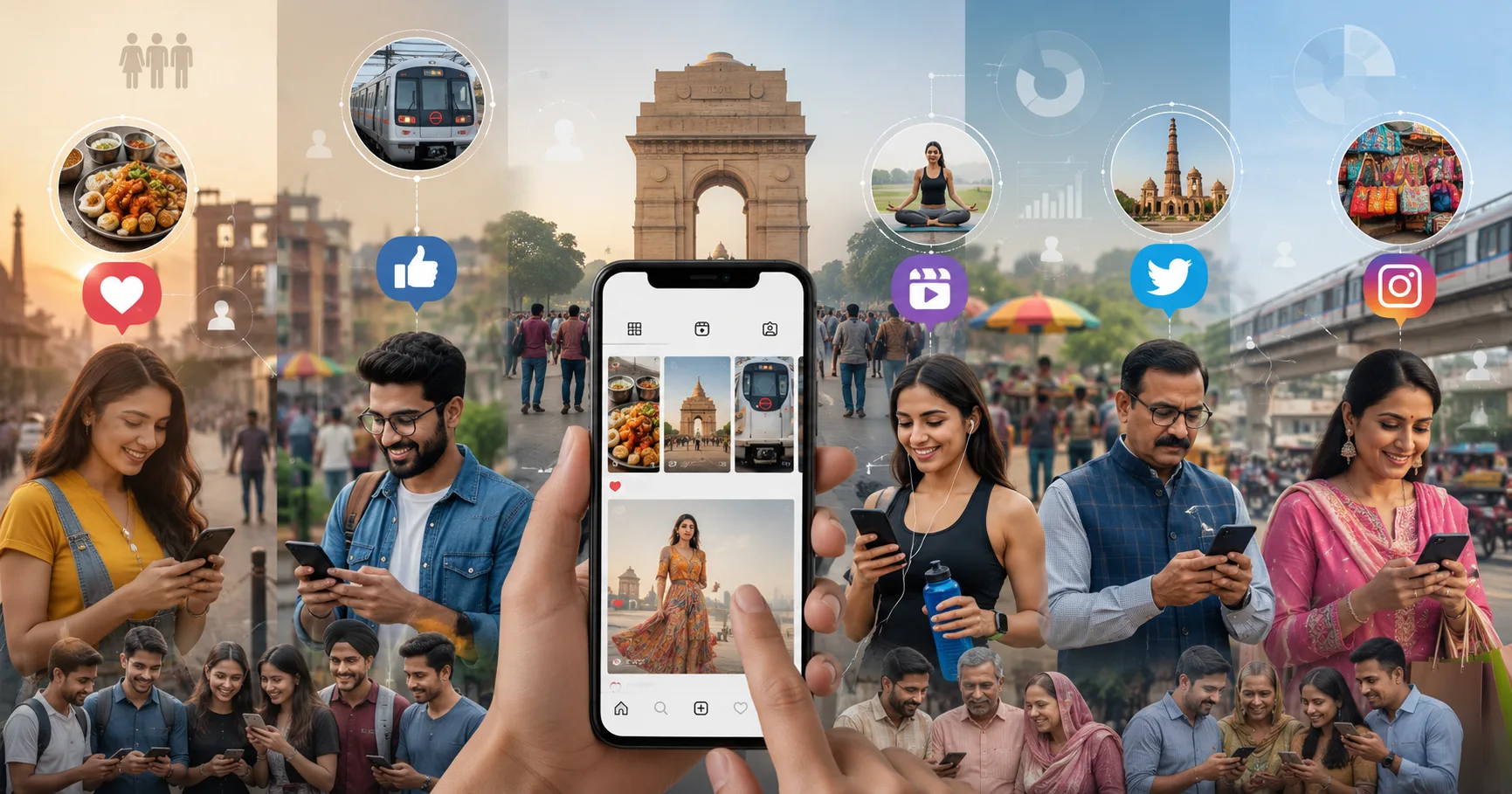
Delhi is not one audience. A corporate professional in Gurugram, a student in North Delhi, a family shopping in South Delhi, and a small-business customer in Dwarka may all use the same social platform differently. Their language, interests, buying triggers, preferred formats, and expectations can vary widely.
That is why social content that performs well for one group can fall flat with another. The strongest brands do not simply publish more often. They understand who they are speaking to, what that audience values, and how content should be adapted without losing the brand’s identity.
For businesses working with social media services in Delhi, this audience-first approach is increasingly important. The goal is not to create a separate brand for every customer segment. It is to make one brand feel relevant to different people.
Understanding Delhi’s Audience
Delhi and the wider NCR market are highly diverse. Businesses can be speaking to students, young professionals, families, entrepreneurs, premium buyers, neighbourhood shoppers, or B2B decision-makers within the same city. Recent audience research also points to a large concentration of younger social-network users, while local digital marketing practitioners note differences in language, location, and platform preference across Delhi audiences.
This matters because audience segmentation should influence content decisions from the beginning. A premium service may need polished visuals and detailed explanations. A local restaurant may benefit more from short videos, menus, location references, customer moments, and timely offers.
The question is not simply, “What should we post?” It is, “Who needs to find this useful?”
Language Can Change the Response
Language is one of the most visible ways to make content feel local. Delhi audiences frequently move between English, Hindi, and Hinglish depending on the context. A formal LinkedIn post may work well in English, while a consumer-facing Reel can feel more natural in Hindi or Hinglish.
This does not mean every business should start mixing languages randomly. The choice should match the audience and the brand.
A professional B2B company may maintain a primarily English voice because its buyers expect technical clarity. A neighbourhood food business could use conversational Hindi or Hinglish to create familiarity. A lifestyle brand targeting younger consumers may combine English copy with culturally familiar phrases.
The best social media content strategy treats language as part of audience experience, not merely translation.
Content Format Matters as Much as the Message
A useful idea can lose impact when it appears in the wrong format. Someone looking for a quick restaurant recommendation may respond to a Reel far more readily than a long caption. A business buyer evaluating software may prefer a comparison graphic, case study, carousel, or expert video.
For social media content for businesses, format should follow the job the content needs to perform.
Short-form video can introduce a product or demonstrate how something works. Carousels can break down complex information. Stories can support timely updates, behind-the-scenes content, polls, and questions. Static posts can still work when the visual is strong, and the message is immediately clear.
Instead of choosing formats because they are popular, review what your audience actually does with them. Views are useful, but saves, shares, comments, profile visits, enquiries, and repeat interactions can reveal much more about content quality.
Local Relevance Makes Content Feel Personal
Delhi is too large and varied for “Delhi audience” to be treated as a single customer profile. A business serving Connaught Place may communicate differently from one focused on Rohini, Dwarka, Saket, or Lajpat Nagar.
Local context can make an ordinary post more useful. A restaurant can mention a nearby landmark. A fitness studio can speak to office commuters in its area. A school can address concerns shared by families in its catchment zone. A real estate brand can create content around locality-specific questions rather than broad property advice.
This is where local social media marketing becomes practical rather than cosmetic. Adding a city name to a caption is not enough. The content should show that the business understands the routines, concerns, language, and expectations of the people it wants to reach.
Match Content to Customer Intent
Different audiences may need different information before taking action. Someone discovering a brand for the first time needs a reason to pay attention. A returning follower may want proof, comparison, or practical details. A ready-to-buy customer may be looking for price, availability, location, or a simple way to enquire.
Good social media engagement strategies reflect these stages.
For example, a skincare brand might use educational videos for new audiences, customer experiences for people considering the product, and routine-based content for existing buyers. A restaurant might introduce its menu to new followers, showcase reviews to people comparing options, and share limited-time updates with loyal customers.
The content becomes stronger when every post has a clear purpose.
Trust Matters More Than Perfect Promotion
People can recognise promotional content quickly. A feed filled with discounts, product shots, and sales messages may tell the audience what a business sells but not why they should trust it.
Trust grows through evidence and consistency. Show the people behind the business. Explain how a product is made. Answer common questions. Share genuine customer experiences. Demonstrate expertise instead of repeatedly claiming it.
For businesses investing in social media services in Delhi, this is an important shift. Social platforms are not only distribution channels; they are places where potential customers evaluate whether a brand feels credible, responsive, and relevant.
Use Engagement as Research
Engagement should not be treated only as a performance score. It is also a source of customer insight.
Look at the questions people repeatedly ask. Notice which posts are saved or shared. Review the phrases customers use in comments and direct messages. Compare how different audience segments respond to the same topic.
These signals can reveal what your audience wants explained, what language feels natural to them, and which concerns are being overlooked.
Google’s latest guidance also encourages publishers to use performance insights to understand what audiences care about and identify topics and formats that are gaining traction. Search Console now provides tools for analysing social and video content performance in Google Search, which can help teams connect audience behaviour with content decisions.
Create Audience-Specific Content Without Splitting the Brand
One common mistake is creating radically different voices for every audience. That can make a brand feel inconsistent.
A better approach is to keep the core identity stable while changing the angle. The same brand promise can be expressed through different examples, formats, language choices, and levels of detail.
Think of the brand as having one personality with several ways of speaking. The visual identity, values, standards, and central message remain recognisable. What changes is the way the message is made useful for a particular group.
Build a Practical Social Media Strategy for Delhi Businesses
A strong social media strategy for Delhi businesses can start with five simple questions:
- Who exactly are we trying to reach?
- What problem, desire, or question matters to them?
- Which platform and format fit their behaviour?
- What local or cultural context makes the message more relevant?
- What action should the audience take after seeing it?
These questions are more useful than creating a monthly calendar filled only with posting dates.
A practical workflow is to divide audiences into a few meaningful groups, identify their common needs, select the best formats, and then create recurring content themes. After publishing, compare results by audience and content type. Keep what works, improve what underperforms, and retire ideas that no longer serve a clear purpose.
Why Generic Content Often Struggles
Generic content usually tries to appeal to everyone and ends up feeling relevant to very few people. Phrases such as “quality you can trust” or “we care about our customers” may sound positive but rarely give audiences a reason to stop scrolling.
Specificity creates interest.
Instead of saying a service saves time, explain which task it simplifies. Instead of saying a restaurant serves delicious food, show the dish, preparation, setting, or customer moment. Instead of saying a product is useful, demonstrate the situation in which it solves a real problem.
That level of detail makes content easier to understand, share, and remember.
The Role of Sociostreet in an Audience-Led Approach
Sociostreet’s role in an audience-led approach can go beyond creating attractive posts. The stronger objective is connecting creative execution with audience behaviour, brand positioning, and measurable business outcomes.
That means looking at the audience before deciding the content format, using creative concepts that fit the brand, and learning from performance data after publication. The result is a content system that can evolve instead of relying on a fixed collection of templates.
The Bigger Picture
Delhi businesses do not need to speak louder than everyone else. They need to speak more precisely.
When content matches a real audience need, uses the right format, reflects local context, and gives people something useful or interesting, engagement becomes a natural result rather than the only target.
This is the real value of social media audience engagement: it helps brands understand people while giving those people a reason to keep paying attention.
For brands using social media services in Delhi, the strongest long-term advantage comes from combining creativity with audience understanding. Content works when it feels like it belongs in the audience’s world, not when it simply announces that a brand exists.
That principle also supports visibility in modern search and AI-driven discovery. Google’s current guidance says established SEO fundamentals remain relevant for generative AI features, while useful, original, non-commodity content and strong user-focused practices remain important. No strategy can guarantee inclusion in AI Overviews or other AI systems, but content that is clear, useful, well-structured, and genuinely informative gives search systems more substance to understand and surface.
FAQs
1. What type of social media content works best for Delhi audiences?
There is no single format that works for everyone. Reels, carousels, stories, static posts, and expert videos can all perform well when they match the audience, platform, and purpose. The better approach is to test formats against meaningful actions such as saves, shares, enquiries, and conversions.
2. Should Delhi businesses use Hindi, English, or Hinglish on social media?
Choose language based on the audience rather than assuming one city needs one language. English can suit corporate and professional audiences, while Hindi or Hinglish may feel more natural for many consumer-facing and local brands. Test audience response before making a permanent choice.
3. How can social media marketing Delhi strategies become more local?
Use locality-specific topics, customer questions, neighbourhood references, seasonal behaviour, and relevant cultural context. Localisation should make the content more useful to people in a specific market rather than simply adding “Delhi” to captions or hashtags.
4. Why is a social media content strategy important for a growing brand?
A clear strategy prevents random posting. It connects audience needs, content themes, formats, brand positioning, and business goals so that each post has a reason to exist rather than filling space on a content calendar.
5. What is the best way to improve social media audience engagement?
Start by listening. Review comments, saves, shares, direct messages, FAQs, and recurring customer objections. Then build content around those insights. Engagement improves when the audience sees a clear connection between the content and something they actually care about.
6. How can social media content for businesses support different customer groups?
Create shared brand themes but adapt the examples, format, tone, and depth for each meaningful segment. A single core idea can be turned into different posts for consumers, professionals, local buyers, or returning customers without making the brand inconsistent.
7. What role does local social media marketing play in Delhi?
It helps businesses make their content relevant to specific communities, neighbourhoods, and customer routines. This can be particularly useful for restaurants, clinics, schools, retailers, real estate businesses, and other brands where location strongly influences customer decisions.
8. What are useful social media engagement strategies for small businesses?
Focus on practical content that answers customer questions, demonstrates products, shows real experiences, and encourages conversation. Small brands do not need a huge content volume; they need a repeatable approach that creates trust and gives people a reason to interact.
9. How should a social media strategy for Delhi businesses be measured?
Look beyond follower growth. Track reach, saves, shares, comments, profile visits, website actions, enquiries, leads, and conversions. The right metrics depend on the business objective, because awareness and lead generation should not be judged in exactly the same way.
10. Can a company still appear in AI search with social media-focused content?
Yes, but there is no guaranteed ranking formula for AI search. Clear structure, original insights, useful answers, credible information, and sound technical SEO can help search systems understand the page. Sociostreet’s content approach should therefore focus on genuinely useful information first, with keywords supporting the topic naturally rather than controlling it.