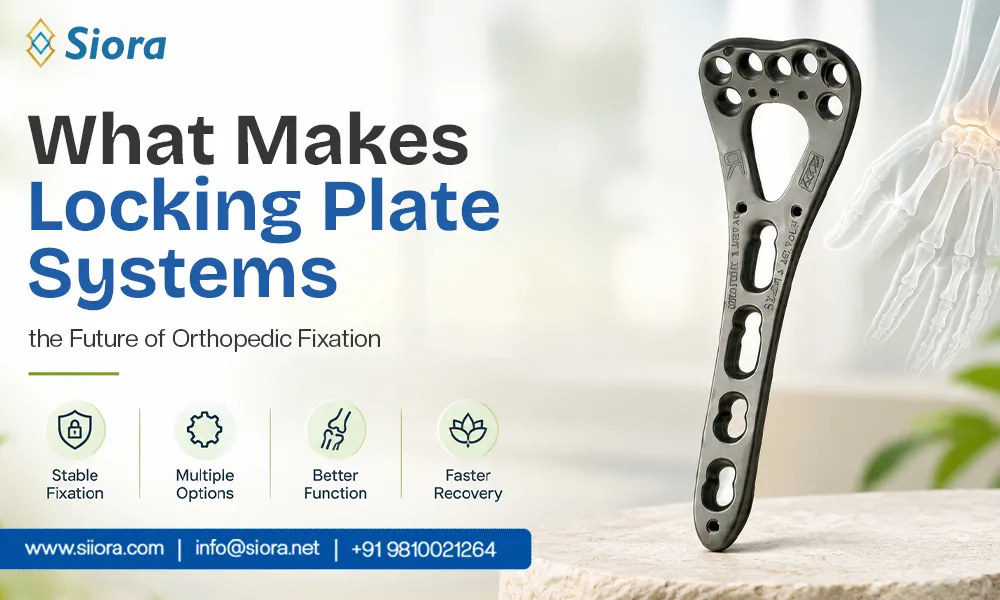
Orthopedic fixation has come a long way from the conventional plates that depended heavily on friction between the plate and the bone. While traditional plating methods remain useful in many clinical situations, modern fracture management increasingly demands greater stability, precision, and flexibility. This is where locking plate systems have changed the conversation.
Designed to create a more stable construct between the plate and screws, locking technology has become an important part of modern orthopedic trauma care. From complex fractures to osteoporotic bone, locking plates offer several advantages that make them a strong choice for the future of fracture fixation.
A More Stable Fixation Construct
The main difference between a conventional plate and a locking plate lies in the way the screw interacts with the plate.
In a traditional system, screws pull the plate tightly against the bone, and stability depends largely on the friction generated at the bone-plate interface. In a locking plate system, the screw head locks into the threaded hole of the plate. This creates a fixed-angle construct in which the plate and screw function together as a single unit.
This design can improve stability, particularly in fractures where maintaining alignment is challenging. The construct is also less dependent on perfect plate-to-bone compression, which can be beneficial in certain biological fixation techniques.
Better Support in Osteoporotic Bone
Poor bone quality is one of the biggest challenges in orthopedic fixation. In osteoporotic bone, conventional screws may lose their grip more easily, increasing the risk of fixation failure.
Locking plate systems help address this concern by allowing the screw to lock directly into the plate. Instead of relying entirely on the screw threads gripping the bone, the stability is shared by the screw-plate interface and the overall construct.
This makes locking technology especially valuable when treating elderly patients or fractures involving weak, fragile bone.
Designed for Complex Fracture Patterns
Not every fracture is straightforward. Some injuries involve multiple fragments, periarticular regions, or anatomically demanding locations where maintaining reduction can be difficult.
Locking plates provide surgeons with the option to create stable fixed-angle constructs that can support fracture fragments without excessive compression of the plate against the bone. This can be particularly useful in comminuted fractures, where preserving the surrounding biological environment is an important consideration.
Many modern systems also feature anatomically contoured designs and carefully positioned screw holes to match specific regions of the skeleton.
Variable-Angle Technology Adds Flexibility
Another major advancement is the development of variable-angle locking plate systems. These systems can allow controlled changes in screw direction within a defined range.
That additional flexibility can help surgeons direct screws around fracture lines, avoid existing implants, and obtain better purchase in the available bone stock. It combines the stability benefits of locking technology with greater intraoperative freedom.
Supporting Biological Fracture Healing
Modern orthopedic treatment is not only about making a fracture rigid. It is also about creating an environment that supports healing while minimizing unnecessary disruption to soft tissues and blood supply.
Because locking plates can function without being tightly compressed against the bone along their entire length, they may support less invasive fixation approaches in appropriate cases. This can help preserve the periosteal blood supply and surrounding soft tissues.
Of course, the final outcome depends on several factors, including fracture type, implant selection, surgical technique, patient health, and post-operative care.
Why Locking Plates Are Shaping the Future
The future of orthopedic fixation will likely focus on trauma implants that are stronger, more precise, and adaptable to different clinical situations. Locking plate systems already represent an important step in that direction.
Their ability to provide stable fixation, support weak bone, accommodate complex fracture patterns, and work with modern minimally invasive techniques makes them highly relevant in contemporary trauma surgery.
Key Advantages of Locking Plate Systems
- Fixed-angle stability between the plate and screws
- Improved fixation support in osteoporotic bone
- Useful for complex and comminuted fractures
- Available in anatomical and variable-angle designs
- Can support biological and minimally invasive fixation techniques
- Reduced dependence on plate-to-bone compression in appropriate constructs