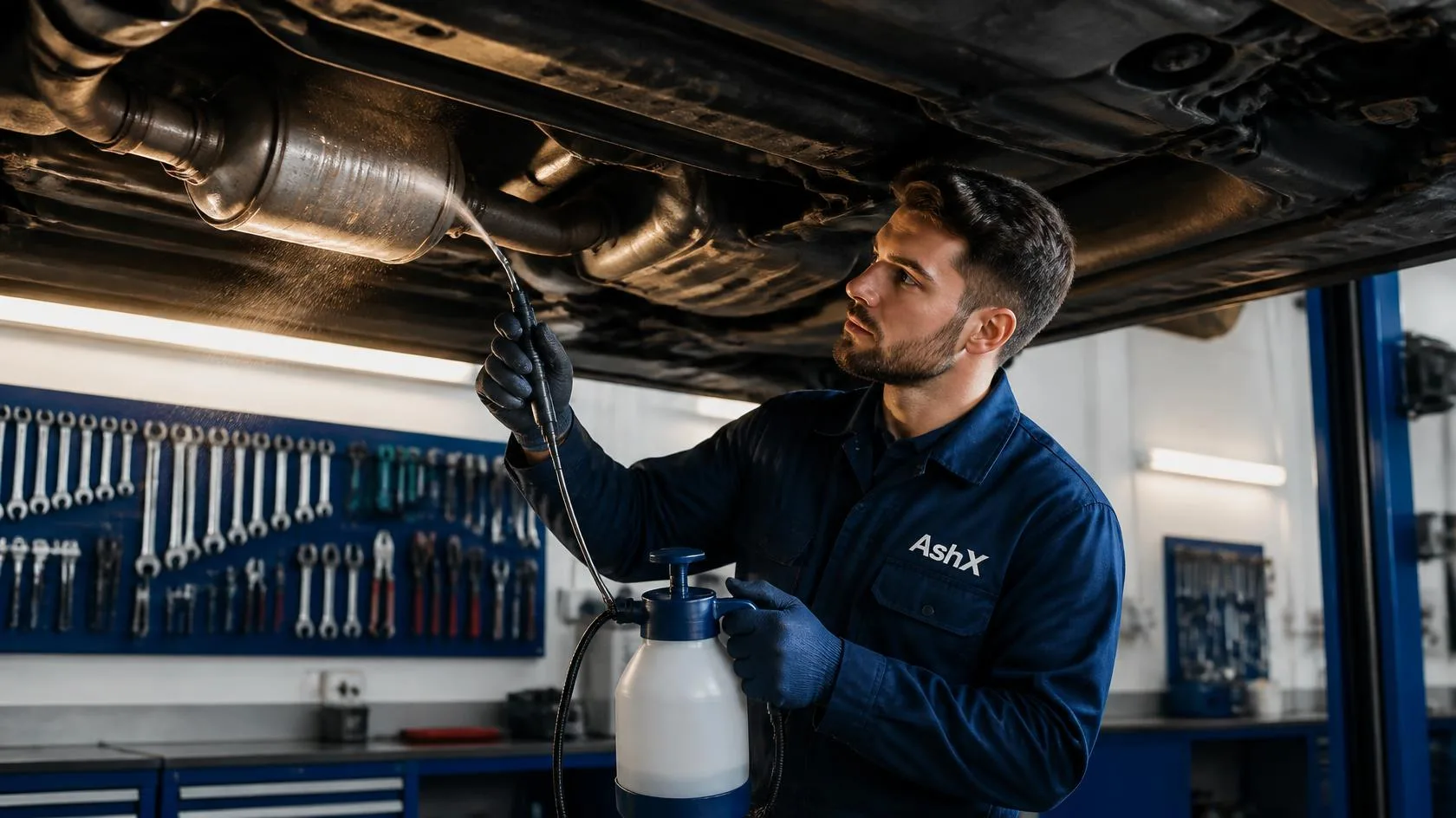
A professional-grade product like AshX DPF Cleaner is formulated to a completely different standard.
The Chemistry Behind Professional-Grade Formulas
Professional cleaners use concentrated active ingredients that are designed to dissolve baked-on carbon deposits at a molecular level. They are not diluted fuel additives — they are applied directly to the filter substrate where the contamination actually sits.
The best professional products use a two-stage approach. Stage one attacks carbonaceous soot with alkaline surfactants that break the bond between the carbon and the filter wall. Stage two uses a different chemistry to dissolve metalite ash — the calcium, zinc, and phosphorus residues left behind by engine oil additives. No single chemical can effectively tackle both types of deposit, which is why the two-stage method consistently outperforms single-stage products.
Why Workshops Are Switching to Professional Cleaners
Time is money in a busy garage. Professional cleaners work faster, clean deeper, and produce more reliable results. That means fewer comebacks, happier customers, and higher profit margins on DPF service jobs.
I have watched workshops transform their DPF service offering simply by switching from generic products to professional-grade solutions. One garage owner in Birmingham told me his DPF job success rate went from about 65 percent to over 90 percent after making the switch. That is the difference between a profitable service and a headache.
How to Spot a Genuinely Professional Product
Look for products that provide clear technical data sheets, specify the active ingredients, and offer guidance on application rates for different filter sizes. Professional products also tend to come with proper application tools — pump sprayers, extension lances, and detailed instructions.
Be wary of products that make vague claims without backing them up with data. If a manufacturer cannot tell you exactly what is in the bottle and how it works, that is a red flag. Transparency is a hallmark of professional-grade chemistry.
Real-World Performance: What the Data Shows
Independent testing has shown that professional two-stage cleaners can reduce DPF back-pressure by 40 to 70 percent in a single treatment. That is a dramatic improvement that translates directly to better engine performance and fuel efficiency.
By contrast, fuel additive cleaners typically show a 5 to 15 percent improvement — better than nothing, but nowhere near enough to resolve a significant blockage. They work as a maintenance product, not a remedial one. Knowing the difference matters when your customer is staring at a £2,000 replacement quote.
The Bottom Line for Workshop Owners
Investing in professional cleaning products is not an expense — it is a revenue opportunity. DPF cleaning is one of the highest-margin services a garage can offer, but only if the results are consistent. Professional-grade products give you that consistency, and they pay for themselves within the first few jobs.
Conclusion
Choosing a professional DPF cleaner over a generic alternative is one of the smartest decisions a workshop or technician can make. The chemistry is better, the results are more reliable, and the cost per treatment is justified by the outcomes. If you are still using fuel additives to tackle serious DPF issues, it is time to upgrade your approach.