The tool fits the machine. It has handled job after job without a fuss. The punch and die look right for the material.
Then a new part arrives, and something does not work.
Maybe the flange sits too close to the tooling. Maybe the punch bumps into another section of the part. Or the bend radius you need simply is not possible with the current profile.
Your first instinct? Order a new tool.
Hold on. You may not need to.
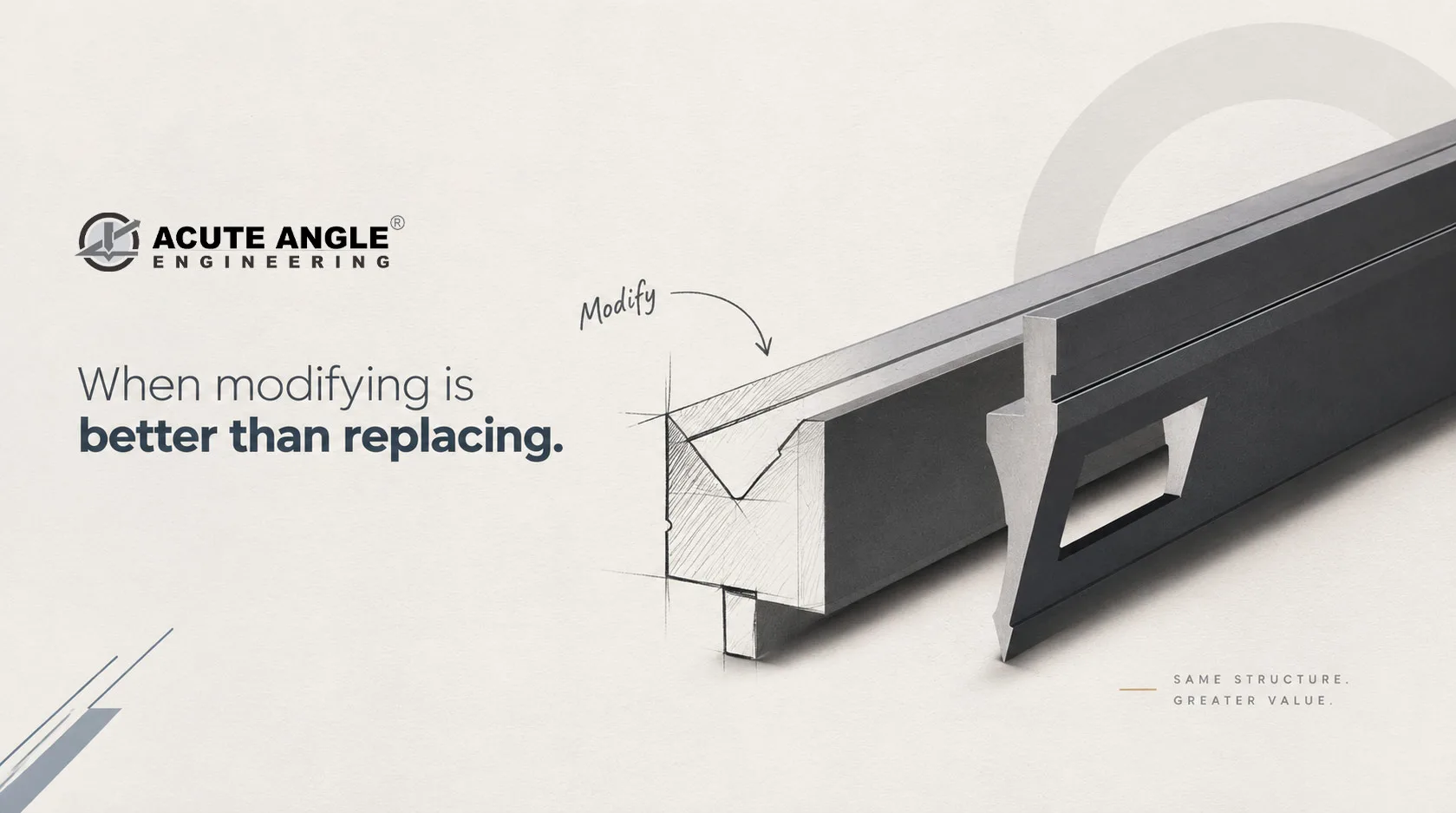
In many sheet metal jobs, the tool you already own has the right foundation. The trouble sits in one small area of its shape. A tweak to the profile, clearance, radius or relief can sometimes make it work. That is when modifying press brake tools becomes a smart engineering call instead of a replacement purchase.
So, the real question is: is it practical, and does it make sense for this job?
When Standard Tooling Falls Short
Standard tooling shines when the part matches what the punch and die were built for: simple bends, regular profiles, sensible flange sizes and enough room to move.
Things get tricky with:
• A narrow flange close to another bend
• A bend that needs extra clearance around the punch
• Deep profiles, unusual radii or offsets
• Closely spaced bends in sequence
In these cases, the press brake is not the problem. The tool’s geometry is.
And that matters, because no setup tweak or program change can remove a physical obstruction. The punch and die must leave enough room for the part to form properly.
Even good CNC press brake tools hit their limits when parts get complex.
When a Modification Is the Answer
It makes sense when the tool is basically right, but one feature is blocking the job.
Then you fix only that spot: add clearance, change a profile, adjust a radius or cut a relief. You are not redesigning the tool. You are making one controlled change.
Take a punch top tool with the right angle and shape, but a profile that clips a flange. Reworking that one area gives you the clearance and keeps everything that already works.
Every case is different. The right change depends on part geometry, material thickness, bend angle, inside radius, flange size, machine setup and how the punch, die and workpiece interact.
Be careful, though. A change that looks tiny on a drawing can matter a lot during bending. Remove material from the wrong place and clearance, contact or forming behaviour can suffer.
So, the goal is not just to make it fit. It is to make it work for the whole bending operation.
Often, the best change is the smallest one that solves the real problem.
Modify or Build New Tooling?
Being able to modify a tool does not mean you should. First, check whether it is a good candidate.
Modify when:
• The punch or die already meets the basic bending need
• The problem is limited to one area
• Extra clearance or a profile or radius change fixes it without hurting the tool
Go for new tooling when:
• The required geometry is completely different
• The changes would become extensive
• Your production volume justifies dedicated tooling
• The altered tool could no longer give the performance and repeatability you need
And do not stop at the upfront price. Think about how often you run the job, part complexity, tool life, setup effort and repeatability.
For example, reworking a punch for an occasional part is smart when the original stays useful elsewhere. But if the same special geometry runs every day in high volume, custom press brake tooling will likely serve you better in the long run.
Do not pick modification because it is cheaper, or new tooling because it is easier to order. Pick what the part actually demands.
Stuck With a Difficult Bend?
Acute Angle Engineering can help you decide whether modification or a purpose-built solution is right for you. Share your part geometry, clearance needs and bending challenges with the tooling specialists at Acute Angle Engineering.