What Makes a Pharmaceutical Supply Chain Reliable for Global Buyers?
A pharmaceutical product does not reach an international market through manufacturing alone.
Between the moment a buyer identifies a requirement and the moment a shipment arrives at its destination, several connected activities have to work properly. Suppliers need to be evaluated, product specifications need to be understood, quality information needs to be available, documentation needs to match the market, packaging needs to be coordinated, and logistics need to move according to plan.
For international pharmaceutical buyers, this makes supply-chain reliability just as important as finding a competitive product or quotation.
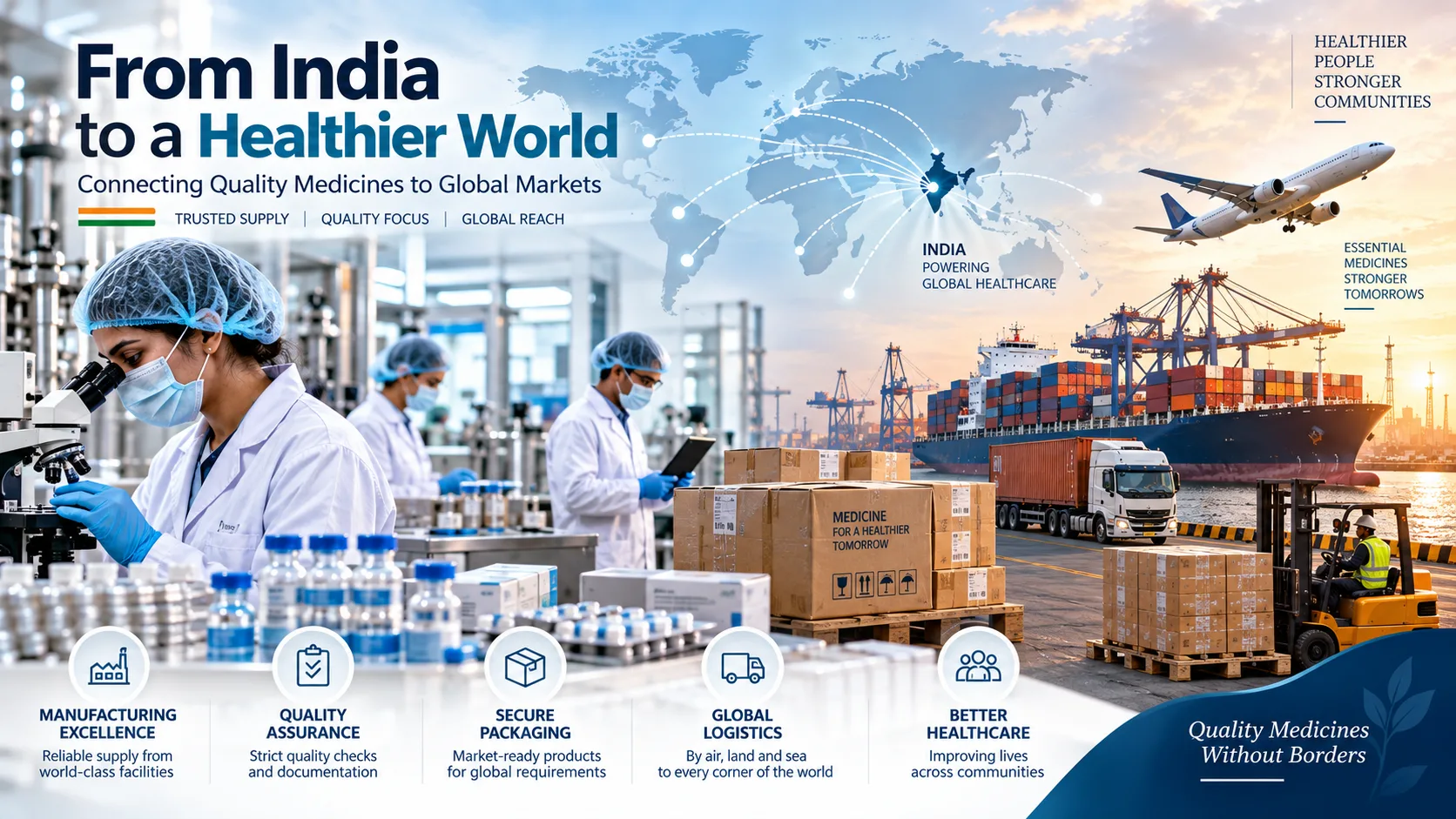
India is already deeply connected to this global system. Pharmaceutical exports from the country reached about US$30.46 billion in FY 2024–25, according to the Pharmaceuticals Export Promotion Council of India (Pharmexcil).
But export volume alone does not explain what makes a pharmaceutical supply relationship dependable. The more useful question is: what needs to happen behind the scenes for that supply to keep working?
It Starts With a Clear Requirement
A reliable pharmaceutical supply chain begins with a clearly defined buyer requirement.
An international buyer may know the medicine or product category they are looking for, but the actual sourcing requirement can involve much more detail.
The supplier may need to understand:
- Product name and formulation
- Strength and dosage form
- Required quantities
- Packaging format
- Intended destination market
- Documentation requirements
- Expected delivery timelines
- Recurring or long-term supply needs
These details matter because a product that appears suitable at first glance may not meet the precise requirements of the buyer's market.
For this reason, pharmaceutical sourcing from India is more effective when the requirement is established before suppliers are compared.
Supplier Selection Is More Than a Price Comparison
Price naturally matters in an international transaction, but it should not be the only factor used to evaluate a supply source.
A buyer may also need to consider the supplier's relevant manufacturing capabilities, product range, quality systems, available documentation, production capacity and communication process.
Two suppliers may quote for the same product while offering very different levels of support around documentation, packaging, lead times or recurring supply.
This is why supplier selection should be viewed as part of a broader sourcing process rather than a simple quotation exercise.
Our pharmaceutical sourcing solutions are built around this broader approach, connecting product requirements with supplier coordination and international supply considerations.
Quality Needs to Be Supported by Information
Quality is often discussed as a characteristic of a finished product, but international pharmaceutical sourcing requires buyers to look at the information behind that product as well.
Depending on the product and destination market, buyers may need access to relevant specifications, testing information, Certificates of Analysis, quality documentation, manufacturing information and other supporting records.
The exact requirements differ by product and country.
That means buyers should avoid relying only on broad statements such as “high quality” or “international standard.” More useful questions focus on what documentation and product information can actually be provided and whether it is appropriate for the intended market.
A structured quality assurance approach can therefore become an important part of the supplier evaluation process.
Documentation Is Part of the Product Journey
When a pharmaceutical shipment crosses a border, physical products are only one part of the transaction.
Documentation can include information relating to the product, quality, packaging, export process and destination-market requirements.
Some markets may have specific registration or import requirements. Packaging may need certain information or languages. Buyers may also require particular documents before a shipment can move forward.
These details are easier to manage when they are discussed early.
A common mistake in international sourcing is to treat documentation as something that can be completed after the commercial decision has already been made. In reality, documentation requirements can influence which supplier is suitable in the first place.
Packaging Can Affect International Supply
Packaging is another area where apparently small details can create larger supply-chain issues.
A buyer may require a particular pack size, label format, carton specification, language or export configuration.
The destination market may also have its own expectations.
For this reason, packaging should be discussed alongside the product requirement rather than treated as a final cosmetic step before shipment.
Clear packaging specifications help align the manufacturer, sourcing partner, buyer and logistics provider before goods are dispatched.
Logistics Connects Every Previous Decision
Once a product is ready, it still has to reach the buyer.
International pharmaceutical shipments can involve road transport, warehousing, ports, air freight, customs procedures and local distribution.
This means logistics is closely connected to everything that came before it.
For example, a documentation problem can delay a shipment. A packaging change can affect preparation time. Production delays can alter freight schedules. A lack of coordination between different parties can create uncertainty for the buyer.
A reliable supply-chain process therefore needs communication between product, documentation and logistics teams rather than treating transportation as an isolated final step.
The First Shipment Is Not the Whole Relationship
One successful shipment is useful, but many international buyers are ultimately concerned with what happens afterward.
Demand can change.
A buyer may need larger quantities, additional products, different packaging, new destination markets or more frequent shipments.
This makes supply continuity an important consideration when evaluating a supplier.
Questions worth asking include:
Can the supplier support recurring orders?
How does capacity change as volumes increase?
How clearly are lead times communicated?
Who coordinates documentation and shipment planning?
How are changes in product or market requirements handled?
These questions shift the focus from one transaction to the quality of the overall supply relationship.
Why a Sourcing Partner Can Matter
Some international buyers work directly with manufacturers and have the internal teams needed to manage procurement, documentation, regulatory matters and logistics.
For others, especially buyers handling several products or markets, the sourcing process can involve many moving parts.
A pharmaceutical sourcing partner can help connect these activities.
The role may involve understanding the buyer's requirement, identifying suitable supply sources, coordinating product information, helping organize documentation, discussing packaging requirements and supporting the wider supply process.
This does not mean that every buyer needs a sourcing partner. It means that the appropriate structure depends on the complexity of the requirement.
Our guide on how global pharmaceutical sourcing works explores this process in greater detail.
Market Requirements Cannot Be Ignored
A pharmaceutical supply chain does not operate in exactly the same way for every destination.
Different countries and regions can have different expectations around registration, labelling, documentation, packaging and imports.
For an international buyer, communicating the destination market early can therefore save time later.
It can also affect supplier selection.
A supplier that can meet one market's requirements may not automatically be suitable for another without additional documentation, packaging or regulatory coordination.
The wider lesson is straightforward: the destination market should be part of the sourcing discussion from the beginning.
India's Position in the Global Pharmaceutical Network
India's pharmaceutical industry has developed a broad international export footprint.
The Ministry of Commerce and Industry's 2024–25 annual report identifies North America, Europe and Africa as major regional destinations for Indian pharmaceutical exports and notes that these three regions together accounted for roughly 69% of exports during April–November 2024.
This international reach means Indian pharmaceutical supply is connected to very different healthcare markets and buyer requirements.
For suppliers and sourcing partners, that creates an ongoing need to coordinate manufacturing, quality, documentation and logistics according to the market being served.
For buyers, it means the search for a pharmaceutical supplier should be based on fit rather than geography alone.
How Buyers Can Evaluate Supply Reliability
There is no single question that can guarantee whether a supplier will be dependable.
Instead, buyers can look at the complete process.
A useful evaluation may consider:
Product fit: Can the supplier meet the precise product requirement?
Quality: Is relevant quality information available?
Documentation: Can required documents be provided for the intended market?
Packaging: Can packaging and labelling specifications be supported?
Capacity: Can the supplier handle the expected volume?
Communication: Are requirements and timelines communicated clearly?
Logistics: Are shipment responsibilities understood?
Continuity: Can the relationship support recurring or changing requirements?
Buyers who evaluate these areas together are more likely to understand the strengths and limitations of a prospective supply source.
For a more specific supplier-evaluation framework, see our guide on how to verify a pharmaceutical exporter in India before placing an international order.
Building a More Reliable Supply Path
A dependable pharmaceutical supply chain is not created by one company or one shipment.
It comes from several connected decisions working together.
The buyer must communicate the requirement clearly. The supplier must understand the product. Quality and documentation need to support the intended market. Packaging must be coordinated. Logistics must be planned. Communication must continue throughout the process.
When these pieces work together, the supply chain becomes easier to manage and more adaptable to changing requirements.
For international pharmaceutical buyers, that is often the real goal—not simply finding a supplier, but establishing a supply pathway that can continue to function as products, markets and volumes evolve.
About Sidmex Inovia
Sidmex Inovia Pvt. Ltd. is an India-based pharmaceutical exporter and global pharmaceutical sourcing partner serving international buyers.
The company supports pharmaceutical sourcing, supplier coordination, quality and documentation requirements, export processes and supply-chain coordination for buyers sourcing pharmaceutical products from India.
Explore: Pharmaceutical Sourcing Solutions