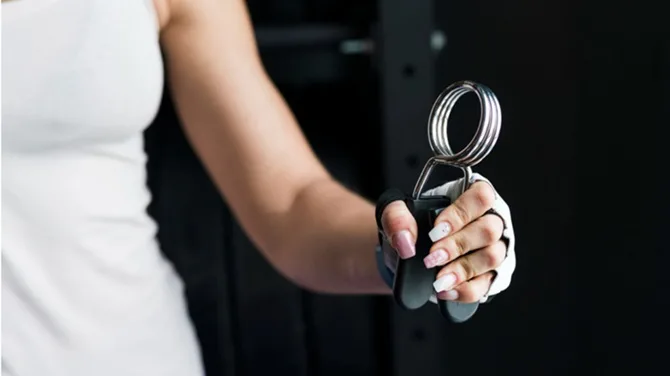
Hand grippers are cheap, portable and easy to overhype. Some websites promise a "crushing" grip in weeks, and others dismiss the whole category as a gimmick. The research sits between those two positions.
Short answer: yes, a grip strengthener can raise hand strength, but the benefit is narrower than the marketing suggests, and the best grip strengthener for you depends on what you want it to do. This article separates the three questions people usually blur together: does it make your hand stronger, does that strength carry over to other things, and does it do anything for your health?
Question 1: does grip training make your hands stronger?
For most people, yes. A 2025 systematic review and meta-analysis of randomized trials in healthy adults concluded that strength-focused hand training produces meaningful improvements in grip strength and dexterity, particularly in older adults. The authors also noted that more high-quality trials are needed for outcomes that are less well studied.
That fits the basic physiology of strength training. Muscles and the nerves that drive them respond to progressive loading, and hand and forearm muscles are no exception. A broader 2019 meta-analysis of 24 trials in healthy older adults, with over 3,000 participants, found that many kinds of exercise produced small but significant gains in handgrip strength, with task-specific and multimodal training looking like the more effective stimulus. In other words, grip can be trained by a lot of things, and training it directly tends to help.
One caution on timing and age. A small, not-yet-peer-reviewed study of 48 adults tested four weeks of home grip training and found that the young training group's handgrip strength rose, while the older groups' strength did not change in that short window, even though nerve conduction improved in both. Four weeks is brief, and a preprint is preliminary evidence, so treat it as a reminder that results vary with age and timeframe rather than as a verdict.
Question 2: does that strength transfer to sport or lifting?
This is where the claims get shaky. Grip strength comes in three broad forms: crush (closing the fingers against resistance), pinch (fingers against thumb) and support (holding on over time, as in deadlifts, hangs and carries). Crush grip is the type researchers measure most often, because grip dynamometers test it accurately, but it isn't the type most sports and lifts demand.
A gripper trains crush. Training effects tend to be specific to the pattern and the task, so gripper work is no substitute for carries, hangs and pinch holds if those are what limit you. Strength coaches who write about grip also advise using lower-specificity training to supplement sport-specific grip work rather than replace it.
Transfer can also fail outright when the athlete's sport already loads the hands heavily. In a small study of college wrestlers, six weeks of twice-weekly grip-specific training added to regular wrestling produced no significant change in grip, pinch or grab strength. It was a conference abstract rather than a full paper, so it doesn't prove grippers fail for athletes, but it shows that adding more of the same to people who are already training their hands hard may not move the needle.
Question 3: does a stronger grip make you healthier?
This is where the headlines run furthest ahead of the evidence.
The best-known data come from the PURE study, which measured handgrip strength in almost 140,000 adults aged 35 to 70 across 17 countries and followed them for a median of about four years. For every 5 kg reduction in grip strength, risk of death from any cause was 16% higher, cardiovascular death 17% higher, heart attack 7% higher and stroke 9% higher. Grip strength predicted all-cause and cardiovascular death more strongly than systolic blood pressure did.
The important word is predicted. PURE was observational. It shows that weak grip marks people at higher risk, not that squeezing a gripper lowers that risk. The lead author said further research was needed to establish whether efforts to improve muscle strength are likely to reduce an individual's risk of death and cardiovascular disease. The authors themselves suggested that low grip strength is linked to greater susceptibility to dying once someone develops a serious illness, which points to a marker of resilience rather than a lever you can pull.
So a strengthener is best thought of as a way to build hand strength, not as a health intervention. If you're concerned about your health, general strength training, activity and medical advice matter far more than any single device.
Who is most likely to benefit
- Beginners and people who are out of practice. Untrained hands respond quickly to almost any progressive loading.
- Older adults. The meta-analytic evidence is strongest here, and hand strength is closely tied to daily independence. Talk to a clinician first if you have arthritis, a past injury or another hand condition.
- People with a specific crush-grip weakness. If jar lids, handshakes or tools are the problem, a gripper targets it directly.
- Strength athletes with a lagging crush grip. It can fill a gap, alongside heavy carries and holds.
Benefits are likelier to be modest for athletes whose sport already works the hands hard, or for anyone expecting a gripper to fix hanging, pinching or pulling limits.
How to get results
Strength principles apply in miniature. Use enough resistance that the last couple of reps are hard, and increase it gradually. Train both hands. Keep the movement controlled, closing fully and opening slowly. Write down what you did, because "feels easier" is a weak measure and a logged number tells you whether you're improving.
Frequency doesn't need to be extreme. Strength coaches suggest that one to two focused grip sessions a week can produce worthwhile gains for athletes who aren't grip specialists, and one study of already-strong climbers saw improvements within four weeks at three sessions a week. Tendons adapt more slowly than muscle, so build volume gradually and rest between sessions. If you feel pain rather than fatigue, stop and get it checked.
Choosing the best grip strengthener
The best grip strengthener is the one that matches your current strength and lets you keep progressing.
- Adjustable or graded resistance. A single fixed tension is quickly outgrown, so choose adjustable models or a set with several strengths.
- Handle fit. A handle span that's wrong for your hand alters the movement and the effort.
- Measurement. Some digital models show or log squeeze force, which makes progress visible and helps you spot differences between hands.
- Comfort for both hands. If it hurts to use, you won't use it.
For most people, any well-made gripper with progressive resistance beats an expensive one used inconsistently.
What science can't tell us yet
There is little long-term trial evidence on gripper training specifically, and many studies are short, small or in specialised groups. We don't know whether raising grip strength changes long-term health outcomes. And individual responses vary widely.
Quick answers
Do grip strengtheners build forearm muscle? They train the muscles that close the hand, and larger gains come from progressive, regular training. Results vary from person to person.
Is a gripper better than farmer's carries? They train different things. A gripper isolates crush grip, while carries train support grip with the whole body.
Can a grip strengthener hurt? Overuse can irritate tendons. Ease in, rest between sessions, and see a clinician for persistent pain.
The takeaway
Grip strengtheners work for what they are designed to do: build crush strength in the hand, especially in people who haven't trained it. They won't automatically improve pulling, hanging or sport performance, and no evidence yet shows that squeezing one extends your life. Pick the best grip strengthener for your needs, load it progressively, track your results, and combine it with other grip work that matches your goals.