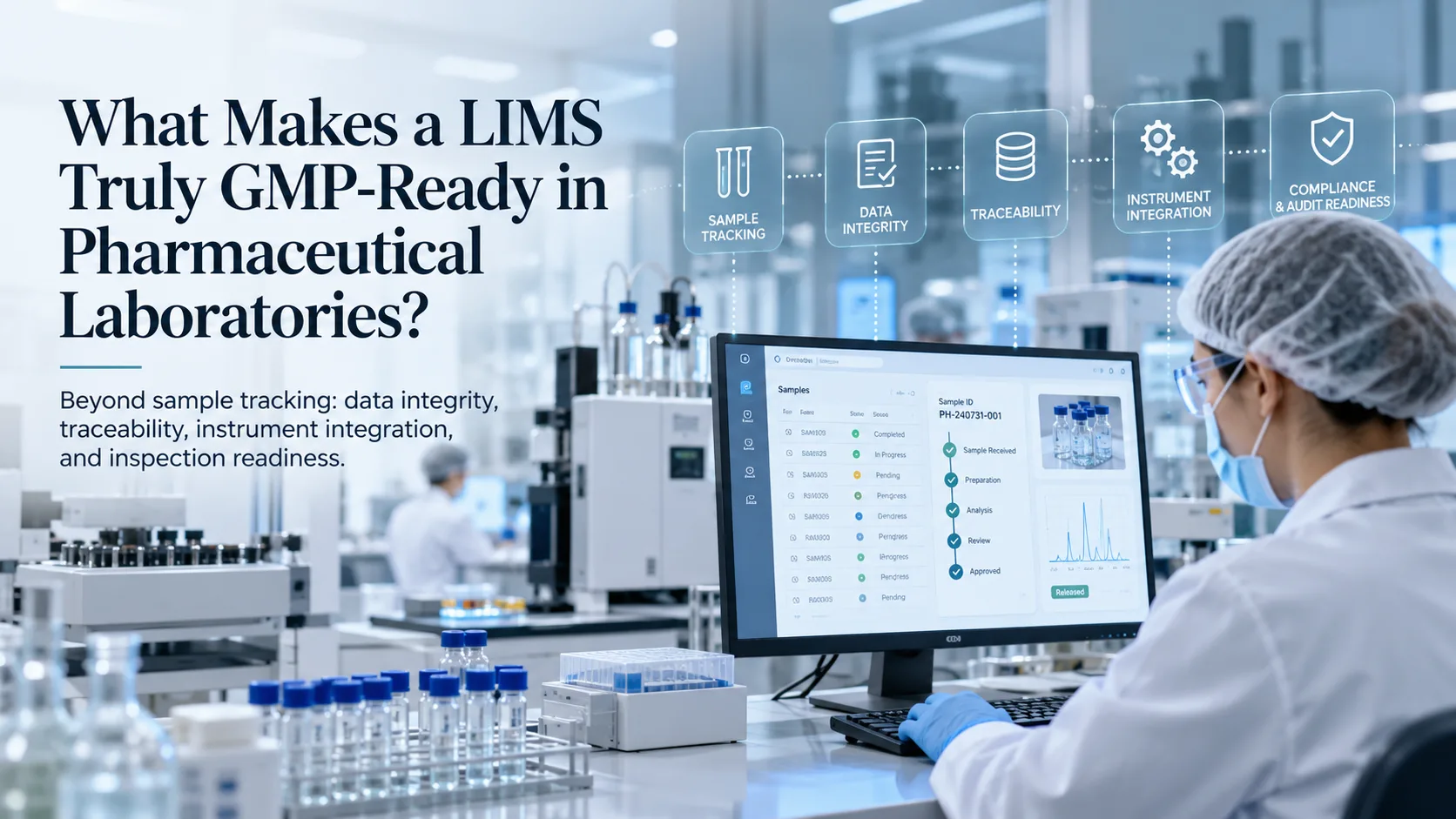
Sample tracking is only the starting point. For regulated pharmaceutical laboratories, a LIMS also needs to support data integrity, traceability, controlled workflows, instrument connectivity, and inspection readiness.
Laboratory Information Management Systems have been used for years to organize samples, tests, specifications, results, and reports.
But in a pharmaceutical quality-control laboratory, simply being able to track a sample from receipt to release does not make a LIMS GMP-ready.
The more important question is:
Can the system help the laboratory demonstrate that its data is complete, accurate, traceable, controlled, and reliable throughout the analytical process?
That changes how pharmaceutical companies should evaluate LIMS software.
A modern pharmaceutical LIMS is increasingly becoming part of the laboratory's quality infrastructure—not simply a database for samples.
Sample Management Is Only the Beginning
Sample management is usually the most visible function of a LIMS.
A laboratory receives a raw material, in-process sample, finished product, stability sample, environmental sample, or another testing requirement. The LIMS assigns an identity, associates specifications and tests, tracks progress, records results, and ultimately supports review and reporting.
That alone brings significant value.
However, regulated laboratories need to understand everything that happened around the result as well.
Who performed the test?
Was the analyst qualified?
Which method and specification were applicable at the time?
Which instrument was used?
Was that instrument within calibration?
Were any results changed?
Who reviewed the result?
Was an OOS or OOT event associated with it?
These questions explain why GMP LIMS implementations quickly extend beyond sample tracking.
Data Integrity Must Be Designed Into the Workflow
FDA's guidance on data integrity states that pharmaceutical manufacturers are expected to maintain reliable and accurate data and recommends meaningful, risk-based strategies for preventing and detecting data-integrity problems. U.S. Food and Drug Administration
FDA — Data Integrity and Compliance With Drug CGMP: Questions and Answers
For a laboratory, this means the controls surrounding an analytical result matter just as much as the result itself.
A GMP-oriented LIMS should therefore help maintain a clear relationship between:
- samples and specifications,
- analysts and activities,
- instruments and results,
- original and changed information,
- approvals and electronic signatures,
- investigations and laboratory events.
This is where a structured digital system can offer an advantage over disconnected spreadsheets, handwritten records, and manually transferred analytical data.
The goal is not merely to store information electronically.
It is to maintain the context and history of that information.
Audit Trails Need to Be Useful During Review
Audit trails are frequently included in LIMS requirements, particularly where electronic records are used in regulated operations.
But simply having an audit trail is not enough.
Imagine that a reviewer notices that a test result was modified.
The system should make it practical to determine:
What was the original value?
What was changed?
Who made the change?
When did it happen?
Why was the change made?
When the record history is difficult to interpret, the existence of an audit trail does not automatically make investigation easier.
This is why audit-trail design, review practices, user access, and procedural controls need to work together.
Instrument Integration Can Remove an Important Manual Step
One of the most interesting opportunities for modern pharmaceutical laboratories is the connection between instruments and laboratory systems.
Consider a common workflow.
An analyst performs testing on laboratory equipment, reads or exports a result, and then manually enters that value into another system.
The LIMS may be electronic, but one of the most important data transfers in the process is still manual.
That creates opportunities for:
- transcription errors,
- incorrect decimal placement,
- missing results,
- duplicate entry,
- reconciliation effort,
- and additional review.
Instrument integration can help reduce this dependency by transferring appropriate data directly between laboratory equipment and laboratory systems.
This is becoming a common emphasis across the LIMS market.
LabWare, for example, describes integration with laboratory instruments and enterprise systems as part of its LIMS architecture, alongside sample management, test scheduling, QC management and compliance documentation. Labware
Thermo Fisher Scientific similarly describes SampleManager LIMS as supporting audit trails, electronic signatures, laboratory execution and enterprise connectivity, including controls relevant to regulated laboratories. Thermo Fisher Scientific
Thermo Fisher Scientific — SampleManager LIMS
The technology will differ between environments, but the objective is similar:
reduce unnecessary manual transcription while preserving traceability.
Controlled Execution Matters as Much as Data Storage
Another distinction between a basic laboratory database and a GMP-focused LIMS is what happens before a result reaches the system.
Does the software simply receive a number?
Or can it help guide the laboratory process that produces that number?
For example, controlled workflows can help ensure that:
- appropriate tests are assigned,
- required activities are completed,
- applicable specifications are used,
- required reviews cannot simply be skipped,
- only authorized personnel perform particular activities.
The more laboratory controls are built into execution, the less an organization needs to depend on detecting documentation problems after the work has already occurred.
That does not mean automation replaces laboratory procedures or human oversight.
It means the software can reinforce them.
Electronic Signatures and Access Controls Need Context
Pharmaceutical systems usually involve different responsibilities.
An analyst may enter a result.
A reviewer may assess it.
QA may approve certain records.
An administrator may configure the application but should not necessarily perform GMP laboratory activities.
A well-controlled LIMS needs to distinguish these responsibilities through appropriate roles and permissions.
The system should also maintain the relationship between an electronic approval and the record being approved.
These controls become particularly important as laboratory processes become increasingly paperless.
A LIMS Should Connect the Laboratory, Not Create Another Data Silo
One of the unintended consequences of digital transformation is the creation of more isolated software.
A laboratory may already use:
- chromatographic data systems,
- laboratory instruments,
- ERP,
- QMS,
- document management,
- environmental-monitoring applications,
- stability systems,
- training systems,
- manufacturing applications.
If a LIMS operates independently of the rest of this environment, people may still need to transfer information manually between systems.
The better question therefore becomes:
Where should laboratory data originate, where should it flow, and which system should remain the authoritative record for each activity?
This is why integration is increasingly central to LIMS strategy.
CaliberLIMS, for example, describes integration with instruments as well as systems such as ERP, QMS, DMS and CDS as part of its approach to a connected pharmaceutical laboratory. Caliber Technologies
CaliberLIMS — Pharmaceutical Laboratory Information Management System
Rather than treating this as a feature comparison between vendors, pharmaceutical companies should use these examples to understand how the LIMS category itself is evolving.
What Happens When an Inspector Requests the Complete Record?
Perhaps the most practical test of a GMP LIMS is not the demo.
It is the inspection scenario.
Suppose an inspector identifies a finished-product batch and asks to see:
- the relevant samples,
- analytical results,
- specifications,
- analysts involved,
- instruments used,
- review history,
- changes to records,
- associated OOS/OOT investigations,
- and final approvals.
How many different systems and departments need to be involved before the complete story can be reconstructed?
A mature digital laboratory should make that reconstruction progressively easier.
The LIMS does not necessarily need to contain every record itself.
But the organization needs clear traceability across the systems involved.
What Should Pharma Companies Ask When Evaluating a LIMS?
Instead of starting with:
“How many modules does this LIMS have?”
A better evaluation might ask:
Can we trace every important laboratory result back through the activity that created it?
Other useful questions include:
- Can instruments transfer data without unnecessary transcription?
- Are changes to GMP records fully traceable?
- Can roles and permissions reflect laboratory responsibilities?
- Can electronic reviews and approvals be reconstructed later?
- Can the platform support OOS and OOT processes?
- How are specifications, methods, and versions controlled?
- Can laboratory information connect with quality and enterprise systems?
- How easily can relevant records be retrieved during an inspection?
The answers reveal considerably more than a long feature checklist.
The Goal Is Not Simply a Paperless Lab
Going paperless is an important milestone.
But it should not be the final objective.
The real opportunity is to create a laboratory where information is captured correctly, remains traceable, moves between systems with less manual intervention, supports timely review, and can be confidently reconstructed when regulators or quality teams need it.
That is what separates a system that stores laboratory data from one that helps support a GMP-controlled digital laboratory.
As pharmaceutical operations continue to become more connected, LIMS platforms from vendors such as LabWare, Thermo Fisher Scientific, Caliber and others are increasingly addressing this broader role.
For laboratories evaluating their next stage of digitalization, the most useful question may therefore be simple:
Does our LIMS just know what the result was—or can it help us understand and defend how that result came to exist?
Suggested references for TheOmniBuzz
Regulatory
FDA — Data Integrity and Compliance With Drug CGMP
Industry / competitor references
LabWare — Pharmaceutical Laboratory Software
LabWare — Laboratory Information Management Systems