
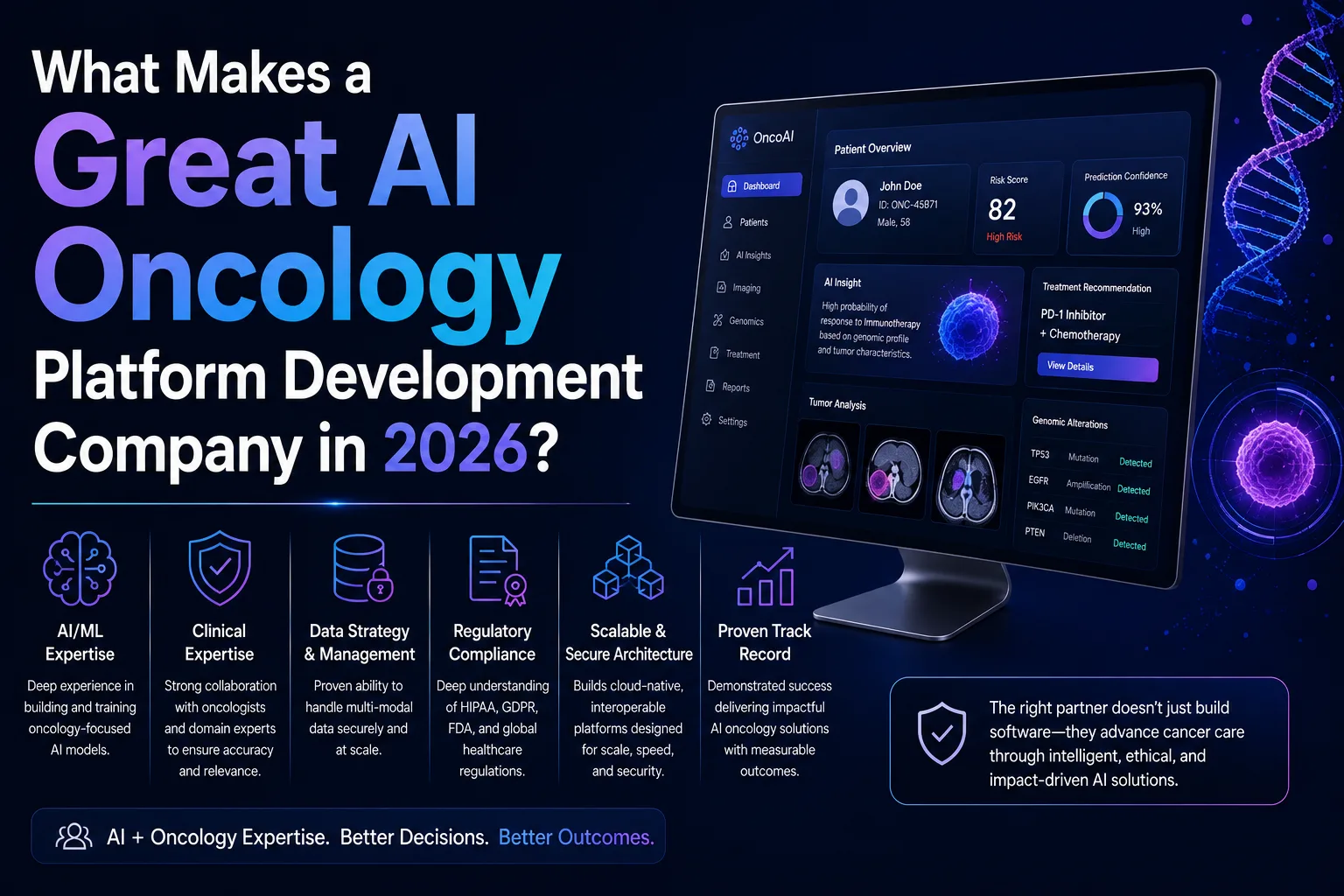
Artificial intelligence is no longer being adopted only to automate administrative work in oncology. Today's platforms assist clinicians in interpreting medical images, identifying genomic biomarkers, prioritizing treatment options, managing multidisciplinary cancer care, and accelerating clinical research. As healthcare organizations continue investing in AI Oncology Platform Development, the expectations placed on software vendors have changed dramatically. Development companies are now expected to understand oncology workflows, precision medicine, regulatory requirements, cloud infrastructure, and responsible AI alongside software engineering.
This creates an important challenge for healthcare organizations evaluating development partners. Many software companies have experience building healthcare applications, but relatively few have demonstrated expertise in combining artificial intelligence, clinical workflows, medical imaging, genomic analytics, interoperability, and enterprise architecture within a single oncology platform.
Instead of comparing vendors by company size or years in business, decision-makers should evaluate the technical capabilities that determine whether an AI oncology platform can succeed in real clinical environments. The following sections explore those capabilities before examining development companies whose strengths align with different areas of oncology technology.
Seven Capabilities Every AI Oncology Platform Development Company Should Have
1. Multimodal Artificial Intelligence
Modern oncology decisions rarely rely on a single source of information. Clinicians evaluate pathology reports, radiology images, genomic sequencing, laboratory results, physician notes, and patient histories together before selecting treatment strategies.
Development companies should understand how AI models process multiple data sources simultaneously while maintaining explainability and clinical transparency.
2. Precision Medicine Expertise
Cancer treatment is becoming increasingly personalized. Oncology platforms should support biomarker analysis, genomic interpretation, targeted therapies, companion diagnostics, and precision medicine workflows that evolve alongside scientific research.
3. Clinical Workflow Integration
An AI platform creates value only when it fits naturally into daily oncology practice. Development teams should understand tumor boards, multidisciplinary reviews, treatment planning, pathology workflows, radiology reporting, and clinician collaboration instead of focusing exclusively on AI models.
4. Enterprise Healthcare Interoperability
Successful oncology platforms integrate with Electronic Health Records, PACS, Laboratory Information Systems, pathology software, clinical trial management tools, and hospital infrastructure. Healthcare interoperability remains one of the strongest indicators of long-term platform success.
5. Scalable Cloud Infrastructure
AI oncology platforms process extremely large datasets that include medical imaging, pathology slides, genomic files, treatment histories, and AI inference requests. Cloud-native engineering allows these workloads to scale while maintaining performance and availability.
6. Responsible AI and Regulatory Compliance
Healthcare organizations increasingly expect explainable AI, audit trails, human oversight, cybersecurity, HIPAA compliance, GDPR readiness, and governance frameworks that support safe clinical deployment.
7. Long-Term Product Engineering
Oncology research evolves rapidly. Development companies should build modular platforms capable of supporting future biomarkers, foundation models, clinical decision support capabilities, and new diagnostic technologies without requiring complete redevelopment.
Companies Demonstrating These Capabilities
Choosing a development company becomes much easier once these seven capabilities have been clearly defined. Rather than assuming every healthcare software vendor delivers the same expertise, organizations can evaluate companies according to the areas where they create the greatest value.
The following companies represent different strengths across artificial intelligence, enterprise healthcare software, precision medicine, cloud engineering, interoperability, clinician experience, and AI oncology platform development. Understanding those differences provides a more meaningful basis for comparison than traditional rankings alone.
Idea Usher
Most healthcare organizations investing in AI oncology are not looking for another standalone application. Their objective is to build an intelligent clinical platform that brings together medical imaging, pathology, genomics, patient records, AI-assisted decision support, clinician collaboration, and analytics within a single environment.
Idea Usher approaches oncology software from this product engineering perspective. Rather than developing isolated AI modules, its teams design connected healthcare ecosystems where clinical data, artificial intelligence, cloud infrastructure, interoperability, and user experience work together to support the complete oncology care pathway.
One of the company's strongest differentiators is its emphasis on future-ready architecture. Oncology research evolves continuously, with new biomarkers, treatment guidelines, AI models, and precision medicine approaches emerging every year. By designing modular platforms from the outset, organizations can introduce new capabilities without rebuilding their core infrastructure.
This makes Idea Usher particularly suitable for hospitals, cancer centers, biotechnology companies, and digital health organizations planning long-term investment in AI-powered oncology solutions.
Intellivon
Artificial intelligence cannot improve cancer care if it operates outside the systems clinicians already use every day. Oncology departments typically rely on Electronic Health Records, PACS, pathology software, laboratory systems, scheduling platforms, and multidisciplinary review tools that have been refined over many years.
Intellivon specializes in connecting new AI capabilities with these existing clinical environments. Instead of replacing established infrastructure, its engineering teams focus on interoperability, secure healthcare data exchange, and enterprise integration that allows oncology platforms to become part of routine clinical practice.
This experience is particularly valuable for healthcare providers introducing AI into existing cancer programs, where minimizing workflow disruption is just as important as improving diagnostic accuracy.
LeewayHertz
Artificial intelligence has become one of the primary differentiators in oncology software. Beyond assisting with medical imaging, modern AI platforms support pathology interpretation, genomic analysis, treatment recommendations, clinical summarization, and research automation across increasingly complex datasets.
LeewayHertz has built its reputation around advanced AI engineering rather than conventional software development. Its expertise spans large language models, computer vision, predictive analytics, intelligent automation, and enterprise machine learning, making it well suited for organizations where AI serves as the core product capability.
Instead of simply embedding AI into existing workflows, the company focuses on developing systems where intelligent analysis directly supports oncologists, researchers, and multidisciplinary care teams. This makes LeewayHertz particularly relevant for companies creating the next generation of precision oncology platforms.
Glorium Technologies
Cancer treatment is inherently collaborative. Every patient journey may involve oncologists, surgeons, radiologists, pathologists, pharmacists, specialist nurses, genetic counselors, and tumor boards working together to determine the most appropriate course of treatment.
Glorium Technologies develops healthcare platforms that strengthen these collaborative workflows. Rather than concentrating exclusively on AI functionality, its solutions improve communication between departments, simplify treatment coordination, streamline documentation, and support multidisciplinary clinical decision-making.
For organizations implementing AI across multiple oncology services, this operational expertise helps ensure that intelligent software improves the overall care process instead of becoming another disconnected clinical tool.
Intellectsoft
Many hospitals initially deploy AI to support one area of oncology, such as radiology or clinical decision support. Over time, however, these initiatives often expand into genomic medicine, precision oncology, remote patient monitoring, clinical research, and population health analytics.
Intellectsoft develops enterprise healthcare platforms with this evolution in mind. Its engineering teams emphasize modular architecture, scalable cloud infrastructure, and sustainable product engineering that allow organizations to introduce additional oncology services without major redevelopment.
For healthcare systems pursuing multi-year digital transformation strategies, this long-term architectural approach provides a stable foundation capable of adapting as cancer care, artificial intelligence, and precision medicine continue to advance.
Simform
Why organizations building data-intensive oncology platforms evaluate them
AI oncology platforms generate and process enormous volumes of information every day. A single deployment may need to handle radiology images, whole-slide pathology files, genomic sequencing data, Electronic Health Records, AI inference requests, clinician dashboards, and research datasets simultaneously. Supporting these workloads requires infrastructure that is engineered for performance as much as functionality.
Simform specializes in cloud-native platform engineering for enterprise software operating at scale. Its expertise includes microservices, Kubernetes, API-first architecture, distributed systems, containerization, and DevOps automation, allowing oncology platforms to remain responsive as data volumes and user numbers continue to increase.
For organizations expecting their AI oncology platform to expand across multiple hospitals or clinical departments, this engineering-first approach provides a foundation capable of supporting future growth without repeated infrastructure redesign.
Chetu
Why specialized cancer centers often prefer a customization-first development partner
No two oncology organizations follow identical treatment pathways. Clinical documentation standards, tumor board workflows, pathology review processes, chemotherapy scheduling, radiation planning, and multidisciplinary reporting often vary depending on institutional protocols and areas of specialization.
Chetu develops software around these operational realities rather than relying on standardized healthcare templates. Its engineering teams customize clinician dashboards, reporting modules, workflow automation, scheduling systems, administrative controls, and integration layers according to each organization's clinical processes.
This flexibility makes Chetu particularly relevant for cancer centers introducing AI into highly specialized workflows where preserving existing operational practices is just as important as adding new technology.
Topflight Apps
Why clinician adoption becomes their primary design objective
An oncology platform may generate highly accurate recommendations, but those insights deliver little value if clinicians struggle to interpret or trust the interface presenting them. User experience has become an increasingly important factor as AI systems become part of routine oncology practice.
Topflight Apps approaches oncology software through clinician-centered product design. Instead of overwhelming physicians with technical complexity, the company focuses on presenting diagnostic information through intuitive dashboards, effective visualizations, simplified navigation, and streamlined workflows that support faster decision-making.
For organizations building physician-facing oncology platforms, this emphasis on usability can significantly improve adoption while reducing training requirements across clinical teams.
Arkenea
Why emerging oncology innovators frequently begin their product journey here
Many oncology startups originate from academic research, biotechnology innovation, or new diagnostic discoveries. While the underlying science may be highly differentiated, the commercial product often needs to be validated before expanding into a comprehensive enterprise platform.
Arkenea supports this transition through phased healthcare product development. Rather than attempting to deliver every capability in an initial release, its methodology focuses on validating core clinical functionality before introducing advanced analytics, AI-assisted decision support, research collaboration tools, and enterprise integrations.
This measured approach allows oncology innovators to gather meaningful clinical feedback while building a platform that can evolve alongside scientific progress and market demand.
BairesDev
Why global healthcare organizations rely on their engineering scale
Large healthcare providers, pharmaceutical companies, and life sciences organizations increasingly deploy oncology platforms across multiple countries and healthcare systems. These initiatives require software capable of supporting regional regulations, multilingual environments, distributed cloud infrastructure, and geographically diverse clinical operations.
BairesDev provides enterprise engineering teams experienced in artificial intelligence, cloud computing, cybersecurity, enterprise architecture, and large-scale software delivery. Its ability to support complex international implementations makes it particularly suitable for organizations expanding oncology platforms across multiple markets.
For enterprises planning global precision oncology initiatives, this engineering capacity provides the flexibility needed to support long-term international growth while maintaining consistent software quality.
How to Evaluate an AI Oncology Development Partner
Selecting the right development company begins with understanding your oncology strategy rather than comparing marketing claims. A hospital introducing AI-assisted radiology has very different requirements from a biotechnology company developing genomic decision support or a pharmaceutical organization creating clinical research platforms.
During the evaluation process, consider asking questions such as:
- Has the company developed software for oncology, precision medicine, pathology, radiology, or genomics?
- Can it integrate with Electronic Health Records, PACS, pathology systems, laboratory platforms, and FHIR-based healthcare infrastructure?
- How does it validate AI models intended to support clinical decision-making?
- What experience does it have managing multimodal healthcare data that combines imaging, pathology, genomic, and clinical information?
- Can the architecture support future AI models, biomarkers, and oncology services without major redevelopment?
- Does the company provide long-term product support as oncology workflows and regulatory requirements continue to evolve?
These considerations often provide a more accurate picture of a company's suitability than portfolio size or years in business.
Final Thoughts
The future of oncology will increasingly depend on platforms capable of combining artificial intelligence, precision medicine, clinical expertise, and interoperable healthcare systems into a unified digital environment. Organizations investing in AI Oncology Platform Development are not simply implementing new software. They are creating technology that can improve diagnostic accuracy, accelerate treatment decisions, strengthen multidisciplinary collaboration, and support the next generation of cancer care.
The companies featured throughout this guide each contribute different strengths to this rapidly advancing field. Some excel in end-to-end healthcare product engineering, others focus on enterprise integration, advanced AI, scalable infrastructure, workflow customization, startup innovation, or clinician experience. Evaluating those strengths against your product vision, clinical objectives, and long-term innovation strategy will help identify a development partner capable of delivering meaningful impact in precision oncology.