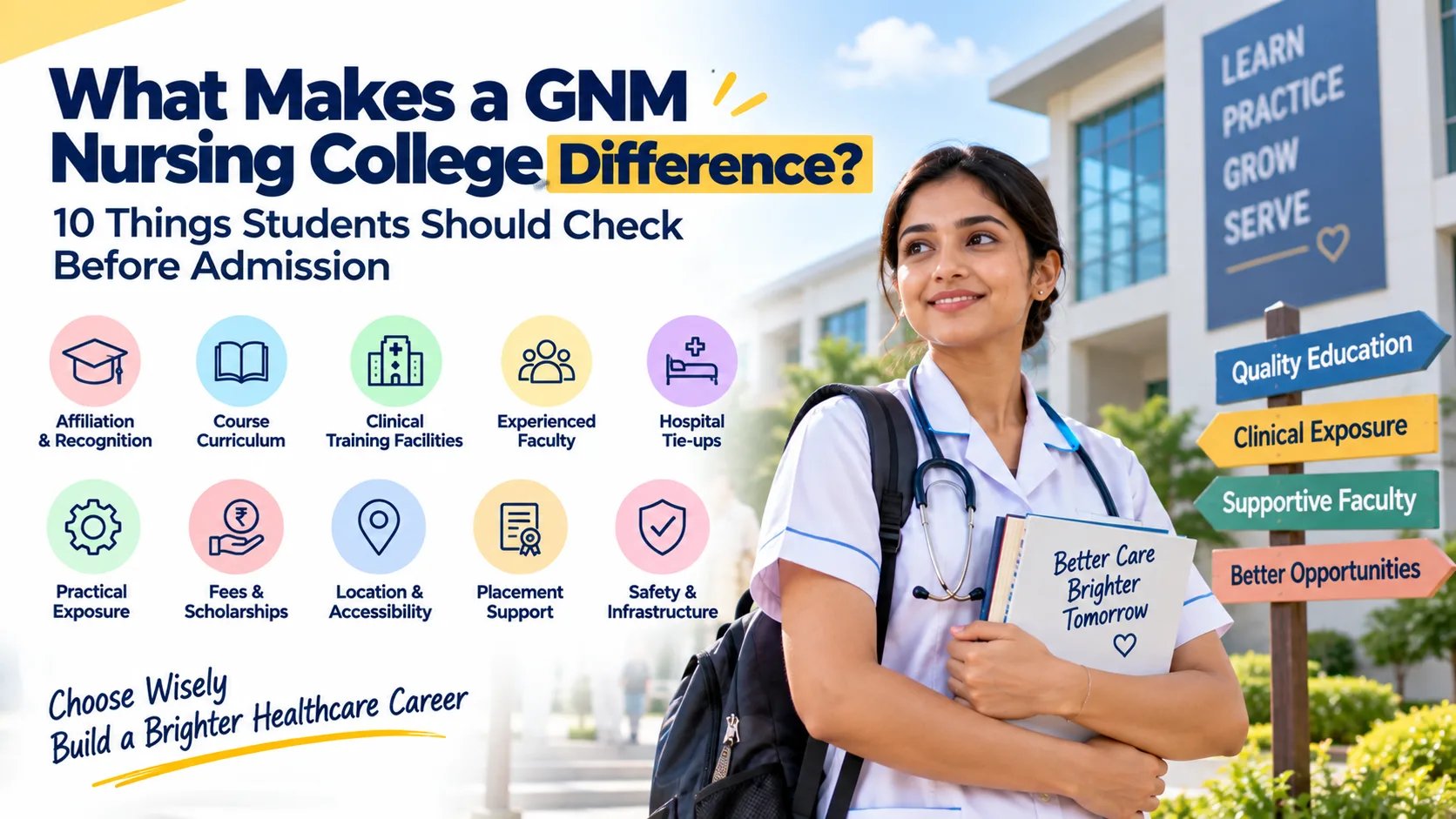
Choosing a nursing college is an important decision, especially for students who are planning their first step into healthcare education. A course may have the same name across different institutions, but the actual learning environment, practical exposure, academic support, and admission requirements can vary.
For students searching for a GNM nursing college, looking beyond the course name can help them understand what they are actually signing up for.
General Nursing and Midwifery (GNM) combines theoretical education with practical and clinical learning. The Indian Nursing Council lists GNM as a three-year nursing program, while specific admission conditions and institutional arrangements may differ depending on the college and applicable state requirements.
Here are ten practical areas students should investigate before selecting a college.
1. Check Recognition and Affiliation
The first thing to verify is whether the institution and its GNM program have the required recognition or affiliation.
Students should check the current information provided by the college and verify the relevant nursing authorities or examining bodies associated with the program.
This is more important than relying only on advertisements or third-party education websites.
Ask the college:
- Which nursing authority is associated with the program?
- Which board conducts or oversees examinations?
- What certification or registration pathway applies after completion?
- Is the current academic session covered by the stated recognition?
Taking a little time to verify these details can prevent confusion later.
2. Understand the Actual Course Structure
A GNM program is not simply a classroom-based qualification.
The curriculum includes theoretical subjects as well as practical and clinical learning.
Students should ask for information about:
- Theory classes
- Practical sessions
- Nursing skills laboratory training
- Clinical postings
- Internship or extended practical exposure
- Examination structure
- Attendance requirements
Understanding the complete structure gives students a more realistic idea of what their three years of training may involve.
3. Look at Practical Training Facilities
Nursing is a hands-on profession.
A student may understand a procedure theoretically but still need supervised practice before developing confidence in performing it correctly.
A nursing skills laboratory can provide an environment where students learn procedures before applying appropriate skills during clinical training.
When visiting a GNM nursing college in Mumbai, students can ask whether practical sessions are conducted regularly and how students are supervised.
The important question is not simply whether a college has a “lab,” but how that facility is actually used for student learning.
4. Ask About Clinical Exposure
Clinical exposure is one of the most important parts of nursing education.
It allows students to connect classroom knowledge with patient-care environments.
Students should ask:
Where do students receive clinical training?
They can also ask about the departments, healthcare settings, supervision arrangements, and approximate structure of clinical postings.
Clinical exposure can help students develop practical understanding of patient communication, observation, documentation, infection-control procedures, teamwork, and nursing responsibilities.
For anyone considering a GNM nursing course in Mumbai, this can be particularly important because the learning environment extends beyond the classroom.
5. Understand the Subjects You Will Study
Before admission, students should understand what they will actually study during the program.
GNM education covers different areas of nursing and healthcare.
Depending on the curriculum and institution, students may study areas such as:
- Anatomy and physiology
- Microbiology
- Nursing foundations
- Psychology
- Sociology
- Community health nursing
- Medical-surgical nursing
- Child health nursing
- Mental health nursing
- Midwifery
- Nursing education and administration
The purpose of studying these subjects is to build a broad foundation for patient care rather than focusing on one narrow healthcare area.
6. Don't Look at Fees in Isolation
GNM nursing fees in Mumbai can vary between institutions and may depend on the facilities, course structure, affiliation, accommodation, and other services offered.
Students should therefore ask for a complete fee breakdown rather than comparing only one advertised figure.
Questions worth asking include:
- What is the tuition fee?
- Are examination fees separate?
- Are practical or laboratory charges included?
- Is there an admission or registration fee?
- Is hostel accommodation available?
- What additional expenses should students expect?
A written fee structure is preferable because it makes comparisons easier.
Students should also confirm whether fees are annual, semester-based, or payable according to another schedule.
7. Check Eligibility Carefully
Eligibility is another area where students should avoid assumptions.
The Indian Nursing Council currently provides national-level GNM eligibility guidance, including requirements related to 10+2 education and English. However, particular institutions and state-level admission processes may apply additional conditions.
For example, Maharashtra has specific admission rules for certain public-health GNM pathways, so students should check the requirements that apply to the particular institution and admission route they are considering.
This is especially important for students from different educational backgrounds.
Instead of relying on a general statement such as “12th pass is enough,” ask the college for the current eligibility criteria applicable to your application.
8. Consider Location and Daily Travel
Mumbai is a large city, and daily travel can become a significant part of a student's routine.
A college that looks convenient on a map may involve a much longer commute during peak hours.
Students should consider:
- Distance from home
- Public transport availability
- Travel time
- Clinical posting locations
- Class timings
- Safety and convenience of the daily route
This is not only about comfort.
Long daily travel can affect the time available for study, practical preparation, assignments, and rest.
Students looking at a GNM nursing college in Mumbai should therefore consider the complete daily routine rather than only the college address.
9. Ask About Student Support
Nursing education can involve a demanding combination of theory, practical training, examinations, and clinical responsibilities.
Academic support can therefore be useful.
Before admission, students can ask how the college supports students who need additional help with subjects or practical skills.
Useful questions include:
- Are faculty available for academic guidance?
- How are practical skills demonstrated?
- How are students prepared for examinations?
- Is there support for clinical learning?
- How does the institution communicate important academic information?
The goal is to understand how students are guided throughout the program.
10. Think About What Happens After the Course
Students often focus heavily on admission and forget to investigate what comes afterward.
After completing GNM education and meeting the applicable registration requirements, graduates can explore nursing-related employment and further education pathways.
Career opportunities may exist across hospitals, clinics, community healthcare settings, nursing homes, and other healthcare organisations, depending on qualifications, registration, experience, and employer requirements.
Students should avoid colleges that make unrealistic promises about guaranteed salaries or guaranteed jobs.
Instead, ask about the type of career preparation and practical exposure provided during the course.
A Simple Checklist Before Admission
Before finalising a GNM nursing college, students can create a simple comparison sheet:
AreaWhat to CheckRecognitionCurrent recognition and affiliationDurationCurrent course durationEligibilityInstitution-specific admission criteriaCurriculumSubjects and practical componentsSkills LabFacilities and supervised practiceClinical TrainingWhere and how clinical exposure is providedFeesComplete fee structureLocationDaily travel and accessibilitySupportAcademic and practical guidanceCareer PreparationClinical and professional preparationThis approach can make the admission process more systematic.
Final Thoughts
There is no single factor that defines a good nursing education experience.
Students should look at the complete picture: recognition, curriculum, practical training, clinical exposure, fees, location, student support, and career preparation.
For students researching a GNM nursing college in Mumbai, visiting the institution and asking direct questions can be more useful than relying entirely on online advertisements.
A nursing course is a multi-year commitment. Understanding what happens inside the classroom, skills laboratory, and clinical environment before admission can help students enter the program with clearer expectations.
The right questions before admission can be just as important as the application itself.