
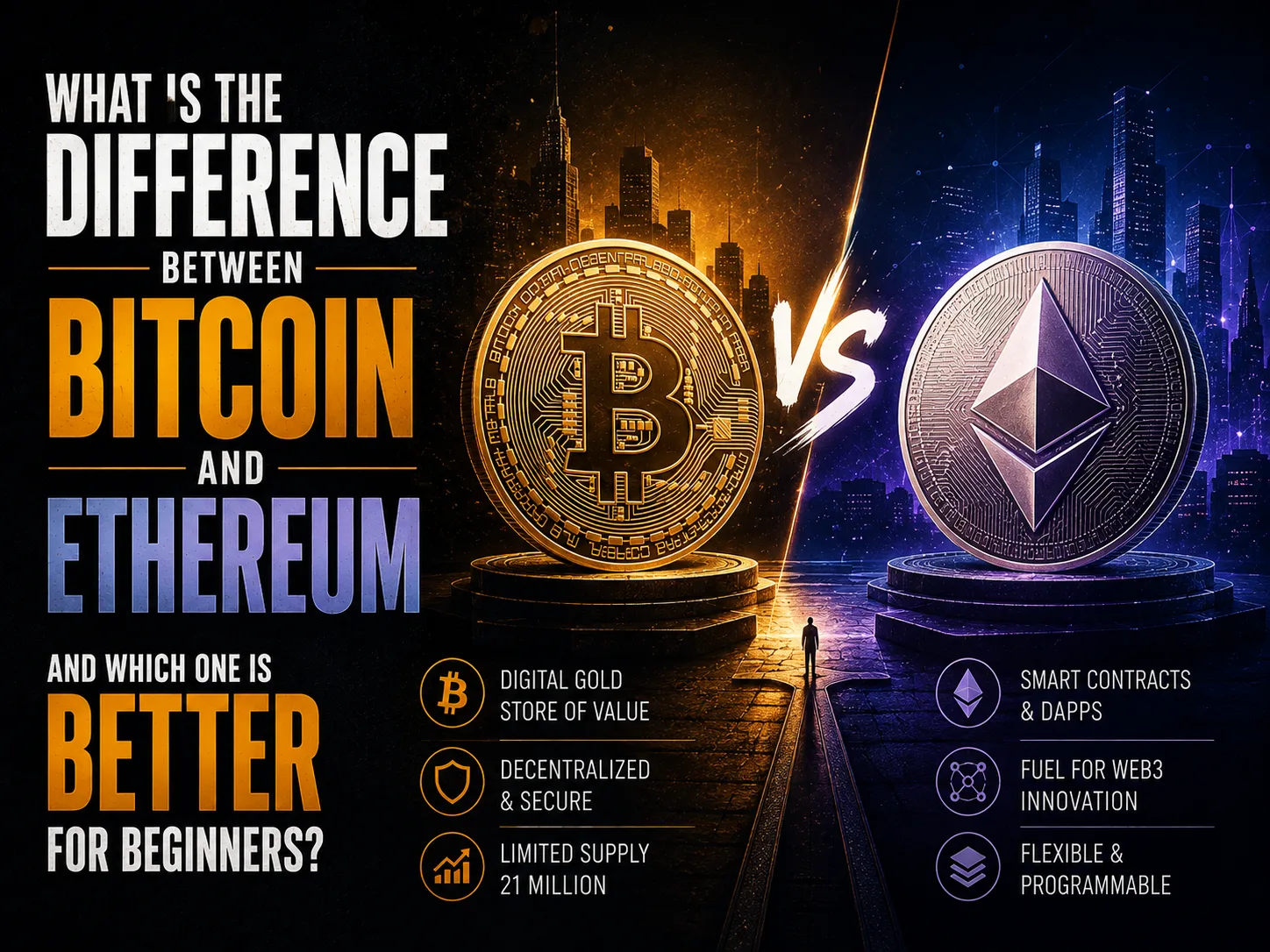
Bitcoin and Ethereum are two of the most well-known names in cryptocurrency.
If you're new to crypto, you may wonder why there are two different cryptocurrencies, what makes them different, and whether one is better than the other.
Although both operate using blockchain technology, Bitcoin and Ethereum were created with different goals.
Bitcoin was primarily designed as a decentralized digital form of money, while Ethereum was built as a programmable blockchain that can support applications, smart contracts, and digital assets.
Understanding this difference is one of the best places to start if you're trying to learn about cryptocurrency.
What Is Bitcoin?
Bitcoin is the first widely adopted cryptocurrency.
It was introduced in 2009 by the anonymous creator or group known as Satoshi Nakamoto.
The main idea behind Bitcoin was to create a form of digital money that could operate without depending on a central bank or single financial institution.
Bitcoin transactions are recorded on its blockchain, which is maintained by a decentralized network of participants.
One of Bitcoin's most recognizable characteristics is its limited supply.
The Bitcoin protocol is designed to have a maximum supply of 21 million coins.
This limited supply is one reason Bitcoin is often described as a digital asset with scarcity.
What Is Ethereum?
Ethereum is a blockchain network launched in 2015.
While Ethereum can also be used to transfer value, its purpose goes beyond digital payments.
Ethereum allows developers to build applications that operate on its blockchain.
These applications can use smart contracts, which are programs that automatically execute actions when predefined conditions are met.
Ethereum has become a foundation for many areas of the blockchain industry, including decentralized finance, NFTs, blockchain games, and other decentralized applications.
Its native cryptocurrency is called Ether, commonly referred to as ETH.
Bitcoin vs. Ethereum: The Main Difference
The easiest way to understand the difference is to look at what each network was primarily designed to do.
Bitcoin: Focuses primarily on decentralized digital money and transferring value.
Ethereum: Focuses on programmable blockchain infrastructure that can support applications and smart contracts.
This doesn't mean Bitcoin can only be used for payments or Ethereum can only be used for applications.
Both ecosystems have expanded over time.
However, their original design goals remain an important part of understanding how they differ.
How Does Bitcoin Work?
Bitcoin uses blockchain technology to record transactions.
Its network uses a consensus mechanism called Proof of Work.
In simple terms, specialized computers called miners compete to solve computational problems and help secure the network.
Successful miners can receive rewards according to Bitcoin's protocol.
The system is designed so that transactions can be verified without requiring a central organization to approve every payment.
This decentralized structure is one of Bitcoin's defining characteristics.
How Does Ethereum Work?
Ethereum also uses blockchain technology, but its network operates differently.
Ethereum uses Proof of Stake to help secure the network.
Participants can stake ETH and take part in the network's validation process under Ethereum's consensus system.
The other major difference is programmability.
Ethereum allows developers to create smart contracts and decentralized applications that operate on the network.
This has made Ethereum more than just a cryptocurrency network. It has become a platform for building blockchain-based applications.
Bitcoin and Ethereum Have Different Supply Models
Bitcoin has a maximum supply of 21 million BTC.
This predetermined limit is a central part of Bitcoin's monetary design.
Ethereum works differently.
ETH does not have the same fixed maximum supply of 21 million coins.
Its supply is influenced by factors within the Ethereum protocol, including the issuance of new ETH and the burning of some transaction fees under certain conditions.
This means the two assets have different supply characteristics.
For beginners, it's important to understand that token price alone doesn't tell you whether an asset is scarce or valuable.
Supply, demand, usage, and market conditions all matter.
What Is Bitcoin Mainly Used For?
Bitcoin is commonly viewed as a digital asset and a decentralized form of money.
People use Bitcoin for different reasons, including:
- Transferring value
- Holding it as a long-term asset
- Speculating on price movements
- Sending money across borders
- Using it as part of a diversified digital asset portfolio
Some investors also view Bitcoin as a potential hedge against certain economic conditions, although this remains a matter of debate and Bitcoin can still experience significant volatility.
What Is Ethereum Mainly Used For?
Ethereum has a much broader range of applications.
Its blockchain can support:
- Smart contracts
- Decentralized finance
- NFTs
- Decentralized applications
- Token creation
- Blockchain-based games
- Digital asset ecosystems
ETH is also used to pay transaction fees on the Ethereum network.
This means ETH has a role within the operation of the Ethereum ecosystem itself.
Which One Is More Decentralized?
Decentralization is a complicated concept because it can refer to different things.
It can involve the distribution of network participants, validators, developers, infrastructure, ownership, and decision-making.
Bitcoin has a long history of decentralized operation and a large global mining ecosystem.
Ethereum also has a large and distributed network of validators.
Rather than simply asking which one is "more decentralized," beginners should understand that the two networks use different architectures and security models.
Which One Is Faster?
Transaction speed is another area where comparisons can become misleading.
Bitcoin and Ethereum have different network designs and processing mechanisms.
Ethereum is designed to support a broader range of blockchain applications, while Bitcoin prioritizes its monetary function and security model.
Both networks have also developed additional technologies and scaling solutions that can improve how transactions and applications operate.
So instead of focusing only on the number of transactions per second, it's better to consider what each network is designed to accomplish.
Which One Is More Expensive to Use?
Transaction fees on both networks can change depending on network activity.
When many people are trying to use a blockchain at the same time, demand for block space can increase.
This can result in higher fees.
Ethereum transaction fees can be particularly important for users interacting with smart contracts and decentralized applications because those activities can require more computational resources than a simple transfer.
Bitcoin transactions also involve network fees, with costs influenced by factors such as transaction demand and block space.
Which Is More Suitable for Beginners?
That depends on what you're trying to accomplish.
If you're primarily interested in learning about cryptocurrency as a digital asset, Bitcoin may be easier to understand initially because its core purpose is relatively straightforward.
If you're interested in decentralized applications, smart contracts, DeFi, NFTs, or blockchain development, Ethereum may be more interesting.
Neither is automatically better for every beginner.
Your choice depends on your goals, risk tolerance, knowledge, and investment strategy.
Bitcoin vs. Ethereum as Investments
Bitcoin and Ethereum are both highly established cryptocurrency assets, but they have different investment characteristics.
Bitcoin's investment narrative often centers around scarcity, decentralized money, and its position as the first major cryptocurrency.
Ethereum's investment case is more closely connected to the growth and activity of its blockchain ecosystem.
Neither thesis guarantees future price performance.
Cryptocurrency prices can be extremely volatile, and both assets have experienced major price increases and declines throughout their histories.
Before investing, it can be useful to consider how an asset fits into your overall crypto portfolio management strategy rather than looking at one cryptocurrency in isolation.
What About Trading Bitcoin and Ethereum?
Both Bitcoin and Ethereum are actively traded across cryptocurrency markets.
Traders may use charts, market data, technical indicators, news, and other information when making decisions.
However, trading isn't the same as long-term investing.
Someone buying Bitcoin because they believe in its long-term potential may have a completely different strategy from a trader trying to benefit from short-term price movements.
Beginners should also be careful about using leverage or making trades based purely on social media predictions.
Understanding basic crypto trading strategies can be useful, but no strategy can guarantee that a trade will be profitable.
Which One Should a Beginner Buy?
There isn't a universal answer.
Bitcoin may appeal to someone who wants to understand the original concept of decentralized digital money.
Ethereum may appeal to someone interested in programmable blockchains and decentralized applications.
Some people choose to learn about both rather than treating the decision as an either-or choice.
The important thing is to understand what you're buying instead of choosing an asset simply because someone online says it will increase in price.
What Should Beginners Research Before Investing?
Before buying either Bitcoin or Ethereum, consider learning about:
- How the blockchain works
- The purpose of the cryptocurrency
- Supply and demand
- Market capitalization
- Network activity
- Security
- Development
- Adoption
- Risks
- Historical volatility
It's also worth understanding how cryptocurrency wallets work and how to protect your assets after purchasing them.
The more you understand about the underlying technology and risks, the easier it becomes to make decisions based on information rather than hype.
Final Thoughts
Bitcoin and Ethereum are both important parts of the cryptocurrency ecosystem, but they were designed with different goals.
Bitcoin focuses primarily on decentralized digital money and has a fixed maximum supply of 21 million BTC.
Ethereum is a programmable blockchain designed to support smart contracts and decentralized applications, with ETH serving as its native asset.
For beginners, neither cryptocurrency is automatically "better."
Bitcoin may be easier to understand if you're interested in digital money and scarcity, while Ethereum may be more appealing if you're interested in blockchain applications and smart contracts.
The best starting point isn't asking which cryptocurrency will make you the most money.
It's understanding why each one exists, how it works, and what risks come with owning it.