Colleges and universities generate enormous amounts of data every day — from student applications and admissions to attendance, academic performance, engagement, fees, alumni interactions, and career outcomes.
But having data is not the same as being able to use it effectively.
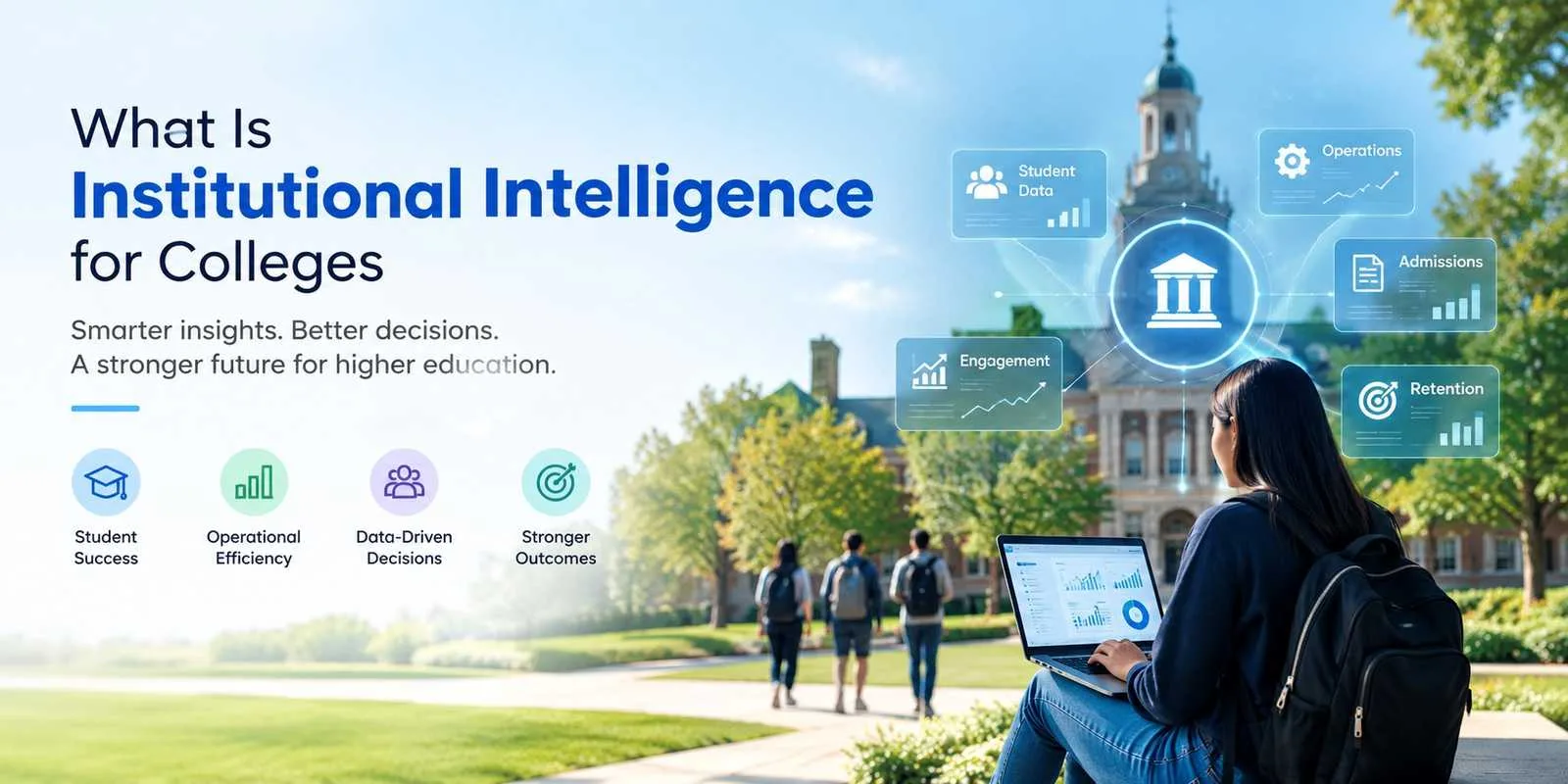
Institutional Intelligence (II) helps colleges bring their data, processes, and people together to create a more complete understanding of how the institution is performing. It enables higher education leaders to move beyond isolated reports and make more informed, timely decisions.
In simple terms, Institutional Intelligence helps a college turn its data into actionable institutional insight.
Understanding Institutional Intelligence
Institutional Intelligence refers to the use of integrated data, analytics, technology, and institutional knowledge to understand and improve different aspects of a college or university.
It brings together information from multiple areas of an institution, such as:
- Admissions and enrollment
- Student engagement
- Academic performance
- Attendance and retention
- Finance and fee management
- Student services
- Faculty and staff operations
- Alumni relations
- Career outcomes
- Institutional performance
Instead of looking at each department separately, Institutional Intelligence provides a broader view of the institution.
For example, an admissions team may see that applications have increased. But Institutional Intelligence can help leaders explore the bigger picture: Which programs are attracting students? Which channels generate the most qualified applicants? How do these students perform after enrollment? Are certain groups more likely to remain engaged or graduate?
This broader perspective can help institutions identify patterns that individual systems may not reveal.
Why Is Institutional Intelligence Important for Colleges?
Higher education has become increasingly data-driven. Colleges need to manage growing student expectations, changing enrollment patterns, operational complexity, and pressure to demonstrate outcomes.
Traditional spreadsheets and disconnected systems can make this difficult.
Institutional Intelligence can help colleges address these challenges by creating a more connected information environment.
1. Better Student Insights
A student's journey involves many interactions with an institution.
Institutional Intelligence can connect information across recruitment, admissions, enrollment, academics, student services, and engagement.
This gives institutions a more comprehensive view of the student journey and can help identify students who may need additional support.
2. Smarter Enrollment Management
Enrollment teams need to understand what is happening throughout the recruitment funnel.
Institutional Intelligence can help colleges analyze:
- Inquiry-to-application conversion
- Application-to-enrollment conversion
- Program-level demand
- Recruitment channel performance
- Geographic trends
- Student demographics
- Enrollment patterns over time
These insights can support more informed enrollment planning.
3. Improved Student Retention
Retention is influenced by multiple factors rather than a single data point.
Academic performance, attendance, engagement, financial circumstances, and interactions with support teams can all provide useful signals.
By connecting these datasets, colleges can gain a more complete picture of student engagement and identify areas where intervention may be appropriate.
4. More Effective Institutional Planning
Institutional leaders need reliable information to plan programs, allocate resources, and evaluate institutional performance.
Instead of relying solely on retrospective reports, Institutional Intelligence can provide dashboards and analytics that make important trends easier to understand.
This can support planning around:
- Program demand
- Faculty requirements
- Student services
- Resource allocation
- Enrollment targets
- Operational performance
5. Stronger Data-Driven Decision-Making
One of the biggest benefits of Institutional Intelligence is creating a common foundation for decision-making.
When departments work with disconnected data, different teams may have different interpretations of institutional performance.
A connected intelligence framework can help establish more consistent, accessible information across the institution.
The Role of AI in Institutional Intelligence
Artificial intelligence is adding another dimension to Institutional Intelligence.
AI can help institutions analyze large volumes of information, identify patterns, summarize data, and support employees in finding relevant insights more quickly.
For example, AI-powered systems can potentially help staff understand:
- Which students require additional engagement
- Which communication approaches are generating responses
- Where applicants are dropping out of the admissions journey
- Which student segments show changing engagement patterns
- What questions students are asking most frequently
However, AI should complement institutional expertise rather than replace it. Colleges still need appropriate governance, data quality, privacy controls, and human oversight.
From Institutional Data to Institutional Intelligence
There is an important difference between institutional data and institutional intelligence.
Data might tell a college that 5,000 students are currently enrolled.
Intelligence helps the institution understand the broader context around that number — such as enrollment trends, program-level changes, student engagement, and related institutional factors.
The journey can be viewed as:
Data → Integration → Analysis → Insight → Action
The goal is not to create more dashboards simply for the sake of reporting. The goal is to make institutional information more useful to the people responsible for improving student and institutional outcomes.
How CRM Platforms Can Support Institutional Intelligence
A modern higher education CRM can play an important role in an institution's intelligence strategy.
A CRM can bring together interactions across prospective students, applicants, enrolled students, parents, alumni, and other stakeholders.
This can provide institutions with a connected view of relationships and engagement throughout the lifecycle.
For colleges exploring this approach, platforms such as Talisma provide capabilities designed around higher education engagement and relationship management. By connecting student and stakeholder interactions across the lifecycle, a platform like Talisma can contribute to the broader data foundation institutions use for reporting, analytics, and informed decision-making.
The important point is that Institutional Intelligence does not necessarily require colleges to replace every existing system. It can involve connecting existing information and making it more accessible and actionable.
What Should Colleges Consider Before Implementing Institutional Intelligence?
Technology is only one part of the equation. Institutions should also consider several foundational areas.
Data Quality
Inaccurate, duplicated, or incomplete data can undermine analytics. Establishing clear data standards is essential.
Data Integration
Information often exists across multiple systems. Institutions need appropriate integration strategies to create a more connected view.
Governance and Privacy
Higher education institutions handle sensitive student and institutional information. Appropriate access controls, governance policies, and privacy practices are critical.
User Adoption
Even sophisticated analytics platforms provide limited value if staff and decision-makers do not use them. Interfaces should be accessible and insights should be relevant to everyday workflows.
Clear Institutional Goals
Colleges should first identify the decisions they want intelligence to improve. Technology should support those goals rather than becoming the goal itself.
The Future of Institutional Intelligence in Higher Education
Institutional Intelligence is evolving from traditional business intelligence and reporting toward more connected, AI-assisted decision support.
Future higher education environments are likely to place greater emphasis on:
- Real-time institutional insights
- AI-assisted analytics
- Predictive and trend analysis
- Personalized student engagement
- Cross-department data integration
- Automated reporting
- Student lifecycle intelligence
- Stronger data governance
For colleges, the opportunity is significant: instead of treating data as something primarily used for reports, institutions can make it part of everyday decision-making.
Final Thoughts
Institutional Intelligence for colleges is ultimately about connecting information to institutional action.
When admissions, academics, student engagement, finance, services, and alumni information can be understood together, institutions gain a more comprehensive perspective on their operations and the student journey.
The right technology can provide the foundation, but successful Institutional Intelligence also depends on data quality, integration, governance, and people.
For colleges looking to strengthen this foundation, a higher education CRM such as Talisma can be one component of a broader institutional intelligence strategy — helping institutions connect stakeholder interactions and create a more unified view of the student lifecycle.