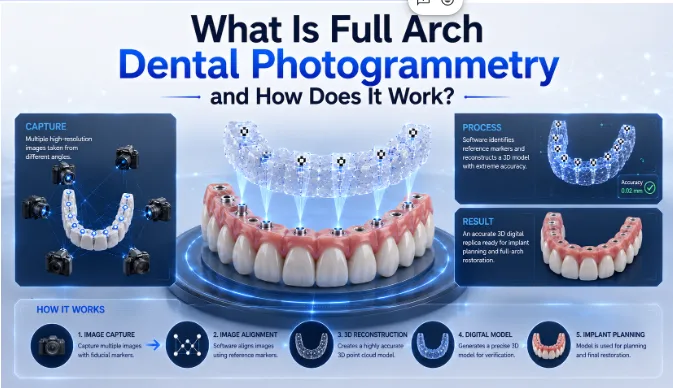
Full arch dental photogrammetry is a digital technique used to capture the precise three-dimensional relationship between multiple implants in a complete-arch restoration. Instead of relying only on conventional impressions or long-span intraoral scans, photogrammetry uses optical imaging and reference components to record implant positions and transfer that information into a digital workflow.
It is particularly useful in All-on-X (AOX) cases, where the accurate relationship between multiple implants is critical for prosthetic design, verification, and final fit.
What Is Dental Photogrammetry?
Dental photogrammetry is a method of recording the spatial position of implants using specialized optical cameras and implant reference components.
The system captures the position of each implant and calculates its relationship to the other implants. This creates a digital implant-position record that can be combined with other clinical datasets.
A typical digital full-arch case may involve:
- Implant position data
- Intraoral scans
- CBCT imaging
- Soft-tissue information
- Prosthetic designs
- CAD/CAM files
The purpose is to create a coordinated digital representation of the patient's anatomy, implant positions, and intended restoration.
Why Is Photogrammetry Important for Full-Arch Implant Cases?
Full-arch cases present a particular challenge because several implants must be accurately represented within one prosthetic framework.
With a long-span scan, small registration errors can potentially accumulate as the scanner moves across the arch. Photogrammetry addresses implant-position capture differently by recording the spatial relationship between implant reference components.
This makes it particularly useful when the primary objective is accurate implant positioning rather than simply capturing surface anatomy.
In simple terms: intraoral scanning captures the surfaces, while photogrammetry is primarily used to capture the spatial relationship of implants.
How Does Full Arch Dental Photogrammetry Work?
The workflow generally involves several stages.
1. Reference Components Are Connected to the Implants
Specialized scan bodies or photogrammetry markers are attached to the implants.
These components provide identifiable reference geometry that the imaging system can recognize.
2. The Implant Positions Are Captured
A dedicated photogrammetry camera captures the reference components from different angles.
The system determines the three-dimensional position of each implant and its relationship to the others.
3. A Digital Implant Map Is Generated
The captured information is converted into a digital representation of the implant positions.
This dataset can then be transferred to compatible digital planning or CAD software.
4. Other Digital Records Are Added
The implant-position data can be combined with additional records, such as:
- Intraoral scans
- CBCT data
- Facial scans
- Digital wax-ups
- Prosthetic designs
This allows the laboratory and clinical team to work from a more complete digital dataset.
5. Prosthetic Planning Begins
Once the implant positions have been accurately registered, the laboratory can use that information to develop the prosthetic design.
The objective is to maintain the correct implant relationship throughout CAD design and manufacturing.
Full Arch Photogrammetry vs. Intraoral Scanning
Photogrammetry and intraoral scanning are often complementary rather than competing technologies.
PhotogrammetryIntraoral ScanningPrimarily records implant positionsCaptures oral surface anatomyUses specialized reference componentsUses optical surface scanningParticularly useful for multiple implantsUseful for teeth and soft tissueProduces implant-position dataProduces a digital surface modelCan be integrated with IOS and CBCTCan be integrated with photogrammetryThis combination can be particularly valuable in full-arch digital dentistry because the two technologies provide different types of information.
What Role Does Photogrammetry Play in AOX Workflows?
All-on-X treatment requires multiple implants to support one complete-arch prosthesis. Consequently, accurate implant-position information is essential for prosthetic-driven treatment planning.
A digital AOX workflow may include:
- Implant placement
- Implant position capture
- Photogrammetry
- Intraoral scanning
- CBCT imaging
- Digital treatment planning
- Prosthetic CAD design
- Verification
- Manufacturing
- Final delivery
The goal is to maintain accurate digital information from the clinical stage through prosthesis fabrication.
For a broader overview, this guide to full-arch digital workflows and AOX integration explains how different digital technologies can work together within a complete-arch workflow.
What Are the Benefits of Full-Arch Photogrammetry?
When properly implemented, photogrammetry can provide several advantages for full-arch implant workflows.
Accurate Implant Position Capture
The technology is specifically designed to record the spatial relationship between multiple implants.
Reduced Dependence on Long-Span Scanning
Instead of relying entirely on sequential surface scanning across an edentulous arch, photogrammetry directly records implant reference positions.
Better Laboratory Communication
A dedicated implant-position dataset gives the laboratory a clear digital reference for prosthetic planning.
Efficient Digital Integration
Photogrammetry data can be combined with intraoral scans and CBCT information to support a comprehensive digital workflow.
Improved Prosthetic Planning
Accurate implant coordinates provide an important foundation for designing implant-supported frameworks and full-arch restorations.
Does Photogrammetry Eliminate the Need for Verification?
No. Photogrammetry can improve implant-position capture, but it does not eliminate the need for verification.
The digital record still needs to be evaluated to ensure that it accurately represents the clinical situation.
Verification can help identify:
- Registration discrepancies
- Incorrect implant data
- Dataset alignment problems
- Framework-related issues
- Communication errors
This is an important distinction: photogrammetry improves data capture, while verification confirms that the captured information is suitable for the next stage of treatment.
Why Reference Markers Matter
Photogrammetry depends on recognizable reference geometry. If markers or reference components are incorrectly positioned, contaminated, damaged, or inadequately captured, the quality of the resulting implant-position dataset can be affected.
This is why dedicated reference systems have become an important part of many digital full-arch workflows.
For example, dental fiducial marker systems for full-arch digital implant workflows provide reference geometry that can support accurate digital registration and implant-position workflows.
What Factors Affect Photogrammetry Accuracy?
Photogrammetry accuracy depends on the complete workflow, not simply the camera or software.
Important factors include:
- Correct reference-component positioning
- Device calibration
- Clean reference surfaces
- Proper image acquisition
- Compatible software
- Accurate dataset registration
- Appropriate clinical protocols
Research has demonstrated that photogrammetry can provide highly accurate implant-position records, while also emphasizing that results can vary depending on the specific system and workflow.
The National Center for Biotechnology Information (NCBI) provides access to research examining the accuracy and clinical applications of digital implant technologies.
Frequently Asked Questions
What is full arch dental photogrammetry?
Full arch dental photogrammetry is a digital technique used to record the three-dimensional positions and spatial relationships of multiple implants across a complete dental arch.
Is photogrammetry more accurate than intraoral scanning?
Photogrammetry can provide highly accurate implant-position records in full-arch cases. However, accuracy depends on the specific system, workflow, and clinical conditions. It should not be viewed as universally replacing intraoral scanning.
Can photogrammetry replace traditional impressions?
It can provide a digital alternative for recording implant positions in appropriate full-arch workflows. However, the need for other clinical records and verification depends on the specific treatment protocol.
Is photogrammetry useful for All-on-X?
Yes. Because AOX restorations depend on the accurate relationship between multiple implants, photogrammetry can be particularly useful for recording implant positions before prosthetic design.
Does photogrammetry replace intraoral scanning?
Not necessarily. The technologies often complement one another. Photogrammetry can capture implant positions, while intraoral scanning records surface anatomy and soft-tissue information.
Final Takeaway
Full arch dental photogrammetry provides a dedicated way to capture the three-dimensional relationship between multiple implants, making it especially valuable for full-arch and AOX restorative workflows.
Its greatest value comes when it is used as part of a coordinated digital workflow rather than as an isolated technology. Combining accurate implant-position capture with intraoral scanning, CBCT, prosthetic-driven planning, and verification allows clinicians and dental laboratories to work from more complete and consistent digital information.
As full-arch implant dentistry continues to move toward digital treatment planning and CAD/CAM fabrication, photogrammetry is becoming an increasingly important tool for transferring accurate implant information from the clinical environment into the prosthetic workflow.