If you're building a product brand, there's a good chance the factory making it won't carry your name. Mixer jars, RO water tanks, stand mixer bowls and car exhaust parts are usually made by specialist original equipment manufacturers, then sold under the brand on the box. Knowing how that model works helps you pick the right partner and negotiate a better deal.
The term trips people up because it gets used in two different ways. Let's untangle it.
What OEM means
An original equipment manufacturer (OEM) makes parts or finished products that another company sells under its own brand. The brand supplies the drawings and specifications. The OEM supplies the factory, the tooling and the people who know how to run them.
Here's the twist. In the car industry, "OEM" usually means the carmaker itself, such as Maruti Suzuki, Tata Motors or Hyundai. That's the company that designs the vehicle and sells it under its badge. The businesses that supply its parts are called suppliers or component manufacturers, and "OEM parts" means parts built to the carmaker's original spec.
Both uses are correct. The context tells you which one is meant.
OEM, ODM, OBM and aftermarket compared
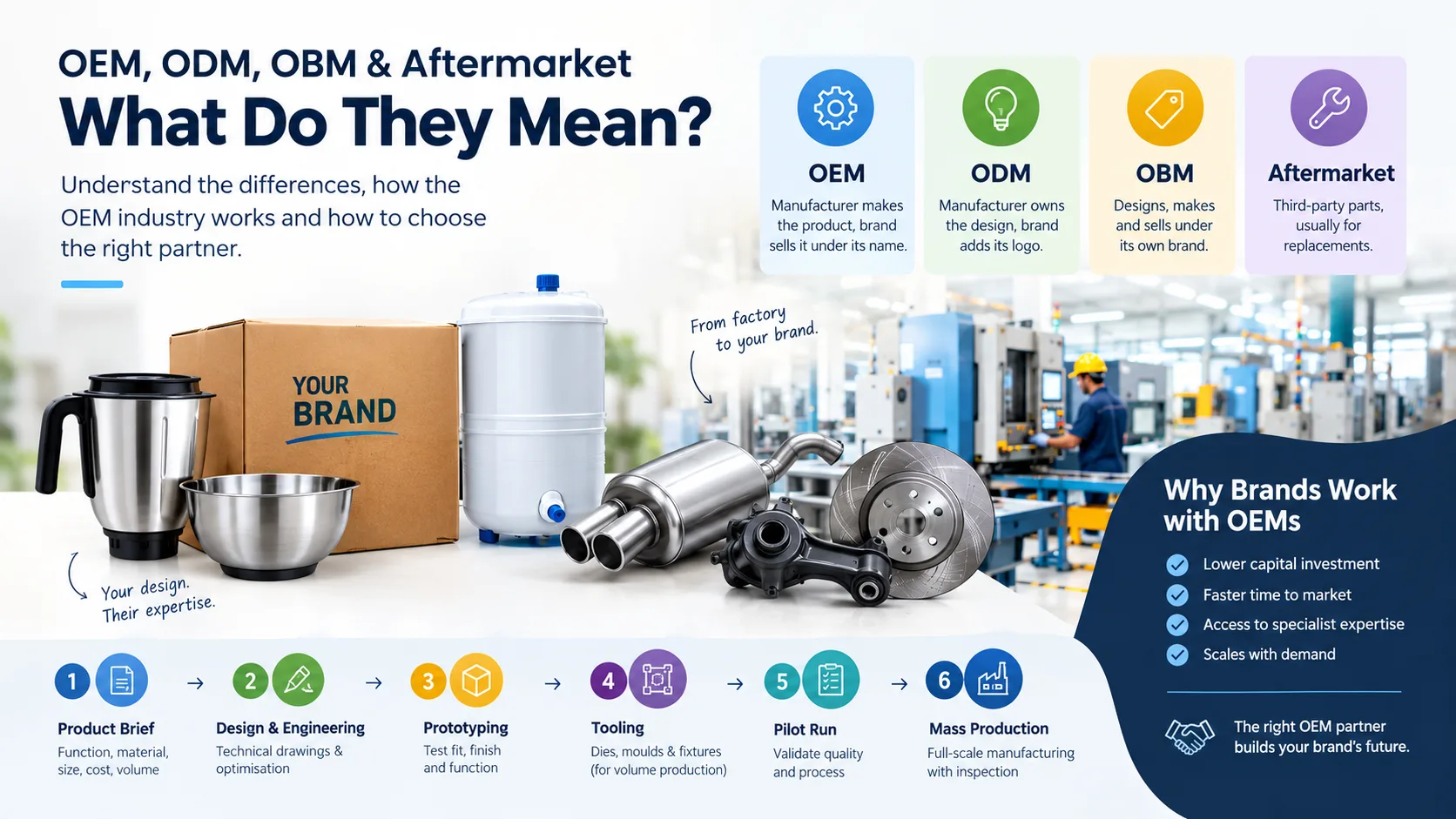
In an OEM arrangement, the buyer designs the product, the manufacturer makes it, and it carries the buyer's brand. An appliance brand ordering steel mixer jars built to its own drawings is a typical case.
With an ODM (original design manufacturer), the manufacturer owns the design and the buyer adds its brand. Think of a retailer picking a ready-designed kettle from a catalogue and putting its logo on it.
An OBM (original brand manufacturer) designs, makes and sells products under its own label.
Aftermarket parts are designed and made by a third party, usually as replacements. Car parts that aren't built to the carmaker's original spec fall into this group.
In practice the lines blur. Many manufacturers run OEM, ODM and OBM work side by side in the same plant.
How the OEM industry works
The split is simple. Brands own the design, the marketing and the customer. OEMs own the factory floor: the presses, welding lines, tooling and quality checks.
These relationships tend to last for years. Switching suppliers means building new tooling, re-qualifying parts and risking delays, so brands look for partners they can stay with. Contracts usually fix specifications, tolerances, volumes, pricing and inspection rules.
The scale is large. India's auto component industry alone, much of it OEM supply, recorded a turnover of ₹7.6 lakh crore (USD 85.9 billion) in FY2025–26, up 12.7% on the previous year, according to ACMA. Home appliances, consumer electronics and kitchen equipment add a great deal more.
The OEM process, step by step
Most OEM projects follow the same path from idea to production line.
- Product brief. The brand shares what it needs: function, size, material, target cost and volumes.
- Design and engineering. The OEM turns the brief into technical drawings, and often suggests changes that make the part easier or cheaper to produce.
- Prototyping. Samples are made quickly to test fit, finish and function.
- Tooling. Dies, moulds and fixtures are built for volume production. This is usually the biggest upfront cost.
- Pilot run. A small batch proves the process and the quality before full commitment.
- Mass production. Full-scale manufacturing begins, with inspection at every stage.
Why brands work with OEMs
Building a factory is expensive and slow. Working with an OEM lets a brand launch products without that capital, and get to market faster because the equipment and skills already exist. It also brings in specialist know-how. A company that has formed stainless steel for decades will usually do it better than a brand learning from scratch. And when demand jumps, a good OEM can scale up without the brand hiring a single extra worker.
What to look for in an OEM partner
Start with process match. Does the manufacturer do the critical steps in-house, such as cutting, forming, welding and finishing, or does it subcontract them? Every handover is a place where quality can slip.
Check the quality systems next. ISO 9001 is the baseline. For automotive parts, IATF 16949 certification is usually expected, and you should ask about inspection tools such as coordinate measuring machines (CMM).
Material control matters more than most buyers expect. A manufacturer that controls its raw material is less exposed to grade substitutions and supply shocks. In stainless steel, for example, Jindal Lifestyle makes OEM components such as mixer jars, RO water tanks and gastronorm pans for appliance and kitchen brands, using steel from its parent group, Jindal Stainless.
Finally, look at capacity headroom and communication. You want a partner with room to grow your volumes and an engineering team that picks up the phone.
Quick answers to common questions
Are OEM parts better than aftermarket parts? They're made to the original specification, so fit and performance are predictable. Aftermarket quality varies widely; some is excellent, some isn't.
Is OEM the same as white label? Not quite. White label (closer to ODM) means rebadging a ready-made product. OEM means the product is built to your design.
Who owns the design in an OEM deal? Usually the brand, but spell it out in the contract, along with who owns the tooling.