Introduction
India is rapidly becoming a global hub for aviation, space research, and defense manufacturing. If you have ever dreamed of designing aircraft or building spacecraft, a B.Tech Aerospace Engineering program can make that ambition a reality. Established in 2001, the Indian Institute for Aeronautical Engineering and Information Technology (IIAEIT), Pune, has been at the forefront of this mission, developing industry-ready aerospace engineers for over two decades. Choosing the best aerospace engineering college in India is the single most important decision you will make on this path. As aerospace engineering shapes everything from commercial aviation to ISRO missions, students are increasingly exploring colleges in Pune and across India. This guide walks you through every step, from the aerospace engineering entrance exam to career scope and salary potential.
Why Aerospace Engineering is a Future-Ready Career
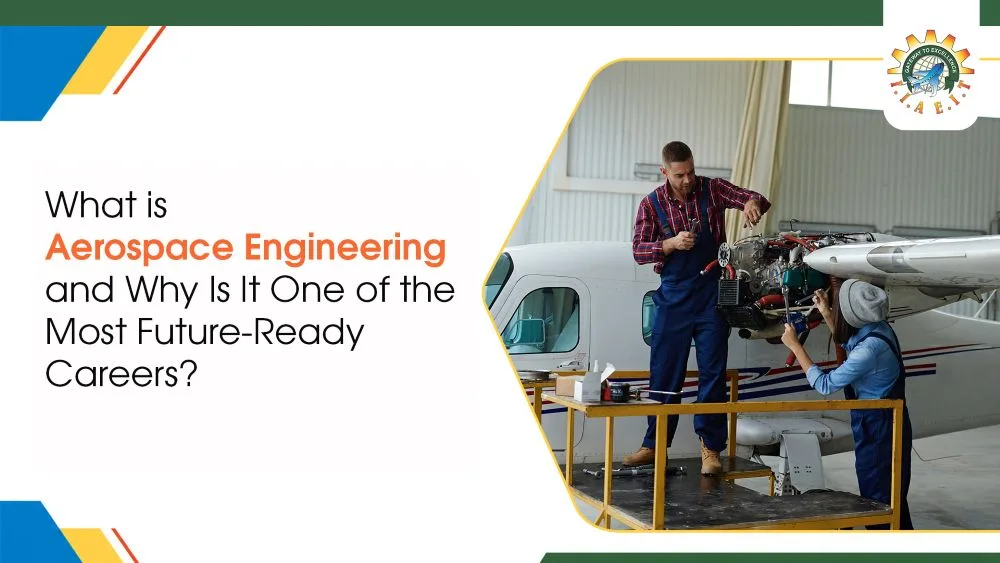
Aerospace engineering sits at the crossroads of innovation, national ambition, and cutting-edge technology. Several powerful forces are driving demand for skilled aerospace engineers in India today:
- Aviation Industry Growth: India is on track to become the world's third-largest aviation market, generating significant demand for engineering talent across design, maintenance, and operations.
- Space Exploration Opportunities: With ISRO scaling its ambitions and India's space sector opening to private organizations, opportunities for aerospace engineers have expanded dramatically.
- Defense Sector Expansion: Initiatives like Aatmanirbhar Bharat are fuelling rapid growth in indigenous defense aerospace manufacturing, missile technology, and naval systems.
- Emerging Technologies: The rise of drones, UAVs, and autonomous systems is creating entirely new engineering career paths that did not exist a decade ago.
For students with strong foundations in mathematics, physics, and problem-solving, aerospace engineering offers a career that is both intellectually stimulating and nationally significant.
B.Tech Aerospace Engineering Course Structure
The B.Tech Aerospace Engineering program at IIAEIT Pune spans 4 years (8 semesters). The industry-oriented curriculum perfectly bridges foundational engineering principles with advanced applications in Aeronautical Engineering and Space Technology.
What You Learn in a B.Tech Aerospace Engineering Program
The B.Tech Aerospace Engineering program at IIAEIT, Pune, integrates core aeronautical engineering with space technology, giving students comprehensive training across both domains. The curriculum is designed to develop technical competence in the design, development, analysis, testing, and manufacturing of aircraft, spacecraft, and advanced aerospace systems. Key subjects include:
- Aerodynamics: Study of airflow behavior, Computational Fluid Dynamics (CFD), wind tunnel testing, and aerodynamic optimization.
- Propulsion Systems: Fundamentals of aircraft propulsion, jet engines, rocket propulsion, combustion processes, and performance analysis.
- Aerospace Structures and Materials: Structural analysis, composite materials, fatigue and fracture mechanics, and lightweight structural design.
- Flight Mechanics and Control: Aircraft stability, control systems, performance calculations, and trajectory analysis for aircraft and spacecraft.
- Space Engineering: Orbital mechanics, satellite systems, launch vehicle technology, space mission design, and space environment studies.
Beyond classroom instruction, the program at IIAEIT emphasizes hands-on projects, MOOCs, industrial certifications, and annual internships to ensure students graduate with skills immediately applicable in industry.
Aerospace Engineering Entrance Exam and Admission Process
How can I get admission to an aerospace engineering course after 12th? The process is more accessible than many students expect. To secure admission to a B.Tech Aerospace Engineering program, here is what you need to do:
- Complete Class 12 with Physics, Chemistry, and Mathematics, securing at least 45% marks in these subjects combined (40% for reserved categories). A 3-year Diploma in Engineering is also accepted.
- Appear for an aerospace engineering entrance exam. IIAEIT conducts its own entrance test called SPACE-CET, which also serves as the gateway to merit-based scholarships.
- Apply through one of three routes: online registration for SPACE-CET, a campus counseling session and interview, or direct admission through the online portal.
- Successful applicants receive an admission offer letter, followed by signing the Acceptance of Admission Form to confirm enrolment.
Choosing the right college to appear for your aerospace engineering entrance exam is as important as the preparation itself. Infrastructure, faculty credentials, and placement outcomes should all factor into your decision.
Career Opportunities After Aerospace Engineering
Aerospace engineering graduates are among the most sought-after professionals in India's high-growth sectors. The career paths available are diverse and rewarding.
Aviation Industry
Airlines, MRO organizations, and global aviation OEMs actively recruit aerospace engineers for roles in design, quality, and technical operations. IIAEIT alumni have secured positions at organizations such as SpiceJet, AirAsia, Airbus, and Safran Helicopter Engines, among others.
Space Research and Exploration
ISRO remains the most prestigious destination for aerospace graduates in India. IIAEIT alumni have gone on to work as scientists at the Aeronautical Development Agency in Bengaluru, reflecting the caliber of talent the institute produces.
Defense and Aerospace Manufacturing
Organizations like DRDO and HAL offer roles in the development of defense aircraft, missile systems, and advanced research. IIAEIT graduates have joined companies such as Paras Defense and Space Technologies Ltd and Godrej Aerospace, working in roles from operations management to manufacturing engineering.
Emerging Fields Like Drones and UAVs
The drone and UAV sector is growing at an exceptional pace. IIAEIT's curriculum explicitly covers UAV systems and autonomous technologies, ensuring graduates are prepared for this fast-evolving segment of the aerospace industry.
Aerospace Engineering Salary and Industry Demand
What is the salary of an aerospace engineer in India? The aerospace engineering salary varies by experience, specialization, and employer type, but the trajectory is consistently upward:
- Fresher Opportunities: Entry-level aerospace engineers in India typically earn between INR 4 to 7 LPA in the private sector. Government roles with ISRO, DRDO, or HAL offer additional benefits and long-term stability.
- Mid-Level Growth: With 3 to 5 years of experience, aerospace engineering salary packages commonly rise to INR 10 to 18 LPA, depending on the organization and area of specialization.
- Global Opportunities: IIAEIT's collaborations with UK and US universities open pathways to international aerospace careers, where salary potential increases significantly.
Is aerospace engineering a good career? Without question. With 200+ placements and a 100% placement support commitment, IIAEIT's track record demonstrates the real-world demand for qualified aerospace engineers in India and abroad.
Why Students Are Exploring Aerospace Engineering Colleges in Pune and Across India
When evaluating aerospace engineering colleges in Pune and across India, students are increasingly looking beyond rankings to focus on what truly prepares them for a career. Here is what sets IIAEIT apart:
- Industry Exposure: IIAEIT's programs include annual internships, field projects, and direct access to industry experts. Recruiters include global names such as Qatar Airways, Emirates, Bombardier Aerospace, Capgemini, and Southwest Airlines.
- Advanced Laboratory Facilities: The institute offers state-of-the-art labs for aerodynamics, propulsion, and flight simulation, along with access to specialized tools like CFD software and 3D modeling platforms.
- Strong Placement Support: The dedicated Training and Placement Cell at IIAEIT provides 100% placement assistance, covering interview coaching, professional profile development, and technical skill enhancement.
- Expert Faculty: The department is led by faculty, including the Head of Department, Dr M. Suresh Kumar, who holds a PhD in Avionics Systems, has published 22 research papers, and brings deep industry and teaching experience.
- Global Academic Collaborations: As a pioneer in aviation education in Western Maharashtra, IIAEIT operates under the Shastri Group of Institutions and has tie-ups with UK and US universities, ensuring students meet global academic standards.
Conclusion: Your Journey to the Skies Starts Here
Aerospace engineering is one of the most exciting and future-proof career choices available to engineering aspirants in India today. The aviation, space, and defense sectors are expanding rapidly, requiring skilled, industry-ready engineers. Your aerospace engineering salary, career opportunities, and professional growth are all directly tied to the quality of education and training you receive from day one.
From understanding the aerospace engineering entrance exam to selecting from the best aerospace engineering colleges in Pune, every decision matters. IIAEIT, Pune, established in 2001 and backed by global academic partnerships and a 200+ placement record, offers students an industry-oriented path into one of India's most exciting engineering disciplines. If you are serious about becoming a part of India's aerospace future, the best aerospace engineering college in India is not just where you study. It is where your career begins to take flight.