
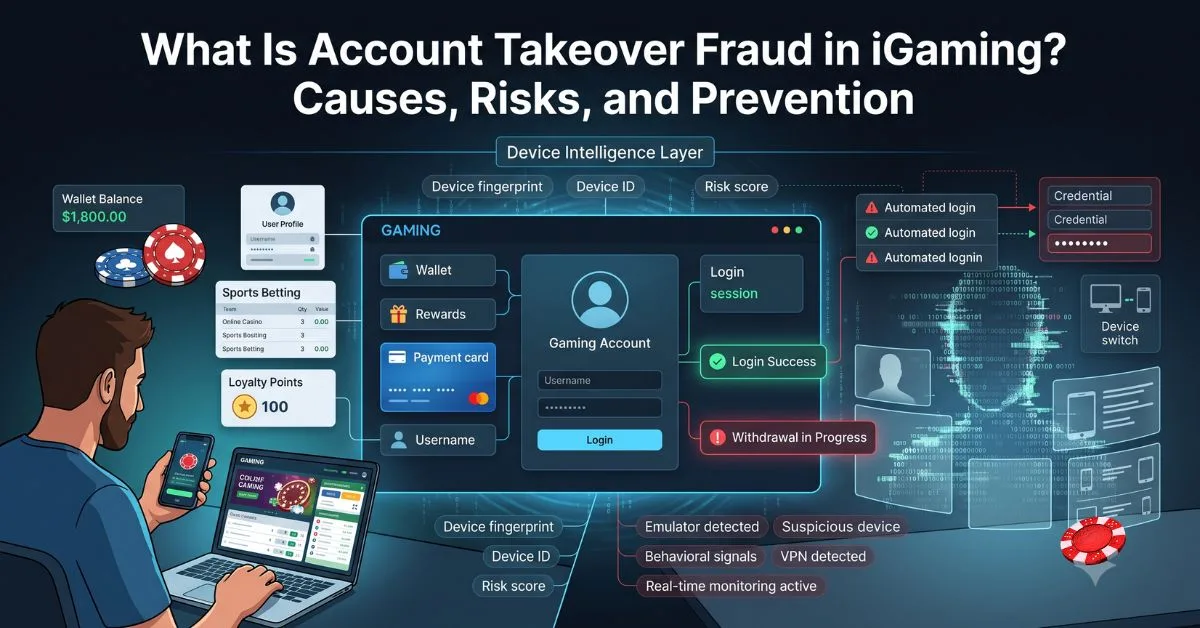
The iGaming industry thrives on speed and convenience. Players expect instant logins, seamless gameplay, and quick withdrawals, while operators focus on delivering engaging experiences that keep users coming back. However, these same advantages have also made online gaming platforms an attractive target for fraudsters.
One of the fastest-growing threats facing the industry today is account takeover fraud in iGaming (ATO). Instead of creating fake accounts, fraudsters compromise legitimate player accounts using stolen credentials, giving them access to wallet balances, loyalty rewards, payment methods, and valuable gaming histories. Since these attacks originate from genuine accounts, they can be difficult to detect until financial losses have already occurred.
The impact extends beyond stolen funds. Successful account takeover attacks can damage player trust, increase chargebacks, trigger compliance concerns, and place additional pressure on fraud and customer support teams.
In this guide, we'll explain what account takeover fraud in iGaming is, why gaming platforms have become prime targets, how these attacks work, and the strategies operators can use to prevent them.
What Is Account Takeover Fraud in iGaming?
Account takeover fraud (ATO) occurs when a fraudster gains unauthorized access to an existing player's account and uses it for fraudulent activities.
Unlike account creation fraud, where criminals register fake accounts to exploit promotions, iGaming account takeover targets genuine player accounts that already have an established history and financial value.
Once attackers gain access, they can perform actions such as:
- Withdraw wallet balances
- Redeem loyalty points or VIP rewards
- Change payment or contact details
- Abuse promotional offers
- Transfer virtual assets
- Sell valuable gaming accounts
Because fraudsters use valid login credentials, their activity often appears legitimate during the initial login. This makes account takeover significantly harder to detect than many other forms of online gaming fraud.
For operators, every successful ATO attack represents more than a financial loss—it can also result in reduced player confidence, increased operational costs, and long-term reputational damage.
Why Is iGaming a Prime Target for Account Takeover Fraud?
While account takeover affects many digital businesses, online gaming platforms present a uniquely attractive opportunity for fraudsters because they combine valuable player accounts with real-time financial transactions.
High-Value Accounts
Many iGaming accounts contain deposited funds, accumulated winnings, loyalty rewards, promotional credits, and linked payment methods. Compromising one established account often generates greater financial returns than creating multiple fake accounts.
Fast Withdrawals
The iGaming experience is built around speed. Once attackers gain access to an account, they typically attempt withdrawals or account changes immediately, leaving operators with very little time to identify suspicious activity.
Password Reuse
Many players reuse the same passwords across multiple online services. When credentials are exposed through unrelated data breaches, fraudsters use automated credential stuffing attacks to test them across gaming platforms until they find valid matches.
Automated Fraud at Scale
Today's account takeover attacks are rarely manual. Fraudsters use bots, residential proxies, device spoofing tools, and AI-powered automation to launch thousands of login attempts simultaneously while mimicking legitimate player behavior.
As the online gaming industry continues to grow, these automated attacks have become more frequent, making account security in online gaming a critical priority for operators.
How Does Account Takeover Fraud Work in iGaming?
Most account takeover attacks follow a predictable sequence. Understanding this lifecycle helps operators identify where fraud prevention controls can be most effective.
- Credentials are stolen through phishing campaigns, malware, or third-party data breaches.
- Credential stuffing bots automatically test stolen usernames and passwords across multiple gaming platforms.
- A successful login gives the fraudster access to a legitimate player account.
- High-value actions begin immediately, such as changing account information, redeeming rewards, or requesting withdrawals before the genuine player notices the compromise.
Because these attacks rely on valid credentials rather than exploiting application vulnerabilities, traditional password-based security measures often struggle to distinguish fraudsters from legitimate players.
What Are the Risks of Account Takeover Fraud in iGaming?
A successful account takeover fraud in iGaming incident impacts far more than a single player's wallet. It can trigger financial losses, disrupt platform operations, damage player trust, and expose operators to regulatory scrutiny.
Financial Losses
Once fraudsters gain control of an account, they often act quickly to maximize financial gains before the legitimate player notices. Common outcomes include:
- Unauthorized withdrawals
- Stolen wallet balances
- Abuse of loyalty rewards and promotional credits
- Chargebacks and refund claims
For operators, these losses are often compounded by the costs of fraud investigations and customer reimbursements.
Loss of Player Trust
Trust is one of the most valuable assets for any iGaming platform. Players expect their accounts, funds, and personal information to remain secure.
A single account takeover can lead to:
- Negative customer experiences
- Reduced player retention
- Poor reviews and brand reputation
- Increased customer support requests
Even when stolen funds are recovered, rebuilding player confidence can take much longer.
Compliance and Regulatory Risks
In regulated markets, account takeover attacks may also create compliance challenges. A compromised account can be used to bypass responsible gambling controls, manipulate payment activities, or facilitate suspicious transactions that raise AML and KYC concerns.
As regulations become stricter, operators are expected to demonstrate that they have effective controls in place to identify and respond to suspicious account activity.
How to Prevent Account Takeover Fraud in iGaming
Preventing account takeover attacks in iGaming requires more than securing the login page. Since fraudsters increasingly use valid credentials, operators need a layered fraud prevention strategy that evaluates users throughout their journey—not just during authentication.
Strengthen Authentication
Passwords remain an important security layer, but they should not be the only one.
Operators can reduce account compromise by implementing:
- Multi-factor authentication (MFA)
- Passwordless authentication where appropriate
- Risk-based or adaptive authentication for suspicious logins
Rather than challenging every player, adaptive authentication applies additional verification only when elevated risk is detected, helping reduce friction for legitimate users.
Use Device Intelligence
Credentials identify who is logging in.
Device intelligence identifies what they're logging in from.
Even if a fraudster steals valid credentials, they still need a device to access the account. By evaluating device integrity and identifying suspicious device characteristics, operators can detect attacks that traditional authentication may miss.
Modern device intelligence for iGaming can identify:
- Emulators and virtual devices
- Device spoofing attempts
- VPNs and proxy usage
- Device tampering
- Previously linked fraudulent devices
This additional context allows fraud teams to detect suspicious logins before money leaves the platform.
Monitor Player Behavior
Legitimate players typically follow predictable behavior patterns.
Account takeover attacks often introduce unusual activity immediately after login, such as:
- Password or account detail changes
- Rapid navigation through the platform
- Immediate withdrawal requests
- Unexpected payment method updates
Behavioral analytics helps identify these anomalies in real time, allowing operators to intervene before fraud is completed.
Continuously Assess Risk Throughout the Session
Fraud doesn't always begin at login.
Attackers may log in normally before activating malicious tools or initiating high-risk actions later in the session. Continuous monitoring helps operators evaluate player activity from login through withdrawal, enabling faster detection of suspicious behavior.
By combining authentication, device fingerprinting for fraud prevention, behavioral analytics, and continuous monitoring, operators can build a more effective online gaming fraud prevention strategy that protects both revenue and player trust.
Why Device Intelligence Matters for Account Takeover Prevention
As account takeover attacks become more sophisticated, traditional login security alone is no longer enough. Passwords can be stolen through phishing, data breaches, or malware, and even multi-factor authentication (MFA) can be bypassed using social engineering or SIM-swapping attacks.
This is why device intelligence for account takeover prevention has become an essential layer of modern fraud prevention.
Instead of relying only on login credentials, device intelligence evaluates the device attempting to access the account, providing valuable context that traditional authentication cannot.
It helps operators identify:
- New or unfamiliar devices
- Device spoofing and fingerprint manipulation
- Emulators and virtual environments
- VPNs and proxy usage
- Devices linked to previous fraudulent activity
Combined with behavioral analytics and real-time risk scoring, device intelligence enables operators to distinguish genuine players from fraudsters—even when valid credentials are being used.
Why SHIELD for Account Takeover Fraud Prevention?
Account takeover fraud cannot be prevented by passwords alone. Operators need visibility into the device behind every login to identify suspicious activity before funds are withdrawn.
SHIELD's Device-First Fraud Intelligence platform helps iGaming operators detect and prevent account takeover attacks by combining persistent device identification with real-time fraud intelligence. Instead of relying solely on credentials, SHIELD identifies the physical device behind every interaction and continuously monitors it throughout the user journey.
With SHIELD, operators can:
- Persistently identify physical devices with 99.99% accuracy, even if fraudsters attempt to manipulate device identifiers.
- Detects more than 20 real-time fraud signals, including emulators, VPNs, proxies, app cloners, and device tampering.
- Continuously monitor user sessions to identify when legitimate-looking activity turns malicious.
By combining device intelligence with real-time fraud detection, SHIELD helps iGaming operators reduce account takeover fraud while maintaining a seamless experience for legitimate players.
FAQs
1. What is account takeover fraud in iGaming?
Account takeover fraud in iGaming occurs when a fraudster gains unauthorized access to a legitimate player's account using stolen credentials. They may then withdraw funds, redeem rewards, change account details, or abuse promotions.
2. How does account takeover fraud happen in online gaming?
It typically involves four steps:
- Player credentials are stolen.
- Automated tools test those credentials on gaming platforms.
- The fraudster successfully logs into a genuine account.
- Funds, rewards, or account details are quickly exploited before the player notices.
3. Why is account takeover fraud increasing in iGaming?
The rise of online gaming, password reuse, credential stuffing attacks, AI-powered automation, and high-value player accounts has made iGaming an increasingly attractive target for fraudsters.
4. How does device intelligence help detect account takeover fraud?
Device intelligence analyzes the device behind every login to identify suspicious signals such as:
- Unknown or high-risk devices
- Emulators and virtual environments
- Device spoofing attempts
- VPN and proxy usage
- Previously linked fraudulent devices
These insights help operators identify suspicious logins before high-risk actions are completed.
5. Why is real-time fraud detection important for preventing account takeover?
Real-time fraud detection continuously evaluates player activity throughout the session. This enables operators to detect suspicious behavior, trigger additional verification, and stop fraudulent withdrawals before financial losses occur.