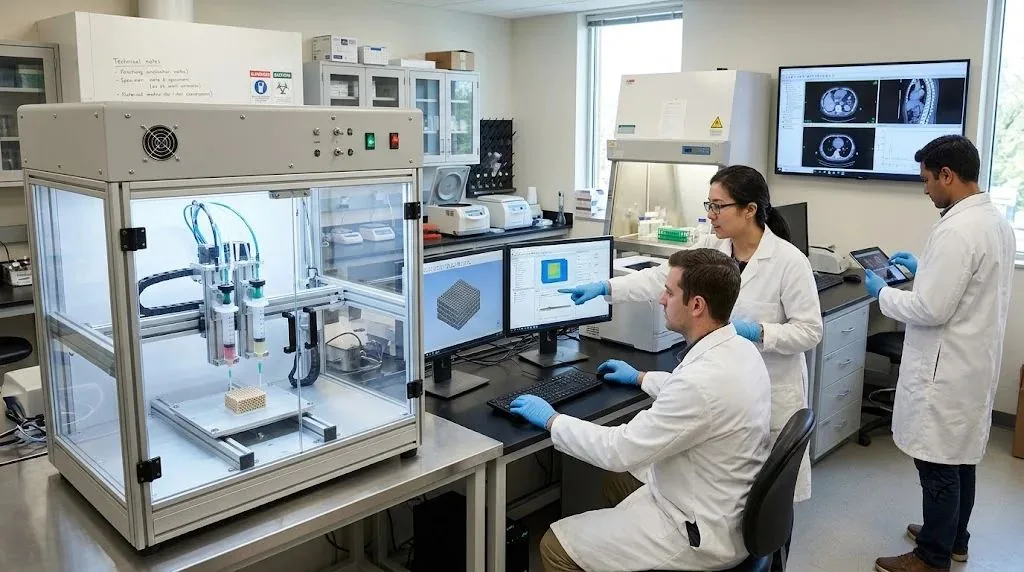
A 3d bioplotter is a specialized additive manufacturing instrument designed to fabricate three-dimensional biological scaffolds, tissue constructs, and biomedical implants by dispensing living cells, biocompatible polymers, hydrogels, and ceramic pastes under tightly controlled physiological conditions. While a standard 3D printer manufactures inert prototypes or structural components using heat-melted plastics, photosensitive resins, or metal powders, a bioplotter processes fragile biological matrices without destroying living cells.
As organizations across medical technology, pharmaceutical research, and life sciences invest in advanced biofabrication, understanding these underlying mechanical, fluid, and environmental distinctions is essential for specifying the correct platform for clinical and laboratory requirements.
Core Mechanics: Syringe-Based Printing vs. Conventional Extrusion
The foundational difference between a standard additive manufacturing machine and a bioplotter lies in the fluid dispensing mechanism. Conventional Fused Deposition Modeling (FDM) relies on mechanical pinch-wheels pulling a solid thermoplastic filament into a liquefier block operating between 200°C and 400°C.
A biological plotter replaces the heated filament extruder with high-precision syringe-based printing assemblies:
- Pneumatic Pressure Dispensing: Regulated compressed air or inert gas drives viscous hydrogels or cell suspensions through sterile needle tips. Pneumatic systems allow continuous fluid deposition and rapid start-stop cycles through micro-solenoid valves.
- Mechanical Piston and Screw Extrusion: For high-viscosity pastes, such as tricalcium phosphate (TCP) or concentrated collagen, motor-driven pistons or Archimedes screws apply positive displacement, ensuring consistent volumetric flow regardless of fluid resistance.
- Sub-Micron Needle Gauges: Rather than using broad brass nozzles, bioplotters utilize disposable stainless steel, Teflon, or ceramic tips ranging from 100 to 400 microns in diameter, requiring sub-micron automated Z-axis bed-leveling to prevent needle occlusion against the substrate.
The Physics of Cell Viability and Shear Stress
Standard 3D printing technologies rely on thermal or chemical transitions that are fundamentally lethal to living biological systems. Laser stereolithography uses cytotoxic photoinitiators and high-intensity ultraviolet radiation, while powder bed fusion requires high-energy lasers.
In extrusion bioprinting, the engineering objective centers on preserving cell viability throughout the deposition cycle:
- Shear-Induced Cellular Damage: When a suspension of living cells passes through a narrow nozzle, friction along the inner needle walls generates fluid shear stress. If shear forces exceed specific physiological limits (typically above 5 to 10 kilopascals, depending on cell type), the cell membrane ruptures, leading to immediate lysis or delayed apoptotic cell death.
- Low-Pressure Optimization: Specialized bioplotters maintain laminar, low-velocity fluid paths. By utilizing conical needle geometries and ultra-low pressure dispensing, the hardware minimizes shear gradients across the needle diameter, consistently sustaining post-print cell viability rates above 90 percent.
- Osmotic and Hydration Control: Standard manufacturing environments expose parts to dry ambient air. A bioplotter must manage surrounding humidity and ambient temperature to prevent the rapid evaporation of water from extruded hydrogels, which would alter osmotic balance and kill suspended cells.
Multi-Material Capabilities and Independent Thermal Zoning
Real human tissue is heterogeneous, requiring combinations of stiff structural matrices and soft, nutrient-permeable cellular pathways. Standard 3D printers typically utilize one or two identical extruders operating at a single temperature.
To recreate complex structures for tissue engineering, an advanced platform like the EnvisionTEC 3D-Bioplotter series incorporates independent thermal zoning across multiple printheads:
- Low-Temperature Cartridges (0°C to 4°C): Critical for preserving temperature-sensitive proteins, enzymes, and low-viscosity hydrogels (such as collagen or extracellular matrix extracts) prior to deposition.
- Physiological Cartridges (37°C): Maintains mammalian cell suspensions at standard human body temperature to prevent cellular shock during long-duration fabrication runs.
- High-Temperature Cartridges (up to 250°C): Necessary for extruding rigid, biodegradable supporting polymers such as polycaprolactone (PCL) or polylactic acid (PLA). These materials form the mechanical framework that supports softer cell-laden hydrogels until tissue maturation occurs.
Integrated tool changers allow the system to alternate between these distinct temperature zones within a single build layer, creating unified scaffolds combining load-bearing synthetic polymers and living cellular channels.
Environmental Isolation and Sterile Production Standards
Conventional 3D printers operate in open-air offices or industrial factory floors. Biofabrication hardware, however, must prevent bacterial, fungal, and viral contamination from colonizing the nutrient-rich hydrogels used in cell culture.
Bioplotters incorporate specialized cleanroom and sterility features:
- Laminar Airflow and HEPA Filtration: High-performance units feature built-in laminar flow hoods equipped with Class 100 (ISO Class 5) HEPA filtration systems to create a continuous positive-pressure sterile barrier around the print envelope.
- Integrated Ultraviolet Decontamination: Internal UV germicidal lamps run automated sterilization cycles between builds, decontaminating chamber walls, build stages, and tool changers.
- Corrosion-Resistant Cleanroom Materials: Internal components are machined from passivated stainless steel, anodized aluminum, and optical glass to withstand regular wipe-downs with isopropyl alcohol, hydrogen peroxide, or automated clean-in-place chemical agents.
System Configurations: Academic R&D vs. Regulated Manufacturing
Selecting a bioplotter platform requires aligning system capability with institutional objectives and regulatory oversight. Platforms generally split into two distinct tiers:
- Research and Academic Prototyping: Laboratories conducting exploratory biomaterials research or non-clinical in vitro drug testing prioritize modularity and experimental flexibility. A system like the 3D-Bioplotter Developer Series provides a compact, multi-cartridge environment optimized for university research teams formulating novel hydrogels and evaluating cell-scaffold interaction.
- Cleanroom Medical Device Production: Enterprises manufacturing patient-matched implantable resorbable scaffolds or clinical-grade biological devices require process determinism and comprehensive validation. Deploying a platform like the 3D-Bioplotter Manufacturer Series delivers automated needle calibration cameras, particle-free environmental isolation, detailed process logging, and the quality documentation necessary to support ISO 13485 and FDA regulatory filings.
Translating Medical Data to Physical Scaffolds
The digital toolchain for a bioplotter differs sharply from standard manufacturing CAD workflows. While mechanical components are drawn as solid bodies in parametric modeling programs, biological scaffolds originate from patient-specific anatomical data:
- Patient Imaging Inputs: High-resolution Computed Tomography (CT) or Magnetic Resonance Imaging (MRI) scans serve as the geometric foundation, capturing the exact contours of an anatomical defect or vascular network.
- Lattice and Porosity Engineering: Using advanced cad services to process patient surface models, engineers generate complex interconnected internal porosity. Pore sizing (typically between 100 and 500 microns) must be balanced to allow vascularization, cell migration, and fluid nutrient perfusion while maintaining structural load capabilities.
- Strand Orientation and Infill Strategies: Unlike standard infill patterns that prioritize mass reduction, bioplotter toolpaths dictate strand angle laydown (such as 0°/90° or 0°/60°/120°) to influence cellular alignment, directional mechanical stiffness, and scaffold degradation rates inside the body.
Frequently Asked Questions
What materials can a 3D bioplotter print?
A 3D bioplotter can process a wide range of biomaterials, including natural hydrogels (alginate, collagen, gelatin, hyaluronic acid), synthetic biodegradable polymers (polycaprolactone, polylactic acid), ceramic bone-replacement pastes (hydroxyapatite, tricalcium phosphate), and living cell suspensions.
How are bioprinted hydrogels cured or solidified?
Solidification depends on the material formulation and is achieved through thermal cross-linking (temperature-induced gelation), chemical exposure (such as calcium chloride solutions for alginate), or photochemical cross-linking using specialized low-intensity UV or visible blue light LED arrays.
Can a regular 3D printer be converted into a bioprinter?
While hobbyists sometimes mount syringe extruders on desktop plastic printers, these converted systems lack sterility controls (HEPA filtration), active multi-head temperature zoning, sub-micron needle positioning calibration, and precise low-shear pneumatic pressure regulation required to maintain consistent cell viability.
What are the main clinical applications of 3D bioplotters?
Current applications include patient-specific resorbable bone scaffolds, tissue models for pharmaceutical toxicology testing, organ-on-a-chip diagnostic devices, wound healing dressings, and regenerative medicine research focused on cartilage and vascular tissue.
Assessing Biofabrication Architecture for Your Facility
Integrating a 3D bioplotter into an engineering or clinical research facility bridges the gap between conventional materials science and living biology. Evaluating syringe mechanics, thermal controls, sterility infrastructure, and CAD workflow integration ensures that your capital hardware meets current research needs and long-term regulatory manufacturing requirements.
Explore detailed engineering specifications and modular platform options across the complete EnvisionTEC 3D-Bioplotter series to determine the optimal configuration for your laboratory or manufacturing environment.