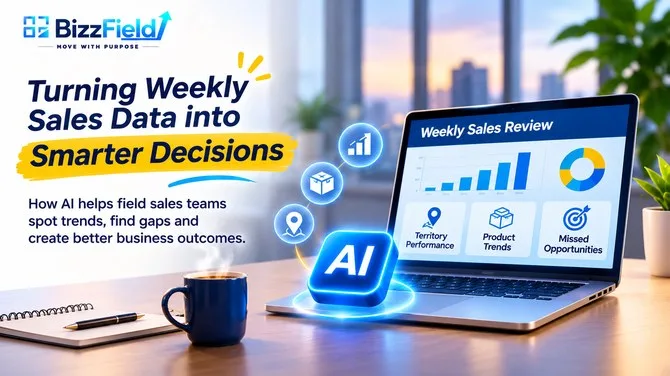
AI in Field Sales: From Daily Reports to Better Sales Decisions
A sales manager can receive dozens of reports every week and still be unsure about what is happening in the market.
The team may have completed its outlet visits. Orders may have been recorded, attendance marked and distributor updates submitted. Yet, when sales decline in a particular territory, the report does not always explain why.
Was an important retailer missed? Did product availability change? Are customers ordering less frequently? Or is the sales team struggling to convert visits into orders?
These are the kinds of questions that make AI in field sales worth exploring. Its practical value is not simply in producing another dashboard. It is in helping businesses make better sense of the information they already collect.
Why Field Sales Teams Need More Than Activity Reports
Traditional field sales management often focuses on measurable activities: attendance, outlet visits, beat coverage, orders and target achievement.
These indicators are important, but looking at them individually can hide the bigger picture.
Imagine two sales representatives working in similar territories. Both complete a comparable number of outlet visits, but one generates significantly fewer orders.
A visit report alone will not explain the difference. Managers may need to examine retailer ordering history, product availability, territory conditions and the quality of customer engagement.
This is where connected sales data and AI-supported analysis can provide additional context. Instead of manually checking several reports, managers can use available information to identify areas that deserve attention.
Four Practical Applications of AI in Field Sales
1. Identifying Territory Performance Gaps
Sales targets are only one part of territory performance. Outlet coverage, visit frequency, order conversion and representative productivity also influence results.
AI-powered analysis can help bring these indicators together and highlight unusual patterns.
For instance, a territory may show consistent outlet visits but declining order conversion. That does not automatically mean the representative is underperforming. Product availability, retailer demand or local market conditions may also be responsible.
The insight gives managers a starting point for investigation instead of relying only on assumptions.
2. Understanding Product and SKU Movement
For FMCG companies and other businesses managing large product portfolios, SKU-level visibility can be difficult to maintain.
A product may move quickly in one market but remain slow in another. Retailer preferences, stock availability and local demand can influence these differences.
AI-supported SKU analysis can help businesses compare product performance across outlets and territories, identify changes in movement and bring potential availability issues to attention.
This can make discussions about stock planning and sales priorities more informed.
3. Monitoring Sales Team Performance
Monthly performance reviews often involve checking spreadsheets, comparing target achievement and speaking with individual representatives.
By the time a problem becomes visible in a month-end report, managers may have limited time to understand what happened.
AI-supported performance monitoring can help examine activity and achievement patterns, highlight potential performance gaps and identify areas where coaching may be useful.
It should support a manager's judgement, not replace conversations with the sales team. Data can highlight a concern, but understanding the reason still requires business context.
4. Improving Distributor and Secondary Sales Visibility
For businesses that depend on distributors, primary sales figures do not provide a complete picture of market movement.
Distributor inventory, secondary sales, retailer ordering patterns and payment cycles also matter.
AI-enabled distribution analysis can help businesses review these indicators and identify changes that may need attention. For example, a retailer who regularly orders a product may begin ordering less frequently. A distributor may also show a change in stock movement.
Recognising these patterns earlier can help teams investigate potential issues before they become larger operational problems.
AI Cannot Fix Poor Sales Data
There is an important limitation that businesses should consider before investing in AI SFA software.
If retailer details are outdated, field visits are recorded inconsistently or distributor information is incomplete, the insights generated from that information may also be unreliable.
Technology cannot automatically correct every gap in the underlying sales process.
Businesses should first establish clear practices for maintaining outlet records, capturing orders, recording field activities and updating product and distributor information.
Mobile usability matters too. Field representatives often work across locations where internet connectivity is inconsistent. Offline access and simple data-entry processes can make regular updates more practical.
The goal should be to improve information quality without making everyday fieldwork unnecessarily complicated.
What Businesses Should Look for in an AI-Powered SFA Solution
Before choosing a solution, sales leaders should consider whether it addresses their actual operational challenges.
Can it connect field activities with sales performance? Does it provide useful product-level visibility? Can managers examine distributor information alongside sales data? Are its recommendations understandable enough to support real decisions?
It is also worth checking how easily the solution fits into existing workflows.
For example, BizzField brings Sales Force Automation and distribution management capabilities together with specialised AI agents. Its product offering includes an SFA Agent for field operations, a SKU Agent for product performance, a Performance Agent for sales team insights and a DMS Agent for distributor operations.
These are examples of how AI capabilities can be applied to different parts of a sales and distribution network.
Businesses can explore the BizzField SFA Agent and BizzField DMS Agent to understand these applications.
The Real Purpose of AI in Field Sales
AI should not be adopted simply because it is becoming part of business technology conversations.
Its value depends on whether it helps solve practical problems: unclear territory performance, limited SKU visibility, delayed sales reviews or gaps in distributor information.
Field representatives still need to understand customers and build relationships. Sales managers still need to make decisions using their experience and knowledge of the market.
AI can support both by making relevant information easier to examine.
The real shift is from asking, "What does this week's report show?" to asking, "What needs our attention, and why?"
That is a more useful direction for field sales management.