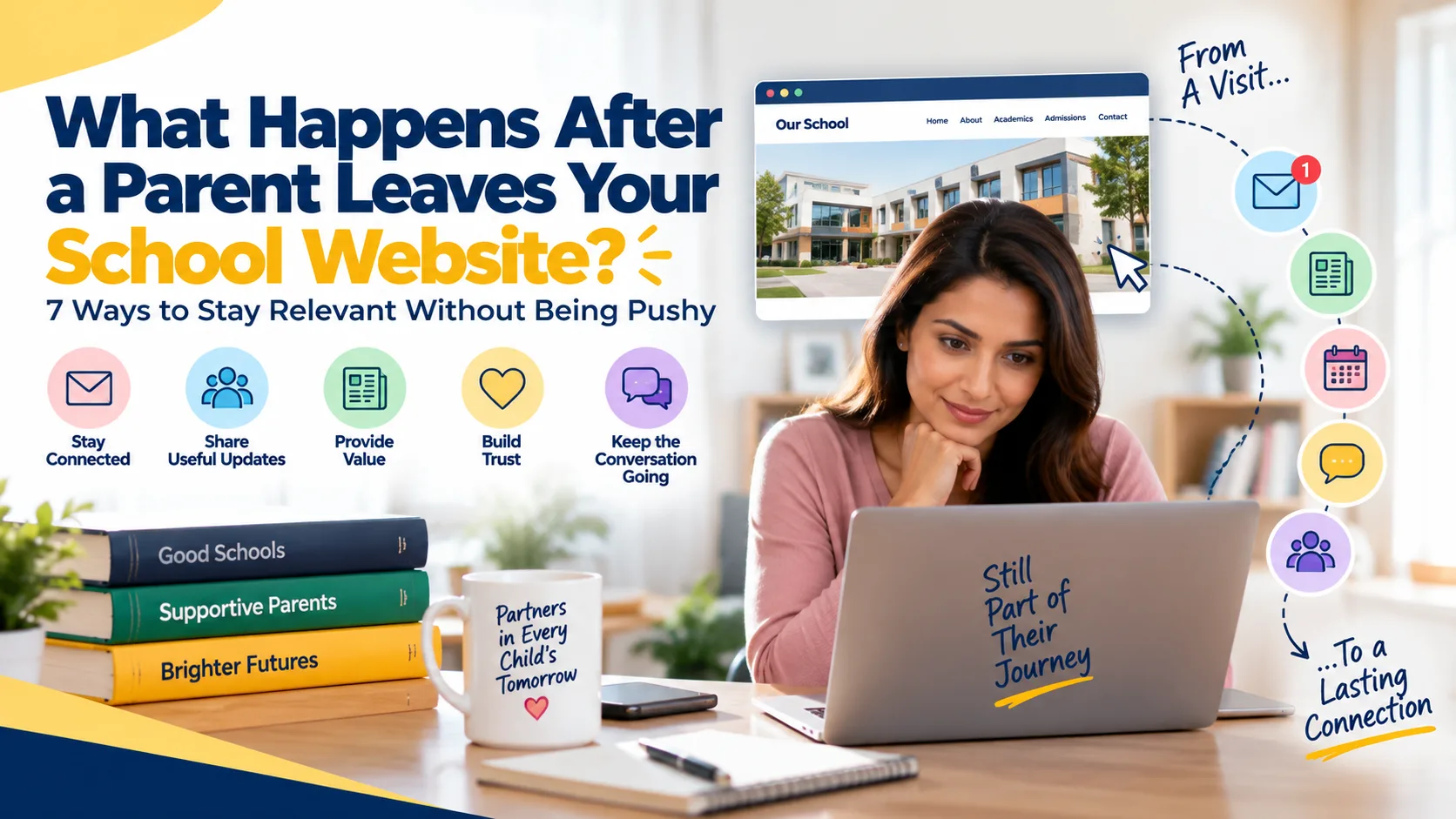
A parent visits a school website, reads a few pages, checks the admission information, and then leaves without submitting an enquiry.
Does that mean the school has lost the opportunity?
Not necessarily.
Parents often research several schools before deciding which ones they want to contact. They may compare curriculum, fees, location, facilities, teaching approach, activities, reviews, and admission requirements.
For schools investing in Lead automation services in India, this stage between the first website visit and the eventual enquiry can be just as important as generating the original website traffic.
The challenge is to remain useful without overwhelming parents with repeated promotional messages.
Why Parents Leave School Websites Without Enquiring
There can be many reasons a parent leaves without taking action.
They may:
- Still be comparing schools
- Need to discuss the decision with another family member
- Want to check fees first
- Be researching for a future academic year
- Need more information about the curriculum
- Want to visit the campus before enquiring
- Simply not be ready to make contact
A website visit does not always represent an immediate admission decision.
Understanding this can help schools create a better follow-up strategy.
1. Give Parents More Useful Information
The first follow-up should provide value.
Instead of sending another generic admission advertisement, schools can share information related to what parents are researching.
For example:
Interested in the curriculum?
Share a curriculum guide.
Looking at facilities?
Share a campus or facilities page.
Comparing admission requirements?
Share a clear admission FAQ.
Planning for the next academic year?
Provide a useful admission timeline.
This approach makes communication more relevant.
2. Use Retargeting Carefully
Digital advertising can remind people about a school after they have visited its website.
But retargeting should be handled carefully.
If a parent sees the same admission advertisement repeatedly, the message can quickly become irritating.
A better approach is to vary the message based on the stage of research.
For example:
First interaction: Introduce the school.
Second interaction: Highlight curriculum or facilities.
Later interaction: Offer a campus visit or admission information.
The objective should be continued relevance, not constant repetition.
3. Build Content Around Parent Questions
A school website can become more useful when it answers questions parents are likely to have during their research.
Useful content might include:
- How to choose the right school
- Understanding different curricula
- Questions to ask during a school visit
- How school transportation works
- What extracurricular activities offer students
- How parents can prepare children for a new academic year
- What documents are usually required during admission
This type of content can support digital marketing for educational institutions while also helping parents make more informed decisions.
4. Use Social Media as a Second Research Point
Parents may move from a school's website to its social media profiles.
This gives schools another opportunity to demonstrate what everyday life looks like.
Useful content can include:
- Classroom activities
- Student projects
- Sports
- Competitions
- Teachers
- School events
- Campus facilities
- Student achievements
- Clubs and activities
Good Social media marketing for schools should show more than promotional banners.
It can help parents understand the culture and experience of the institution.
5. Make the Campus Visit an Easy Next Step
Some parents may be interested in a school but still hesitate to submit a formal admission enquiry.
A campus visit can be a more natural next step.
Schools can clearly explain:
- How to request a visit
- Whether appointments are required
- What parents can expect
- Which areas they can see
- Who they will meet
- How long the visit may take
A clear campus-visit process can reduce uncertainty.
6. Segment Follow-Up Communication
Not every website visitor has the same needs.
A school may eventually receive enquiries from parents interested in:
- Nursery admissions
- Primary grades
- Secondary grades
- Transfers
- Future academic sessions
- Specific curriculum options
Follow-up communication can become more useful when it reflects the parent's situation.
For example, a parent interested in primary education does not necessarily need the same information as a parent enquiring about a senior grade.
Segmentation can help schools avoid sending irrelevant messages.
7. Automate Routine Follow-Up Without Losing the Human Touch
When schools receive a large number of enquiries, manually remembering every follow-up can be difficult.
This is where automation can help.
A school can use an organized process for:
- Enquiry acknowledgement
- Follow-up reminders
- Lead categorization
- Information sharing
- Campus-visit reminders
- Status updates
- Re-engagement
However, automation should handle routine tasks rather than replace human communication.
If a parent asks a detailed question, the admissions team should be able to step in.
The Role of Google Ads After a Website Visit
Google Ads can be useful for reaching parents who are actively searching for schools.
But advertising should not operate separately from the website experience.
The journey could look like:
Google Search → Advertisement → School Website → Research → Return Visit → Enquiry
If the landing page provides limited information, the parent may continue looking elsewhere.
This is why a google ad agency for educational institutes should consider the relationship between the advertisement, landing page and follow-up process.
What About SEO?
SEO helps schools become visible when parents are actively searching for information.
A useful SEO strategy can target different types of searches.
Informational Searches
Parents looking for explanations, guides or educational information.
Local Searches
Parents searching for schools in a particular city or area.
Admission Searches
Parents looking for admission dates, eligibility, fees or application information.
Comparison Searches
Parents comparing schools, curricula, facilities or educational options.
A strong seo agency for educational institutes approach can help organize content around these different search needs.
Don't Ask for the Admission Too Early
One of the biggest mistakes in digital follow-up is treating every website visitor as if they are ready to apply.
Consider two parents.
Parent A: “I am comparing schools for my child and want to understand the curriculum.”
Parent B: “Admissions are open. How can I schedule a campus visit?”
Both are valuable prospects, but they are at different stages.
Parent A may need educational and school information.
Parent B may need a direct path to the admissions team.
The communication should reflect that difference.
A Simple Follow-Up Journey
Schools can create a simple journey for interested parents.
Step 1: First Visit
Provide clear information about the school.
Step 2: Continued Research
Offer useful content about curriculum, facilities, activities and school life.
Step 3: Engagement
Use relevant website content, email, WhatsApp or social media communication where appropriate.
Step 4: Enquiry
Make it easy for the parent to ask a question.
Step 5: Campus Visit
Provide a clear and convenient way to arrange a visit.
Step 6: Admission
Once the parent is ready, provide the required application information.
This approach respects the fact that different parents move through the decision process at different speeds.
How Schools Can Avoid Becoming Too Promotional
A good rule is:
Help first. Promote second.
Instead of sending:
“Admissions are open! Apply now!”
again and again, schools can provide useful information such as:
- “Here is how our curriculum works.”
- “Take a look at our science facilities.”
- “Here are the questions parents often ask about admissions.”
- “See what a typical school day looks like.”
- “Learn how to prepare for your campus visit.”
Useful information can keep the school relevant while giving parents a reason to return.
What Should Schools Measure?
Schools should monitor what happens after the first website interaction.
Useful measurements include:
- Returning visitors
- Admission-page visits
- Enquiry rate
- Qualified enquiries
- Follow-up response rate
- Campus-visit requests
- Campus visits
- Application starts
- Applications completed
- Admissions
This helps schools understand whether their digital strategy is supporting the complete admission journey.
The Bigger Picture
A parent leaving a website does not necessarily mean the marketing process has failed.
The parent may simply need more time.
The opportunity for schools is to create a digital experience that remains useful during that research period.
A combination of informative website content, SEO, social media, appropriate advertising and organized lead follow-up can help schools stay connected without putting unnecessary pressure on prospective families.
Final Thoughts
School admissions are rarely decided by one advertisement or one website visit.
Parents often research, compare, discuss and return several times before taking action.
Schools that understand this can build a more thoughtful digital strategy.
The goal is not to chase every visitor with another promotional message.
It is to provide the right information at the right stage of the parent's decision-making journey.
When digital marketing, website content and lead management work together, a website visit can become the beginning of a longer relationship rather than the end of the interaction.