Peer-to-peer local commerce underwent a massive digital transition over the past decade. Before mobile-first classifieds applications arrived, buying and selling secondhand goods locally meant navigating text-heavy, unmoderated platforms like Craigslist. Sellers had to manually write lengthy descriptions on desktop computers, while buyers had to arrange risky offline meetings with anonymous strangers.
Launched in 2015, Letgo disrupted this sector by introducing a photo-first, mobile-centric buying and selling experience. It allowed users to snap a picture of an item on their smartphone, rely on early image-recognition models to auto-categorize it, set a price, and publish a listing in under thirty seconds. Coupled with geolocation-based browsing and built-in chat, Letgo quickly captured tens of millions of active users.
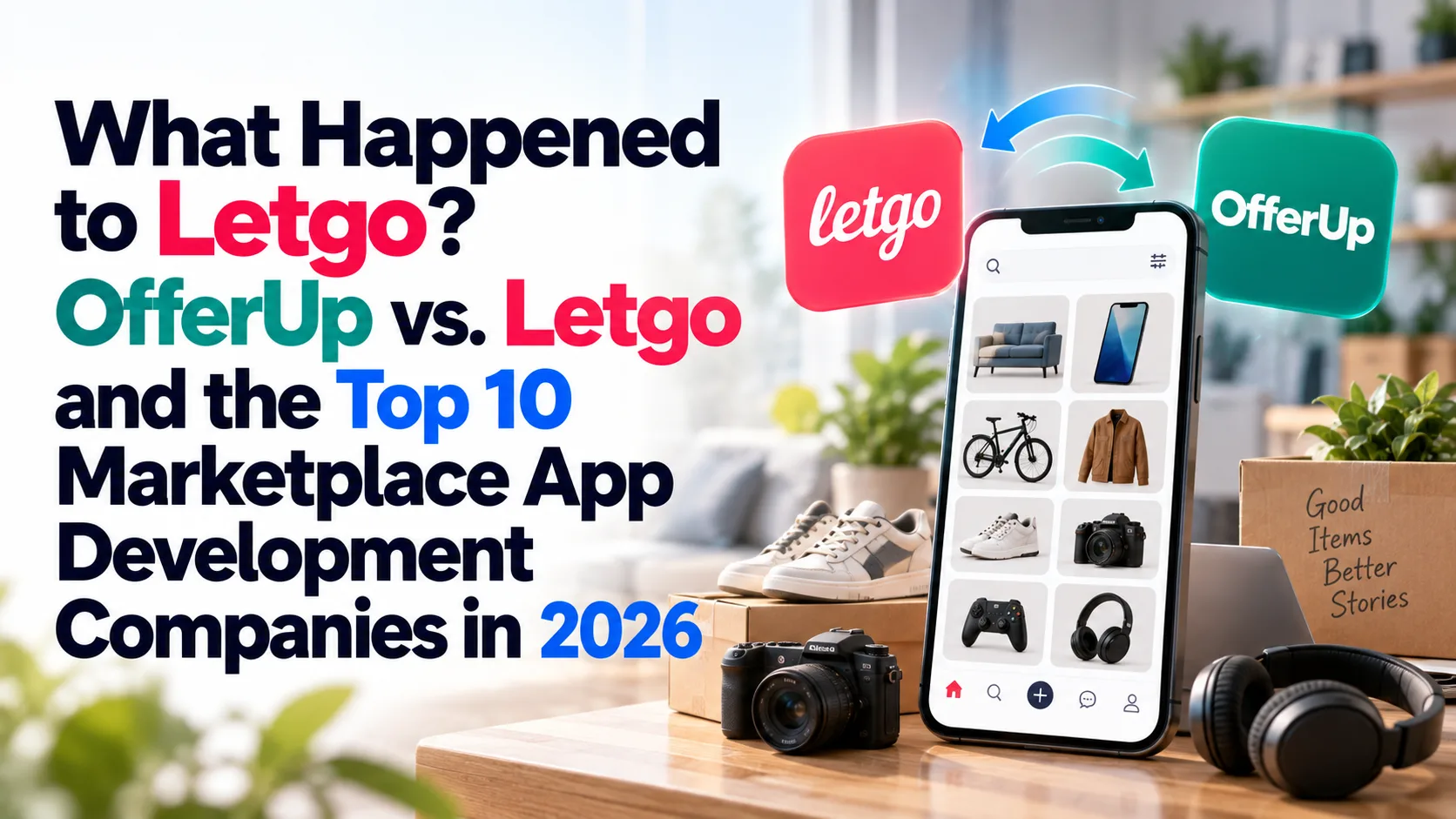
However, the local marketplace landscape transformed permanently when competitor OfferUp acquired Letgo's North American operations, merging the two largest US mobile resale platforms into a single unified marketplace. Despite the acquisition, millions of buyers, sellers, and entrepreneurs still search for "OfferUp vs Letgo". Some seek to understand what happened to their accounts and listings, while founders and product teams study both platforms to reverse-engineer their operational architecture, revenue models, and trust mechanics.
Building a modern peer-to-peer (P2P) marketplace app like Letgo or OfferUp requires sophisticated software engineering. Developers must orchestrate low-latency geospatial search queries, computer-vision auto-tagging, real-time encrypted messaging, fraud detection pipelines, and integrated escrow payment rails.
This guide breaks down what really happened to Letgo, compares the core technical architectures of OfferUp and Letgo, and evaluates the top 10 software development companies capable of building enterprise-grade marketplace applications in 2026.
What Really Happened to Letgo? The OfferUp Merger Explained
In March 2020, OfferUp announced an agreement to acquire Letgo, with the formal merger finalizing later that year. Before the merger, both applications were locked in an expensive customer-acquisition battle for dominance in the US local resale market.
Why the Merger Occurred
Marketplaces require high two-sided liquidity: buyers abandon apps without sufficient local inventory, and sellers stop posting on platforms lacking active buyers. By operating separately in the same geographic regions, OfferUp and Letgo fragmented local user bases. Consolidating the platforms into a single entity eliminated redundant marketing overhead, united local liquidity, and established an indisputable market leader capable of competing directly with Facebook Marketplace.
What Changed for Users
When the merger took effect, the standalone Letgo application was retired across North America. Letgo users were transitioned to the combined OfferUp platform, allowing them to import their ratings, joined dates, and transaction histories.
The consolidated platform retained Letgo's simplified, image-centric listing flow but phased out secondary categories like jobs and services. In exchange, users gained OfferUp's advanced trust features: TruYou identity verification, designated Community MeetUp Spots, nationwide shipping with escrow payment protection, and permanent listings that do not automatically expire after 30 days.
OfferUp vs. Letgo: Core Architectural and Feature Comparison
Understanding the structural differences between legacy Letgo and the combined OfferUp platform highlights how consumer expectations for local resale platforms evolved from simple digital yard sales to secure, multi-channel commerce hubs.
Feature / ArchitectureLegacy Letgo PlatformModern OfferUp PlatformEngineering Significance for New AppsListing Creation FlowSnap-and-post photo flow with basic image recognition.Multi-photo flow with AI pricing suggestions and auto-categorization.Fast onboarding increases seller listing completion rates by over 40%.Geographic ScopeHyper-local only (restricted to local in-person meetups).Hybrid: Local proximity browsing plus nationwide shipping.Shipping expands total addressable market and creates higher transaction fee revenue.Payment ArchitectureCash-in-hand offline transactions only.In-app credit/debit card processing, Stripe escrow, and cash options.In-app payments allow platforms to capture marketplace take-rates on shipped items.Identity & Trust VerificationSocial logins (Facebook/Google) and basic phone verification.TruYou ID validation (government ID scanning, selfie matching, badges).High verification reduces scam listings, ghosting, and unsafe physical meetups.Physical Meetup SafetyBasic safety tips displayed inside chat windows.Integrated Community MeetUp Spots (monitored police stations, lighted retail hubs).Geo-tagged public meetup locations lower transaction anxiety for high-value items.Listing LifespanEphemeral (listings automatically expired after 30 days).Persistent (listings remain active until sold or archived by seller).Persistent listings maximize search engine indexation and long-tail buyer discovery.Monetization EnginePaid listing bumps and basic display ads.Listing promotions, Promote Plus subscriptions, auto dealer fees, and shipping fees.Multi-tiered monetization diversifies revenue across casual users and high-volume merchants.Technical Architecture of a Modern P2P Marketplace Application
Building a scalable application inspired by OfferUp and Letgo requires a distributed backend architecture capable of handling real-time geolocation filtering, high-volume image ingestion, and instant buyer-seller chat:
1. Geospatial Discovery and Search Indexing
Local marketplace apps live or die by the speed and accuracy of their proximity search. When a user opens the app, the system must immediately query listings within a defined radius (e.g., 5, 10, or 30 miles) from the user's GPS coordinates.
Production systems use PostgreSQL with the PostGIS extension or specialized Elasticsearch indices with geo-point mapping. Queries calculate distance using spatial bounding boxes, sorting results by proximity, relevance, and listing recency in sub-100 millisecond response times.
2. Computer Vision and AI Listing Automation
Letgo's original breakthrough was eliminating manual data entry for sellers. Modern applications use custom computer-vision models trained on millions of product photos.
When a user snaps a photo of an acoustic guitar, the vision service identifies the object class, assigns the listing to the "Musical Instruments" category, suggests relevant descriptive tags (brand, finish, type), and queries recent sales data to recommend a competitive price range. This reduces the listing creation time to under twenty seconds.
3. Real-Time Chat and Content Moderation
In-app messaging must be instantaneous, reliable, and secure. Real-time communication runs over WebSockets or MQTT protocols with Redis managing active user presence and unread message counters.
To protect users from fraud, all chat messages pass through asynchronous natural language processing (NLP) filters. The system automatically flags or blocks attempts to share off-platform contact information (such as phone numbers or external payment links), detects toxic language, and prevents phishing scams before messages reach the recipient.
4. In-App Payments, Escrow, and Shipping Logistics
While local buyers can still choose cash on pickup, nationwide shipping requires an escrow payment architecture. Modern marketplace apps integrate payment gateways like Stripe Connect.
When a buyer purchases a shipped item, the payment is authorized and held in escrow. The platform automatically generates a prepaid shipping label via carrier APIs (EasyPost or Shippo). The funds are only released to the seller's bank account once carrier tracking confirms delivery and a 48-hour buyer inspection window closes without a dispute.
Top 10 Marketplace App Development Companies in 2026
Building a peer-to-peer buy-and-sell marketplace requires an engineering partner with proven experience in mobile frontend design, geospatial backend architecture, and secure transaction workflows. These are the top 10 software companies delivering custom marketplace app development:
1. Idea Usher
Best suited for: Full-cycle custom P2P marketplace development, AI-powered listing engines, and scalable multi-vendor platforms.
Idea Usher is a specialized digital product engineering firm that designs and develops high-performance mobile applications, classifieds platforms, and custom peer-to-peer marketplaces. The company approaches marketplace engineering from a full-stack perspective, combining native and cross-platform mobile apps (React Native, Flutter, Swift, Kotlin) with scalable cloud microservices. They specialize in architecting marketplaces that handle large numbers of concurrent users, real-time location-based discovery, and complex buyer-seller negotiation workflows.
A core technical differentiator of Idea Usher is their integration of computer-vision auto-tagging and intelligent pricing engines directly into the seller onboarding flow. Their developers build custom geolocation microservices using PostGIS and Elasticsearch to ensure low-latency proximity queries.
Idea Usher also engineers comprehensive trust and safety suites, including automated identity verification modules (TruYou-style government ID validation), secure escrow payment pipelines, and AI-driven chat moderation that filters out scam patterns. Their full-ownership delivery model ensures clients retain 100% of their intellectual property without ongoing per-transaction licensing fees.
- Core Strengths: Custom C2C/P2P marketplace engineering, computer vision image recognition, low-latency geospatial search, and escrow payment integration.
2. Intellivon
Best suited for: AI-driven marketplace analytics, predictive pricing algorithms, and automated fraud prevention.
Intellivon operates at the intersection of artificial intelligence and custom software engineering, developing intelligent data layers and automated risk-detection models for digital commerce platforms. While standard development agencies focus purely on basic UI and CRUD databases, Intellivon builds intelligent backend systems that maximize marketplace liquidity and platform trust.
Their engineering team specializes in building predictive pricing recommendation models that analyze historical marketplace sales, seasonality, and condition ratings to help sellers price items for faster turnover. Intellivon also builds real-time fraud-detection engines that analyze user account creation velocity, image reuse patterns (detecting stolen stock photos), and conversational sentiment in chat windows to flag fraudulent listings before buyers interact with them.
- Core Strengths: Predictive pricing engines, AI-powered visual search, automated fraud and scam detection, and behavioral user analytics.
3. Codica
Best suited for: Dedicated marketplace web and mobile development, high-load architecture, and MVP rapid delivery.
Codica is an established European software development company that specializes specifically in building custom online marketplaces and complex web applications. The firm has delivered dozens of multi-vendor, C2C, and B2C marketplace platforms across automotive, e-commerce, and real estate sectors.
Their technical team excels at building fast, user-friendly Progressive Web Apps (PWAs) and native mobile applications backed by Ruby on Rails and Node.js microservices. Codica places heavy emphasis on high-load architectural planning, ensuring that marketplace databases can process thousands of concurrent search queries and media uploads without performance degradation. Their development process follows strict agile methodologies, guiding founders from initial product discovery and clickable prototyping to production deployment.
- Core Strengths: Dedicated marketplace development expertise, Ruby on Rails and React/Node microservices, PWA development, and UX-led interface design.
4. FATbit Technologies
Best suited for: Multi-vendor marketplace platforms, turn-key commerce solutions, and custom classifieds software.
FATbit Technologies is an established marketplace software development company that has built and deployed commercial commerce platforms for more than two decades. The firm provides both ready-made, customizable marketplace frameworks and fully custom software engineering services for digital commerce startups.
Their software platforms feature built-in multi-currency processing, multilingual localization, vendor management consoles, and commission management engines. For clients building buy-and-sell mobile apps, FATbit engineers custom mobile clients for iOS and Android that connect to centralized administrative backends. Their architecture supports varied revenue models, including subscription memberships, featured listing fees, and split transaction fees.
- Core Strengths: Proven marketplace software frameworks, multi-vendor commission engines, mobile commerce apps, and localization architecture.
5. Apptunix
Best suited for: Mobile-first marketplace applications, on-demand classifieds, and rapid startup MVPs.
Apptunix is an international mobile app development company that has delivered over two thousand digital products, specializing in on-demand service apps, classifieds platforms, and consumer-facing mobile marketplaces. The company focuses heavily on rapid time-to-market for early-stage venture projects.
Their technical teams build responsive mobile clients using Flutter and React Native, supported by Node.js, Python, and AWS serverless backends. Apptunix specializes in building engaging consumer UI/UX designs that mirror the intuitive, swipe-heavy experiences popularized by Letgo and OfferUp. They integrate turnkey third-party services for identity verification, geolocation mapping, in-app messaging, and credit card processing.
- Core Strengths: Rapid MVP mobile development, Flutter and React Native engineering, on-demand marketplace architecture, and modern mobile UI/UX.
6. Vention
Best suited for: Enterprise-grade marketplace engineering, dedicated developer teams, and complex cloud integrations.
Vention is an international software engineering company that partners with high-growth startups and global enterprises to build scalable digital products. With a massive engineering talent pool, Vention provides dedicated software engineering teams across mobile, web, cloud, and DevOps disciplines.
For marketplace initiatives, Vention delivers enterprise-grade software architecture capable of scaling to millions of daily active users. Their engineers build resilient cloud-native backends on AWS, Google Cloud, and Microsoft Azure, implementing Kubernetes container orchestration, automated CI/CD pipelines, and microservices architectures. Vention is an ideal engineering partner for well-funded startups that need to scale their development velocity quickly with senior technical talent.
- Core Strengths: Dedicated senior engineering teams, enterprise cloud-native architecture, microservices engineering, and rigorous QA automation.
7. ScienceSoft
Best suited for: Secure e-commerce marketplaces, legacy systems integration, and ISO 27001-certified data governance.
ScienceSoft brings over thirty-five years of custom software development and IT consulting experience to digital commerce and marketplace platforms. Operating under ISO 27001 information security standards, the company specializes in engineering secure, highly available commerce architectures for enterprises and regulated industries.
Their developers excel at building complex e-commerce platforms that integrate smoothly with enterprise resource planning (ERP) software, warehouse management systems, and third-party financial clearinghouses. ScienceSoft approaches marketplace development with strict data privacy and security controls, implementing role-based access permissions, end-to-end data encryption, and PCI-DSS-compliant payment processing pipelines.
- Core Strengths: ISO 27001 data governance, PCI-DSS payment compliance, enterprise ERP integration, and secure marketplace backend architecture.
8. Yalantis
Best suited for: High-performance mobile engineering, custom geolocation infrastructure, and complex communications backends.
Yalantis is an experienced software engineering and digital consulting company that specializes in building mobile-first platforms, IoT ecosystems, and custom marketplace solutions. The firm has extensive experience engineering real-time communication tools and location-based mobile software.
For P2P marketplace apps, Yalantis designs custom geolocation tracking and mapping features using native iOS and Android location frameworks paired with custom geospatial databases. Their engineers build custom WebSocket-based chat engines that handle instant messaging, media sharing, and read receipts with low latency. Yalantis places strong emphasis on software architecture reviews, ensuring platforms maintain structural integrity as user traffic multiplies.
- Core Strengths: Custom geolocation engineering, native mobile app performance, real-time messaging backends, and scalable cloud infrastructure.
9. Cleveroad
Best suited for: User-centric mobile marketplace design, microservices architecture, and cross-platform mobile apps.
Cleveroad is a full-cycle software development company that builds web and mobile solutions tailored to specific business requirements. The company has delivered numerous e-commerce, classifieds, and logistics platforms for European and North American clients.
Their development practice focuses on building scalable microservices architectures that isolate core marketplace functions (such as user authentication, product cataloging, payment processing, and messaging) into independent services. Cleveroad excels at creating polished, intuitive user interfaces that streamline the buying and selling journey, ensuring high customer retention and lower user drop-off during checkout.
- Core Strengths: Microservices software design, intuitive consumer UI/UX, cross-platform mobile engineering, and comprehensive quality assurance.
10. Magneto IT Solutions
Best suited for: Digital commerce ecosystems, multi-vendor marketplace engineering, and omnichannel retail integration.
Magneto IT Solutions is an established digital commerce agency with deep expertise in developing B2B, B2C, and C2C marketplace platforms. With more than fourteen years in digital commerce, the company builds scalable platforms using Adobe Commerce (Magento), Shopify Plus, and custom Node.js/PHP frameworks.
For marketplace clients, Magneto engineers unified product catalog systems, custom vendor payout engines, and multi-tier commission structures. Their technical teams build mobile commerce applications that sync real-time catalog changes with centralized databases, enabling businesses to manage inventory, dispute resolutions, and shipping logistics from a single administrative dashboard.
- Core Strengths: Adobe Commerce and Shopify marketplace extensions, custom vendor payout engines, omnichannel commerce, and mobile retail apps.
Comparison Matrix: Top Marketplace Development Companies
CompanyBest Suited ForCore Technical SpecializationPrimary Marketplace FocusIdea UsherCustom P2P MarketplacesAI vision auto-tagging, PostGIS geo-discovery & escrow payment railsC2C local resale, mobile classifieds & specialized marketplacesIntellivonAI Analytics & Fraud PreventionPredictive pricing engines, visual search & chat fraud detectionHigh-security marketplaces, resale platforms & dynamic pricingCodicaHigh-Load Custom MarketplacesDedicated marketplace architecture, Ruby on Rails & PWA designCustom multi-vendor platforms, automotive & service marketplacesFATbit TechnologiesTurn-Key Marketplace PlatformsReady-to-deploy frameworks, multi-vendor payouts & localizationMulti-vendor e-commerce, rental platforms & startup MVPsApptunixMobile-First Classifieds MVPsFlutter/React Native, serverless backends & on-demand workflowsOn-demand apps, local buy/sell platforms & mobile classifiedsVentionScalable Enterprise EngineeringDedicated developer teams, Kubernetes & microservices architectureFunded tech startups, high-volume consumer apps & enterprise cloudScienceSoftSecure Commerce IntegrationISO 27001 data security, ERP connectors & PCI-DSS complianceEnterprise retail marketplaces, healthcare & regulated commerceYalantisGeolocation & Real-Time ChatCustom mapping engines, WebSocket chat backends & native mobileLocation-based marketplaces, social commerce & transport appsCleveroadModular Microservices AppsIndependent service architecture, clean UI/UX & cross-platform appsRetail marketplaces, logistics apps & classified platformsMagneto IT SolutionsOmnichannel Digital CommerceMulti-tier commission engines, Adobe Commerce & vendor payoutsB2B/B2C marketplaces, retail platforms & multi-vendor portalsHow Peer-to-Peer Marketplace Apps Generate Revenue
Building a marketplace app like OfferUp or Letgo requires a clear monetization strategy. Successful platforms utilize multiple complementary revenue streams:
1. Paid Listing Promotions (Bumps and Highlights)
The most common C2C monetization model allows sellers to pay micro-fees ($2 to $15) to feature their items at the top of local search feeds or category pages for 24 to 72 hours. Promoted listings receive significantly more views and offers, encouraging regular sellers to pay for visibility.
2. Transaction Fees on Shipped Goods (Marketplace Take-Rate)
While local cash pickups remain free for users, platforms charge a transaction fee on items sold through nationwide shipping. OfferUp, for example, charges a service fee (typically 12.9% of the sale price with a minimum fee) for processing payments, facilitating shipping labels, and providing buyer protection.
3. Recurring Premium Subscriptions (Promote Plus)
High-volume individual sellers and small businesses can subscribe to monthly premium tiers (such as OfferUp's Promote Plus). For a recurring monthly fee (e.g., $19.99/month), subscribers receive permanent listing boosts, direct phone call options from buyers, profile badges, and priority customer support.
4. Verified Commercial and Auto Dealer Programs
Automotive sales represent one of the most lucrative categories in local classifieds. Platforms offer dedicated dealer programs that charge licensed dealerships recurring subscription fees to bulk-upload their vehicle inventory directly via automated DMS feeds, access verified buyer leads, and display branded showroom badges.
5. Programmatic In-Feed Advertising
Platforms monetize non-paying casual users by displaying targeted native ads within search feeds and between chat conversations. Ad networks (such as Google AdMob) serve relevant local advertisements based on user browsing history and search categories.
Technical Buyer Diligence: What Founders Must Audit Before Development
Building a peer-to-peer marketplace requires technical diligence during vendor evaluation:
1. Evaluate Geolocation Query Efficiency Under Load
Querying geographic databases for thousands of simultaneous mobile users can overwhelm traditional relational databases. Require your prospective development team to demonstrate how they index spatial coordinates (e.g., using PostGIS spatial indexes, R-tree structures, or Elasticsearch geo-distance filters). The architecture must process radius searches without causing CPU spikes or sluggish map rendering.
2. Verify Real-Time Chat Scalability and Offline Sync
In P2P transactions, fast communication closes deals. Ensure your engineering partner designs a chat system that handles offline message queuing, push notifications via Firebase/APNs, read receipts, and media attachments smoothly. The chat system must synchronize state across devices and immediately push unread counts when users reconnect to cellular data.
3. Inspect In-App Fraud and Scam Prevention Mechanisms
Marketplaces that lack moderation quickly become overrun with counterfeit listings, stolen goods, and phishing bots. Require the development firm to demonstrate how they integrate automated image hashing (to prevent the reposting of banned images), rate-limiting for new accounts, phone number verification, and natural language filters that block attempts to steer buyers off-platform to untracked payment methods.
4. Ensure Full Intellectual Property Transfer
Ensure your development contract guarantees complete, unencumbered ownership of all custom mobile source code, backend microservices, deployment scripts, and database schemas upon delivery. Avoid software shops that build on proprietary, closed-source SaaS platforms that lock your business into ongoing per-user monthly licensing fees.
Frequently Asked Questions
Is the Letgo app still available to download?
No. The standalone Letgo application was retired in North America following its acquisition by OfferUp. Users in the United States and Canada were migrated to the combined OfferUp platform, which incorporated Letgo's user base, listings, and core visual features into its existing application.
How much does it cost to build a marketplace app like OfferUp or Letgo?
Developing a custom peer-to-peer marketplace app typically ranges from $60,000 to $220,000+, depending on functional scope and architecture. A basic minimum viable product (MVP) featuring local photo listings, GPS radius search, and simple in-app chat sits at the lower end of the range. A full-scale enterprise platform featuring AI visual recognition, automated escrow payments, shipping label generation, identity verification, and multi-tier monetization requires higher investment.
How do marketplace apps protect buyers and sellers during in-person meetups?
Modern platforms deploy multiple safety layers:
- Identity Verification: Requiring users to upload government IDs and match selfies (like OfferUp's TruYou) to earn verified badges.
- Community MeetUp Spots: Integrated mapping that highlights safe, monitored physical locations (such as well-lit police station parking lots or partner retail stores) for transactions.
- Two-Way Ratings and History: Public seller profiles displaying transaction counts, response times, and verified buyer reviews to establish reputation.
What is the advantage of adding nationwide shipping to a local marketplace?
Adding nationwide shipping expands a platform's total addressable market beyond geographic city boundaries, allowing sellers to access millions of buyers across the country. From a business model perspective, shipped transactions enable the platform to process in-app payments and charge automated marketplace take-rate fees (typically 10% to 15%), significantly increasing revenue compared to offline cash exchanges.
The evolution from Letgo to the consolidated OfferUp platform proved that simplicity alone is no longer enough to win the peer-to-peer commerce market. While photo-first listings and local feeds attract initial downloads, sustainable marketplace growth depends on trust, safety, identity verification, and flexible multi-channel fulfillment.
Successfully launching a competitive marketplace app requires an engineering partner that balances intuitive consumer mobile UX with robust geospatial search, real-time messaging, and secure transaction workflows. Selecting an experienced development team ensures your platform launches securely, scales cost-effectively, and establishes the buyer-seller liquidity required to thrive in modern local commerce.