Food and beverage decision-makers are entering 2026 with less tolerance for generic supplier outreach and greater pressure to demonstrate cost, operational, and strategic value. AlixPartners’ 2025 Beverage Executive Survey of 100 North American beverage executives found that supply-chain resilience and cost efficiency had become higher priorities than traditional growth levers, while the International Foodservice Distributors Association found that 89% of restaurant operators identified food costs as a top challenge.
That context changes what a vendor email needs to accomplish. A successful Food and Beverage Industry Email List strategy is not simply about reaching more contacts; it is about reaching the right decision-maker with a relevant business case, credible information, and an easy next step. This review examines recent survey evidence and B2B outreach research to identify what food-industry buyers increasingly expect from vendor communications in 2026.
What are food industry decision-makers prioritizing in 2026?
Recent research points to a strong emphasis on efficiency, resilience, cost control, technology, and measurable business outcomes.
AlixPartners surveyed 100 senior beverage executives in North America in July 2025. Supply-chain disruption, material costs, labor costs, and trade policy ranked among the industry's major disruptors. The research also found that executives were emphasizing productivity as a way to protect margins and create capacity for growth.
Food Processing's 2025 Manufacturing Outlook Survey similarly found that 37% of respondents said worker shortages were critical and affecting production, up from 32% in 2024.
For vendors, the implication is straightforward: outreach should connect the offering to an operational or financial priority.
Instead of:
“We provide innovative solutions for food manufacturers.”
A more relevant proposition might explain how the solution can help reduce production downtime, improve forecasting, lower labor requirements, strengthen compliance, increase throughput, or improve supply-chain visibility.
A targeted Food and Beverage Industry Mailing List becomes more valuable when contacts can be segmented according to the problems they are actually responsible for solving.
Do food buyers want generic supplier pitches?
The broader B2B evidence suggests they do not.
Gartner reported in 2025 that 73% of B2B buyers actively avoid suppliers that send irrelevant outreach, based on a survey of 632 B2B buyers. The same study found that 61% preferred an overall rep-free buying experience.
These findings are not exclusive to food and beverage, so they should not be interpreted as a food-specific response rate. However, they provide an important benchmark for designing food-industry outreach.
Relevance needs to exist at several levels:
- Company relevance: Is the prospect actually a potential customer?
- Role relevance: Does the recipient influence the problem being discussed?
- Industry relevance: Does the message reflect food-sector operating realities?
- Timing relevance: Is there evidence that the problem matters now?
- Offer relevance: Does the proposed solution address a measurable business need?
This is why a broad database can underperform even when it contains thousands of valid addresses. Accuracy gets a prospect into the campaign; relevance determines whether the prospect has a reason to respond.
Which food-industry roles should vendors consider?
Food and beverage purchasing is rarely controlled by one universal job title.
Current PMMI audience data illustrates the breadth of roles involved in food and beverage manufacturing. Its September 2026 email audience data includes senior management, production/operations/quality, engineering, package design or brand management, procurement, plant management, logistics/supply-chain management, and regulatory/compliance professionals.
This matters because different stakeholders evaluate the same vendor differently.
Procurement may focus on price, supplier reliability, terms, and risk.
Operations and plant management may care more about uptime, labor, throughput, maintenance, and implementation.
Quality and regulatory teams may prioritize documentation, compliance, traceability, and food-safety requirements.
Engineering may evaluate technical compatibility and integration.
Senior executives are more likely to ask whether the proposed solution contributes to productivity, resilience, margin improvement, or growth.
A properly segmented Food and Beverage Industry Email Database can therefore support role-specific messaging instead of sending one generic campaign to everyone.
What evidence shows that food buyers value supplier collaboration?
Recent food-industry research suggests that buyers are not simply looking for another vendor; they are looking for suppliers that can help solve operational problems.
The IFDA's 2025 survey of 500 restaurant operators found that operators purchased from an average of 3.1 distributors, compared with 2.8 before the pandemic. Product availability and specialty items were among the reasons operators used multiple distributors. The survey also found that 91% expressed interest in subscription-based product ordering models, while 57% said AI makes distributor sales representatives more efficient.
This points toward an important outreach principle: demonstrate how the supplier makes purchasing easier, more predictable, or more valuable.
For example, a vendor serving restaurant groups could emphasize:
- inventory availability,
- delivery reliability,
- specialty-product access,
- ordering efficiency,
- pricing visibility,
- automation,
- or supply continuity.
The email should make the operational benefit obvious before asking for a meeting.
How important are digital and self-service experiences?
B2B buyers increasingly expect vendor outreach to connect naturally with digital research.
McKinsey's 2026 Global B2B Pulse Survey, based on nearly 4,000 decision-makers across 13 countries, found that buyers now use an average of 10 channels across the purchasing journey. The research describes omnichannel interaction as an assumed part of modern B2B buying rather than a differentiator.
That means an email should not be treated as the entire sales experience.
A food-industry prospect may receive an email, visit a supplier's website, review technical documentation, compare alternatives, watch a demonstration, speak with a sales representative, and then return to a digital channel before making a decision.
Effective outreach should therefore provide a logical bridge to useful information:
- a technical specification,
- relevant case study,
- product comparison,
- ROI calculator,
- implementation guide,
- compliance documentation,
- or concise product page.
The objective is to help the buyer continue researching rather than forcing an immediate sales conversation.
What should the first email actually say?
Current cold-email data reinforces the importance of precision.
Belkins analyzed 7,530,489 cold emails sent during 2025 and reported an overall reply rate of 0.45%, calculated as unique replies divided by total emails sent. Its research found that smaller companies tended to respond more often, while founders and owners produced a 0.57% response rate compared with 0.42% for C-level executives. Belkins also identified Food & Beverage among the industries showing comparatively stronger engagement in its dataset.
The study does not establish a universal response rate for food-industry buyers, but it reinforces a useful principle: cold outreach performance depends heavily on audience selection and relevance.
A first-touch email should ideally answer three questions quickly:
- Why are you contacting me?
- Why might this matter to my business?
- What can I do next if I am interested?
For example, a supplier targeting food manufacturers might open with an observation about production labor pressure and then explain how its solution addresses a specific workflow.
The email does not need to explain the entire product. It needs to establish enough relevance for the prospect to continue the conversation.
Does data quality affect food-industry outreach?
Yes, because targeting accuracy is foundational to relevance.
A campaign can have excellent copy but still fail if contacts have moved roles, changed companies, or no longer influence the purchasing decision.
This is particularly important in industries where buying committees span procurement, operations, engineering, quality, supply chain, and executive management.
The value of a Food and Beverage Industry Email List therefore depends on more than the number of records. Useful fields can include:
- full name,
- current job title,
- company,
- industry/subindustry,
- company size,
- location,
- business email,
- department,
- seniority,
- and other segmentation attributes relevant to the campaign.
Data should also be verified and refreshed before major campaigns. Belkins' 2026 deliverability research, based on the same 7.5-million-email dataset, emphasizes the importance of bounce and unsubscribe signals when evaluating outreach health.
For marketers using InfoGlobalData, the practical objective is not simply to acquire a larger Food and Beverage Industry Email Database, but to build a campaign-ready audience aligned with the intended buyer profile.
What do food-industry decision-makers expect from vendor outreach?
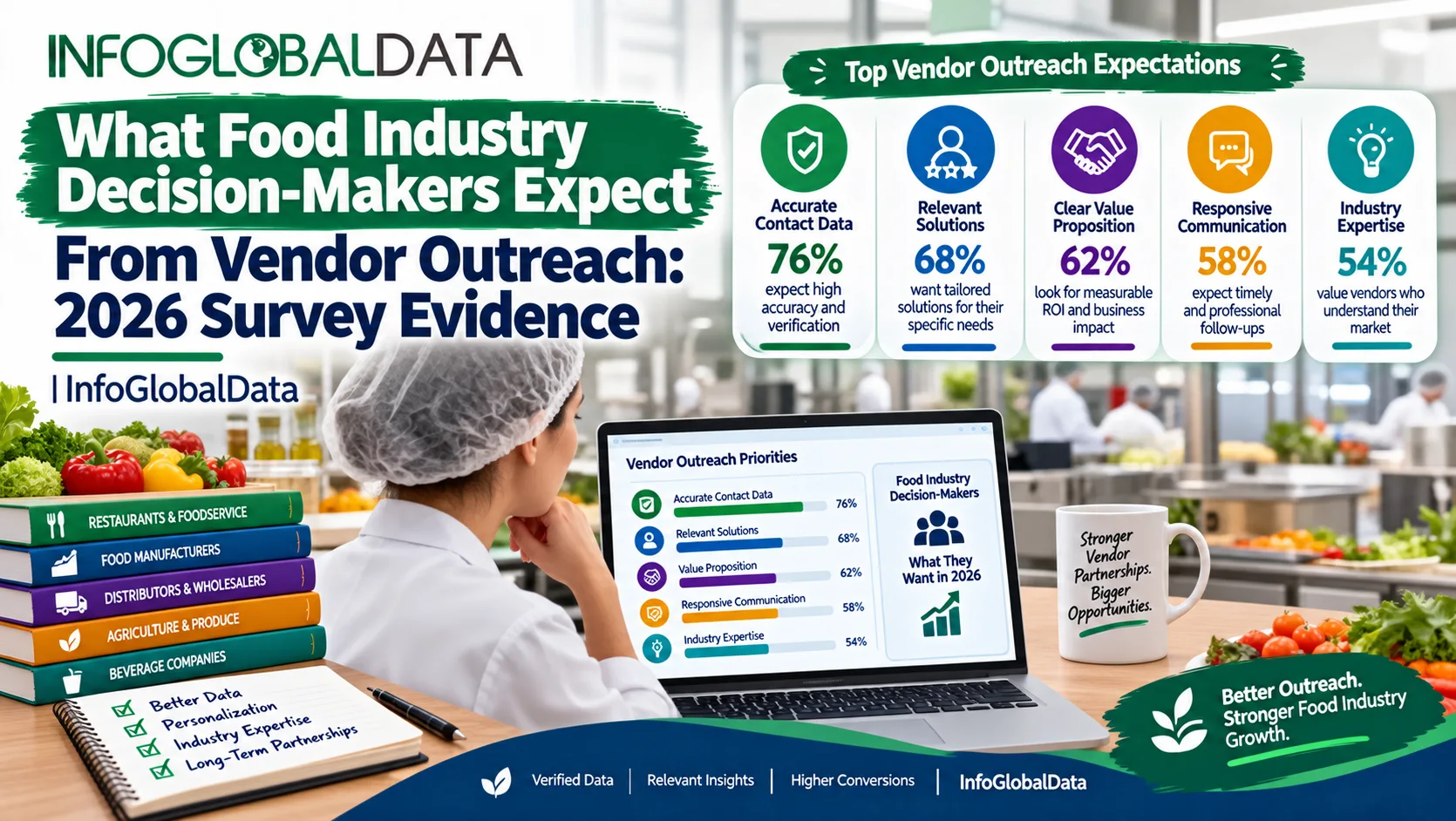
Taken together, recent research suggests five practical expectations.
1. Relevance to a current business problem
Food and beverage leaders are dealing with cost pressures, labor constraints, supply-chain risks, productivity demands, and changing customer expectations. Outreach should connect to one of these issues rather than leading with generic company information.
2. Evidence of business value
Decision-makers need a reason to believe that engaging with a supplier will produce a meaningful outcome.
That could involve lower costs, improved productivity, better availability, reduced risk, faster implementation, or improved customer service.
3. Easy access to supporting information
The buyer should be able to validate the claim through a product page, case study, technical document, demonstration, or other useful resource.
4. Respect for the buyer's time
A concise message with one clear CTA is generally more practical than a long company history or product catalog.
5. Accurate targeting
The message needs to reach someone who has a plausible connection to the problem being discussed. Role, company, industry, and organizational context all matter.
How should marketers measure food-industry vendor outreach?
Open rate alone is an increasingly weak measure of campaign quality.
MailerLite's 2026 benchmark report analyzed more than 3.6 million campaigns from 181,000 approved accounts covering December 2024 through November 2025. The overall median open rate was 43.46%, while the median click rate was 2.09%. MailerLite specifically notes that Apple Mail Privacy Protection can inflate open data, making click activity a more useful engagement signal.
For targeted B2B prospecting, marketers should go further and track:
- delivery and bounce rate,
- click rate,
- positive reply rate,
- qualified conversations,
- meetings booked,
- opportunities created,
- pipeline value,
- unsubscribe rate,
- spam complaints,
- and eventual revenue.
The most useful benchmark is ultimately your own performance across well-defined segments.
5 actionable ways to improve food-industry vendor outreach in 2026
1. Segment by business responsibility
Separate procurement, operations, engineering, quality, supply chain, and executive audiences where possible.
2. Lead with an industry problem
Use current pressures such as labor shortages, supply-chain resilience, productivity, cost efficiency, or compliance as the context for the message.
3. Personalize around the company, not just the name
A first-name merge is not meaningful personalization. Connect the message to company type, manufacturing environment, product category, operational challenge, or role.
4. Give buyers a self-service research path
Link to useful evidence rather than forcing every prospect into a sales call.
5. Test message-market fit systematically
Run controlled tests across subject lines, offers, role segments, and value propositions. Evaluate positive replies and qualified opportunities—not simply opens.
Conclusion
The available 2025–2026 evidence does not support a single universal “food-industry decision-maker response rate,” but it does reveal a consistent pattern: buyers are operating under intense cost, productivity, supply-chain, and operational pressures, while broader B2B research shows increasing resistance to irrelevant outreach.
For marketers, that makes precision more important than volume. A strong Food and Beverage Industry Mailing List should support accurate segmentation, while the message should demonstrate why the offer matters to a particular role and business situation. Vendor outreach in 2026 should function less like a mass promotion and more like a relevant starting point for buyer research.
As food and beverage organizations continue adopting digital procurement, automation, AI, and more resilient supply-chain practices, vendors that combine reliable contact data with useful, role-specific information will be better positioned to earn attention and start qualified conversations.
Frequently Asked Questions
What do food and beverage decision-makers want from vendor outreach?
They increasingly expect relevant information tied to business priorities such as cost efficiency, productivity, supply-chain resilience, availability, and operational performance. Broader B2B research also shows strong resistance to irrelevant supplier outreach.
Which job titles should be targeted in the food and beverage industry?
Relevant roles can include procurement, operations, plant management, engineering, quality, supply chain, regulatory/compliance, and senior management. The appropriate title depends on what the vendor sells and which department controls or influences the purchase.
How can a Food and Beverage Industry Email List improve outreach?
A properly segmented list can help marketers reach contacts by role, company type, geography, seniority, and other relevant characteristics. This makes it easier to align the message with the recipient's responsibilities instead of sending the same offer to an entire industry.
What is a good cold-email response rate for food and beverage prospects?
There is no universally accepted food-and-beverage-specific benchmark. Belkins' 2026 study found a 0.45% overall reply rate across more than 7.5 million B2B cold emails sent in 2025, but that figure covers multiple industries and should not be treated as a food-specific target.
Should food-industry vendors use email or sales representatives?
The evidence supports an integrated approach rather than choosing only one channel. Gartner found that 61% of B2B buyers preferred an overall rep-free experience, while McKinsey's 2026 research shows buyers moving across an average of 10 channels during the purchasing journey.
How often should a Food and Beverage Industry Email Database be updated?
There is no universal refresh interval because data decay varies by market and role. High-value prospect segments should be verified and refreshed regularly, particularly before major campaigns, to reduce bounced messages and outdated contacts.
What metrics should marketers track besides email opens?
Track clicks, positive replies, meetings, qualified opportunities, pipeline, conversions, unsubscribes, spam complaints, and bounce rates. MailerLite notes that privacy protections can distort open-rate data, making click activity a more useful indicator of deliberate engagement.
Why is personalization important for food and beverage vendor outreach?
Food companies have different operational priorities depending on their segment and department. A procurement leader, plant manager, engineer, and executive may evaluate the same product using different criteria, so role-specific messaging can make the outreach more relevant.