Introduction — Where to Start When Everything Feels Overwhelming
Infertility affects more couples than most people talk about openly. In smaller cities like Sivakasi the challenge is not just the medical difficulty but also the lack of clear and reliable information about where to go, who to trust, and what kind of treatment is actually right for your situation.
The number of fertility clinics available today can make the decision feel harder rather than easier. Every clinic website looks professional. Every clinic claims to offer the best care. So how does a couple actually figure out which IVF centre in Sivakasi is genuinely equipped to handle their case?
The answer lies in knowing what questions to ask and what standards to measure a clinic against before you commit to any treatment. This guide walks you through exactly that.
Step One — Start With the Right Diagnosis
The single most important thing a good fertility centre does before recommending any treatment is a complete and thorough diagnosis of both partners. This step is non-negotiable and any clinic that skips it or rushes through it is not working in your best interest.
A proper fertility evaluation for a woman includes blood tests covering key hormones such as FSH, LH, AMH, prolactin, and thyroid function, a transvaginal ultrasound to assess antral follicle count and uterine structure, and a detailed review of menstrual cycle history, previous pregnancies, and any known gynaecological conditions such as PCOS or endometriosis.
For the male partner a comprehensive semen analysis covering sperm count, motility, morphology, and volume is the starting point. In certain cases sperm DNA fragmentation testing is also recommended to check for genetic damage that standard semen analysis does not detect.
Only after both partners have been fully assessed should any fertility specialist recommend a specific treatment pathway. A clinic that immediately quotes IVF pricing at the first consultation without understanding your full picture is one that deserves caution.

Step Two — Understand Which Treatment Is Actually Right for You
Not every couple dealing with infertility needs IVF. In fact many couples achieve pregnancy with simpler and less expensive treatments when the diagnosis is made correctly.
IUI or Intrauterine Insemination is the recommended starting point for couples with mild infertility, unexplained infertility, or borderline sperm parameters. It is a simple outpatient procedure where prepared sperm is placed directly into the uterus during the most fertile window of the cycle. It requires no anaesthesia, no laboratory fertilisation, and significantly less medication than IVF.
IVF or In Vitro Fertilisation becomes the recommended pathway when IUI has been unsuccessful, when fallopian tubes are blocked or damaged, when ovarian reserve is low, or when male factor infertility is moderate to severe. The process involves controlled ovarian stimulation, egg retrieval under sedation, laboratory fertilisation, embryo culture, and transfer of the best-quality embryo back to the uterus.
ICSI or Intracytoplasmic Sperm Injection is a precision technique used within IVF cycles where a single sperm is selected and injected directly into each mature egg. This is particularly effective when sperm quality is a significant concern and conventional IVF fertilisation rates have been poor.
A comprehensive IVF centre in Sivakasi should also offer Frozen Embryo Transfer, Blastocyst Culture and Transfer, Laser Assisted Hatching, Preimplantation Genetic Testing, egg and embryo freezing, PESA and TESA for surgical sperm retrieval, donor egg and sperm programmes, surrogacy, and infertility counselling. Having access to this full range of treatments within one centre means your care is never interrupted by a referral to another clinic mid-journey.

Step Three — Evaluate the Embryology Laboratory
Most couples spend a lot of time researching the doctor and very little time asking about the lab. This is one of the most common and costly oversights in choosing a fertility centre.
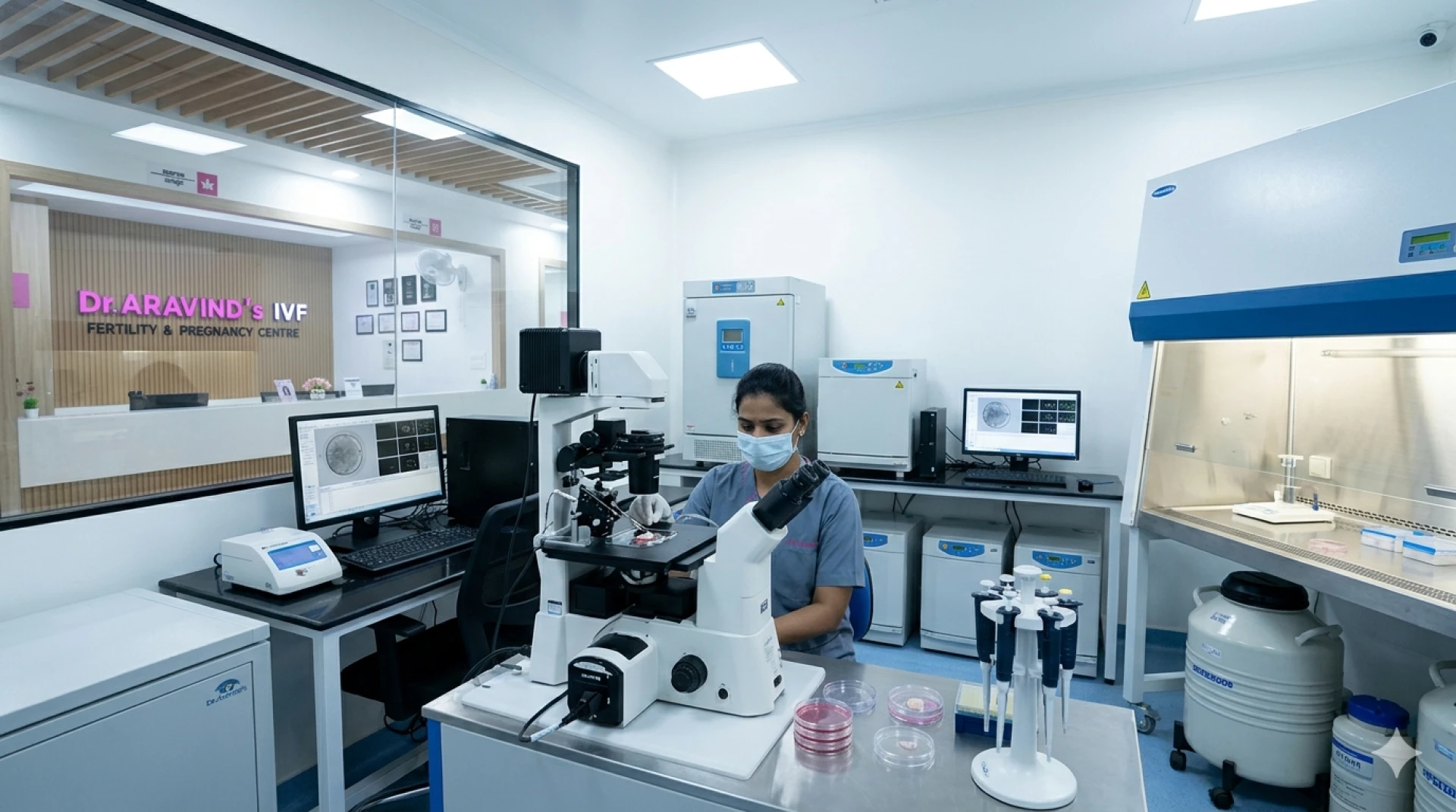
The embryology laboratory is where fertilisation happens, where embryos are cultured for five to six days, and where the most critical grading and selection decisions are made before transfer. The quality of the lab environment directly determines the quality of embryo development.
A good IVF lab uses medical-grade incubators with precise control of temperature, oxygen, carbon dioxide, and humidity. Any fluctuation in these parameters during the culture period can compromise embryo viability.
Modern labs now incorporate time-lapse embryo monitoring systems that record uninterrupted footage of each embryo from fertilisation through to blastocyst stage. This allows the embryology team to observe developmental patterns without opening the incubator and disturbing the controlled environment.
AI-based embryo selection tools analyse this time-lapse footage using pattern recognition trained on large datasets of previous IVF outcomes. This gives a more objective and consistent basis for selecting which embryo to transfer, reducing reliance on visual grading alone which has known limitations in consistency between different embryologists.
Preimplantation Genetic Testing or PGT screens embryos for chromosomal abnormalities before transfer. This is particularly valuable for couples over 37, those with recurrent miscarriage history, or those who have experienced repeated implantation failure.
When you visit a fertility clinic for the first time, bring these questions with you. Ask about their laboratory setup, their fertilisation rates, their blastocyst development rates, and whether they use time-lapse monitoring and AI-assisted embryo selection. How a clinic responds to these questions tells you a great deal about the standard of care they actually deliver.
Dr. Aravind's IVF — A Trusted IVF Centre in Sivakasi
For couples in Sivakasi and surrounding areas including Virudhunagar, Aruppukottai, Rajapalayam, and Sattur, Dr. Aravind's IVF Fertility and Pregnancy Centre offers a fully equipped and experienced fertility care option close to home.
As a trusted IVF centre in Sivakasi the clinic delivers the complete diagnostic and treatment pathway described throughout this guide. Treatments available include IVF, ICSI, IUI, Frozen Embryo Transfer, Blastocyst Culture and Transfer, Laser Assisted Hatching, Preimplantation Genetic Testing, AI-based Embryo Selection, time-lapse embryo monitoring, PESA and TESA, egg and embryo freezing, donor programmes, surrogacy, and infertility counselling.
The fertility team at the Sivakasi centre holds advanced qualifications from institutions in India, Singapore, and Germany. Each couple receives a thorough initial evaluation, a personalised treatment plan built around their specific diagnosis, transparent pricing from the very first consultation, and genuine support throughout every stage of their fertility journey.
The centre treats every couple as an individual case rather than moving patients through a standard protocol. That approach to clinical care is what makes a meaningful difference to outcomes and to the overall experience of going through fertility treatment.
Closing Thought — The Right Centre Is Closer Than You Think
Couples in Sivakasi no longer need to travel to Chennai, Coimbatore, or Bangalore to access quality fertility care. The clinical standards, laboratory technology, and experienced medical teams that define the best fertility treatment in Tamil Nadu are now available locally.
The most important step is simply making the appointment. Go in with your questions, your investigation reports if you have them, and an open mind. One honest consultation with a qualified fertility specialist will give you more clarity than weeks of online searching ever could.
CONTACT DETAILS
Phone — +91 90 2012 2012
Email — [email protected]
Book Appointment — https://www.draravindsivf.com/book-your-appointment
Sivakasi Centre — https://www.draravindsivf.com/sivakasi/sivakasi