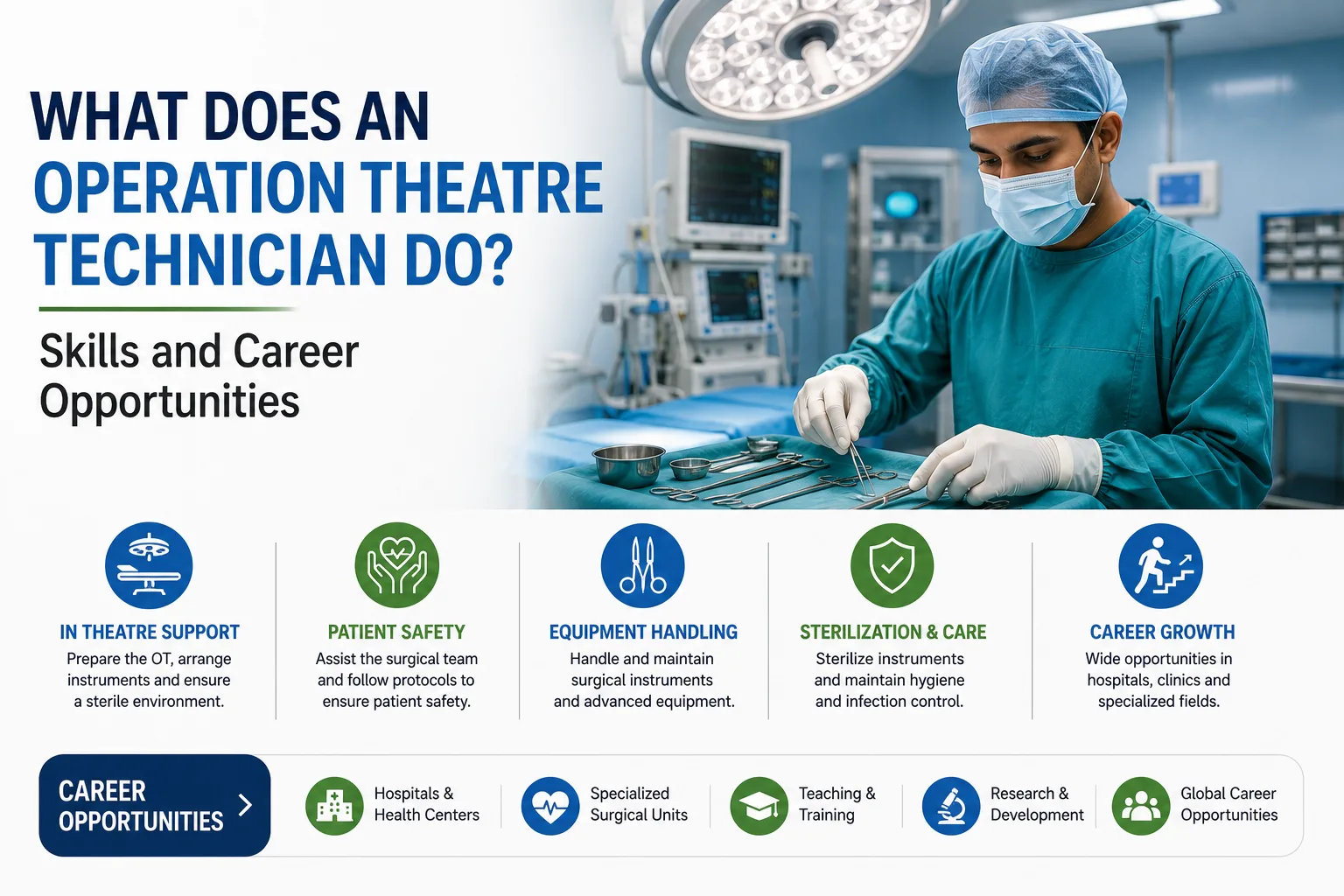
Hospitals are complex environments where different healthcare professionals work together to provide patient care. While doctors, surgeons and nurses are among the most visible members of a healthcare team, many other trained professionals also contribute to the smooth functioning of medical departments.
One such specialized role is that of an operation theatre technician. These professionals support the operational requirements of surgical environments and work alongside healthcare teams by helping maintain organized and properly prepared operation theatre settings.
For students interested in technical healthcare careers, learning about the responsibilities, required skills and educational pathways associated with this field can be a useful first step.
Understanding the Role of an Operation Theatre Technician
An operation theatre technician is trained to support the functioning of an operation theatre according to established healthcare procedures and workplace protocols.
The exact responsibilities of a professional can vary depending on their qualification, experience, workplace and assigned duties. In general, the role may involve supporting the preparation and organization of the operation theatre environment.
Technicians may need to understand medical equipment, basic sterilization concepts, safety procedures and professional protocols related to surgical settings.
Because an operation theatre is a highly structured environment, professionals working in this area need to be responsible, organized and capable of following established instructions carefully.
Educational Pathways for Students
Students interested in this field may explore an operation theatre technician course in Pune to develop foundational knowledge related to operation theatre procedures and healthcare support services.
The curriculum can vary between education providers. Before enrolling, students should carefully review the subjects, duration, eligibility requirements and practical learning opportunities associated with a program.
Depending on the course structure, students may be introduced to topics such as:
- Basic operation theatre procedures
- Medical and surgical equipment awareness
- Sterilization concepts
- Healthcare safety practices
- Patient preparation procedures
- Professional responsibilities
- Infection-control awareness
- Healthcare communication
Students should always verify the latest curriculum directly with the institute because course structures can change.
Why Attention to Detail Is Important
Healthcare professionals often work in environments where following proper procedures is essential. In an operation theatre setting, organization and preparation are important aspects of maintaining an efficient professional environment.
An operation theatre technician needs to understand the importance of following workplace protocols and instructions provided by qualified healthcare professionals.
Attention to detail can help individuals avoid overlooking important steps during assigned responsibilities.
Students considering this career should be comfortable working in structured environments and following established professional practices.
Essential Skills for This Career
Technical knowledge is important, but successful healthcare professionals also require several personal and professional skills.
Students interested in operation theatre technology can benefit from developing:
Teamwork
Healthcare services depend heavily on cooperation between different professionals. Technicians need to work effectively with doctors, nurses and other healthcare staff.
Communication
Clear communication is important in professional healthcare environments. Students should learn how to communicate respectfully and effectively with colleagues.
Discipline
Operation theatre environments follow structured procedures. Being punctual, responsible and disciplined can help professionals perform their duties effectively.
Technical Awareness
Students should develop a good understanding of the equipment and procedures relevant to their educational training.
Ability to Follow Procedures
Healthcare environments use established protocols to support safety and professional standards. The ability to understand and follow instructions is therefore valuable.
The Importance of Practical Learning
Operation theatre technology is a practical field. Classroom education can help students understand concepts, terminology and professional responsibilities, but practical learning can provide additional insight into healthcare environments.
Before selecting a program, students should investigate the practical learning opportunities available.
Important questions include:
- Does the course include hands-on learning?
- What type of facilities are available?
- Are students introduced to relevant equipment?
- Is professional safety included in the training?
- Does the curriculum combine theoretical and practical education?
Practical exposure can help students understand how classroom concepts connect with professional workplace environments.
Career Environment and Professional Growth
Depending on qualifications, experience and available opportunities, trained professionals may explore roles within hospitals and healthcare facilities where surgical services are provided.
Career growth can also depend on factors such as practical experience, additional education, technical skill development and professional performance.
Healthcare is an evolving field, and students can benefit from maintaining a willingness to learn throughout their professional journey.
Choosing the Right Educational Program
Students should avoid selecting a course based only on its name or duration. A detailed comparison of different education options can help them make a better decision.
Before applying, consider:
- Eligibility requirements
- Course duration
- Curriculum
- Practical training
- Learning facilities
- Faculty support
- Future education opportunities
It is also important to confirm current course details directly with the education provider.
Final Thoughts
Operation theatre technology can be an interesting career pathway for students who want to work in a technical and organized healthcare environment.
The field requires a combination of professional discipline, technical understanding, teamwork and attention to detail. Choosing an appropriate educational program and gaining meaningful practical exposure can help students develop a strong foundation.
For anyone considering a future in healthcare support services, taking the time to understand the responsibilities associated with operation theatre technology can be an important first step toward making an informed career decision.