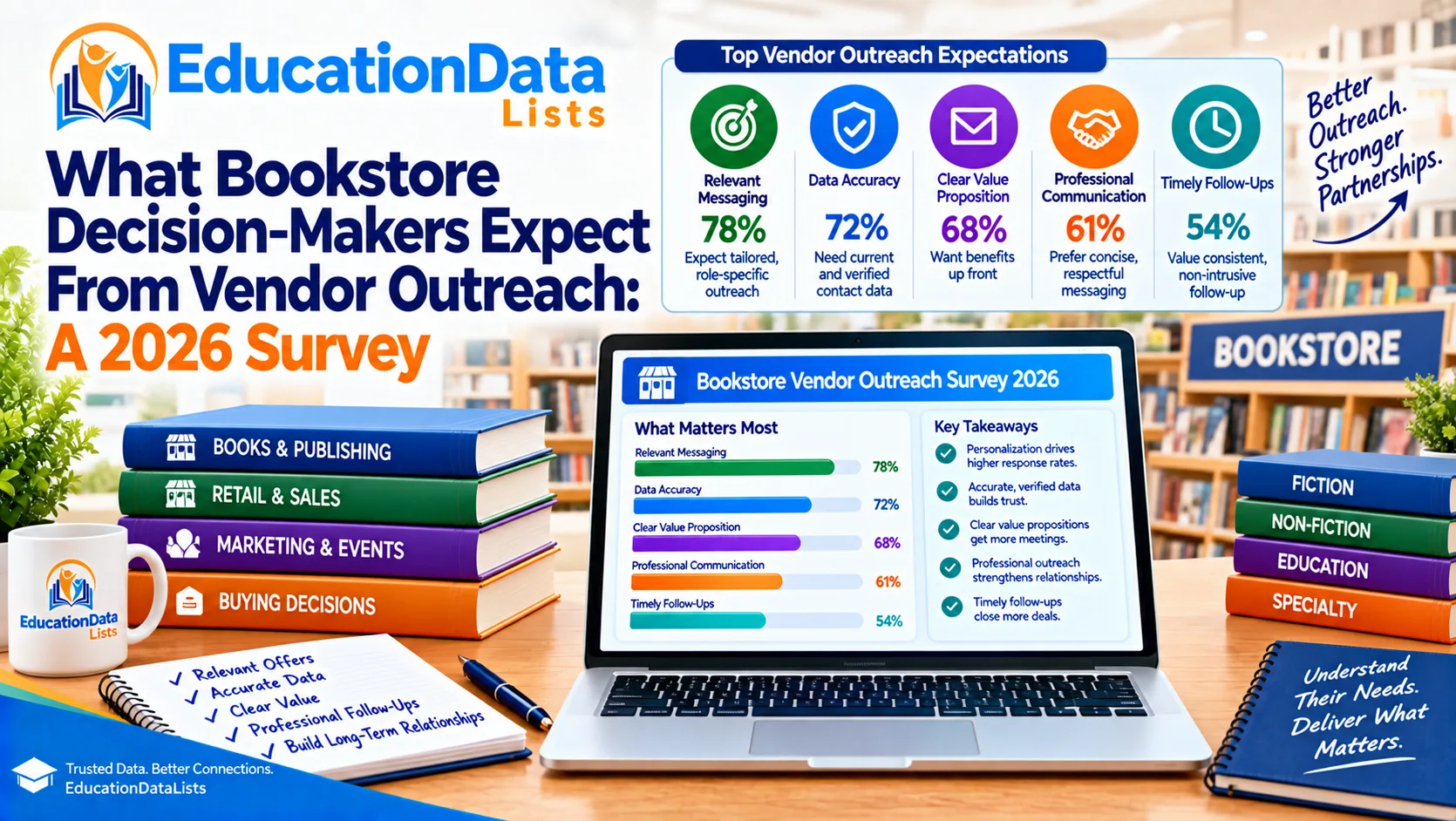
Bookstore decision-makers are operating in a market where sales, e-commerce, inventory technology, and supplier relationships are all changing rapidly. The American Booksellers Association's 2025 sales survey, published in January 2026, found that 73.3% of 382 responding member bookstores reported higher sales in 2025 than in 2024, while 66.3% reported stronger holiday sales.
At the same time, bookstore buyers face increasingly complex vendor choices. Technology platforms, publishers, distributors, marketing providers, payment systems, and other suppliers are competing for limited attention. This research-informed 2026 analysis examines what current evidence suggests bookstore decision-makers expect from vendor outreach: relevance, concise information, practical value, easy self-service research, credible data, and a clear understanding of bookstore operations. For marketers using a Bookstore Mailing List, those expectations have direct implications for segmentation, personalization, and campaign design.
What Do Bookstore Decision-Makers Expect From Vendor Outreach in 2026?
The evidence points to six broad expectations:
- Relevance to the bookstore's actual needs
- Concise, useful information
- Clear business value
- Easy access to additional information
- Evidence that the vendor understands bookselling
- Human support when expertise or validation is needed
These expectations align with the broader B2B buying environment. Gartner's 2026 survey of 646 B2B buyers found that 67% preferred a rep-free buying experience, while 70% preferred a completely digital, self-service experience. Yet Gartner also found that 69% of buyers preferred validating AI-generated insights with sales representatives.
The implication for bookstore vendors is not that salespeople have become irrelevant. Rather, outreach needs to make it easy for a buyer to investigate independently before offering human assistance where it adds value.
1. Relevance Matters More Than Outreach Volume
The first expectation is simple: vendors need to understand who they are contacting.
Gartner's 2025 survey of 632 B2B buyers found that 73% actively avoided suppliers that sent irrelevant outreach. The same research found that 61% preferred an overall rep-free buying experience.
For bookstore marketers, this makes segmentation particularly important.
A bookstore owner evaluating a point-of-sale system does not necessarily need the same information as a purchasing manager considering a publishing distribution arrangement. Likewise, a children's bookstore, university bookstore, independent general bookstore, and multi-location chain may have very different priorities.
A Bookstore Email List becomes considerably more useful when contacts can be segmented by factors such as:
- Store type
- Number of locations
- Buyer or owner role
- Product category
- Geographic market
- E-commerce presence
- Technology environment
- Independent versus chain status
The objective should not be to send more emails. It should be to reduce the number of irrelevant ones.
2. Buyers Want Information They Can Evaluate Independently
Bookstore decision-makers increasingly have access to digital research before speaking with a vendor.
Gartner's 2026 research found that B2B buyers used an average of seven information sources during a recent purchase, with 45% reporting that they had used generative AI. Sixty-seven percent preferred a rep-free experience, while 70% preferred completely digital self-service buying.
This creates an important implication for vendor email.
The email does not necessarily need to contain every detail. Instead, it should give the buyer enough context to determine whether the solution deserves further investigation.
Effective outreach can therefore include:
- A specific problem addressed
- A concise explanation of the solution
- Relevant bookstore use cases
- Pricing or commercial information where appropriate
- A useful resource or demonstration
- A clear next step
A generic message saying "we help retailers grow" gives the recipient little reason to continue researching.
3. Operational Value Is More Persuasive Than Generic Benefits
Current bookstore-industry activity shows that operational efficiency remains a major consideration.
The American Booksellers Association's 2025 programing included dedicated sessions around POS and inventory-control systems, while its education resources highlighted integrating POS data into inventory management and Edelweiss analytics.
The industry's technology ecosystem is also becoming more interconnected. In 2026, Ingram announced its new Covered digital catalog and ordering platform, designed to provide publisher catalogs, reviews, tags, buying tools, order exports, and selected point-of-sale integrations.
That tells vendors something important about bookstore buyers: technology is increasingly evaluated in terms of workflow, not simply features.
A vendor message should therefore answer questions such as:
- Will this reduce administrative work?
- Does it integrate with existing systems?
- Can staff learn it quickly?
- Will it improve inventory visibility?
- Does it support online and physical sales?
- Can it reduce operational friction?
For a Bookstore Mailing List, these operational signals provide useful segmentation and personalization opportunities.
4. Integration Can Be a Stronger Message Than Innovation
"New technology" is not automatically a compelling value proposition.
Bookstores often operate with established systems and workflows. A new vendor must demonstrate how its solution fits into that environment.
The ABA reported that 90% of IndieCommerce 1.0 stores had successfully migrated to IndieCommerce 2.0 by the end of 2025, while IndieCommerce sales increased 21.52% from 2024.
Bookshop.org is also pursuing deeper point-of-sale integration. The company reported nearly $70 million in 2025 revenue, up 55% from 2024, and said deeper POS integration was a major strategic priority for 2027. It also began piloting automated email-marketing tools for smaller bookstore partners in 2026.
These developments suggest that bookstore decision-makers have reason to pay attention to vendors that demonstrate compatibility with existing infrastructure.
Consequently, outreach should explain how a product fits into the current workflow, not just how advanced the technology is.
5. Buyers Want Concise Communication
Bookstore teams often have limited staff and competing operational responsibilities.
The Booksellers Association's 2025/26 workforce survey collected responses from 347 individuals across 227 UK and Irish bookshops. The organization describes the research as part of a continuing effort to understand the bookselling workforce and the barriers affecting the profession.
Meanwhile, Bookshop.org's 2026 reporting highlights its efforts to provide automated email-marketing tools specifically for smaller bookstore partners that lack the staff to sustain regular outreach.
These developments provide context for why brevity matters.
A vendor email should make its value understandable quickly. A practical structure is:
Problem → Solution → Evidence → Next step
For example, rather than explaining every platform feature, an email could identify an inventory challenge, explain the relevant capability, provide one supporting result, and link to a detailed resource.
6. Human Expertise Still Matters When the Decision Becomes Complex
The shift toward self-service does not mean bookstore buyers want every interaction automated.
Gartner's 2026 survey found that 69% of B2B buyers preferred to use sales representatives to validate AI-generated insights. Buyers were also more likely to use sellers when they needed contextual guidance or decision support.
This distinction is particularly relevant to bookstore technology and supply-chain decisions.
A buyer may research a vendor independently but still want to speak with someone who understands:
- Bookstore workflows
- Inventory challenges
- Publishing relationships
- POS integration
- E-commerce operations
- Staff training
- Implementation requirements
Vendor outreach should therefore provide both paths: self-service information for initial evaluation and knowledgeable human support when the buyer needs context.
7. Trust and Industry Knowledge Can Differentiate Vendor Messages
The bookselling industry is also dealing with rapid changes in technology and AI.
A 2025 Book Industry Study Group survey covered 559 North American book-industry professionals across publishers, libraries, manufacturers, retailers, consultants, and service providers. It found that 46% of individuals and 48% of organizations were using AI, while 98% reported significant concerns about AI implementation.
The finding is relevant to vendor outreach because "AI-powered" is not necessarily enough to establish credibility.
Bookstore decision-makers may want to know:
- What data does the system use?
- How is customer or business information handled?
- Can staff control the output?
- What does implementation require?
- Does the technology integrate with existing systems?
- What measurable business problem does it solve?
For vendors selling AI-enabled products, transparency can therefore be more useful than exaggerated claims about automation.
8. The Bookstore Market Is Active, but Buyers Still Need Business Justification
The broader market provides another reason for vendors to focus on measurable value.
The Association of American Publishers reported that U.S. publishing industry sales reached $33.4 billion in 2025, up 2.5% from 2024, while physical-store sales increased 6% to approximately $5 billion.
Independent bookstores also reported positive performance. In the ABA's 2025 survey, 73.3% of respondents said their sales increased year over year, while Bookshop.org reported that in-store sales grew for 73% of ABA members in 2025 and e-commerce sales increased 25%.
However, growth does not eliminate operational pressure.
Vendor outreach should connect its offer to outcomes such as:
- Higher sales
- Lower operating costs
- Faster workflows
- Better inventory decisions
- Increased customer retention
- Improved e-commerce performance
- Reduced administrative work
The more clearly a vendor connects its solution to a bookstore's business objective, the easier it becomes for a decision-maker to evaluate.
What Should a Bookstore Mailing Database Include?
A useful Bookstore Mailing Database should support more than basic email delivery.
Relevant fields may include:
- Contact name
- Professional email
- Job title
- Store name
- Number of locations
- Store type
- Website
- Geographic location
- Buyer category or responsibility
- E-commerce presence
- Technology information where available
- Verification date
These fields make it possible to create smaller, more relevant segments.
For example, a vendor selling inventory-management technology could prioritize bookstore owners and operations leaders rather than sending the same message to every employee in the database.
The principle is consistent with Gartner's 2025 research: buyers are increasingly resistant to irrelevant outreach.
How Should Vendors Structure Outreach to Bookstore Decision-Makers?
A practical vendor email can follow this five-part framework:
1. Start with a bookstore-specific problem
Reference inventory, e-commerce, ordering, staffing, customer engagement, or another genuine business issue.
2. Explain the value quickly
State what the vendor does and what operational outcome it supports.
3. Provide evidence
Use a case study, benchmark, customer result, demonstration, or relevant industry example.
4. Make independent research easy
Link to a product page, comparison, demo, pricing information, documentation, or educational resource.
5. Offer human assistance without forcing it
Give buyers the option to speak with a specialist when they need help evaluating fit.
This approach reflects the current B2B environment: self-directed research first, contextual sales assistance when needed.
5 Practical Takeaways for Vendors Targeting Bookstores
1. Segment before sending.
A bookstore owner, buyer, operations manager, and technology decision-maker may have different priorities.
2. Lead with operational value.
Show how the solution affects inventory, sales, staffing, e-commerce, or workflow.
3. Keep the initial message concise.
Give buyers enough information to decide whether further research is worthwhile.
4. Make self-service research easy.
Provide useful supporting material instead of requiring an immediate sales conversation.
5. Combine automation with expertise.
Use automated outreach for scale, but make knowledgeable human support available when buyers need validation or contextual guidance.
For vendors that need to build targeted bookstore audiences, EducationDataLists can provide a resource for identifying relevant bookstore contacts and creating more focused prospecting segments. The effectiveness of the resulting campaign still depends on data freshness, segmentation quality, message relevance, and appropriate outreach practices.
Conclusion
The evidence available in 2026 does not support the claim that bookstore decision-makers have one universal preferred form of vendor outreach. It does, however, reveal a consistent pattern. Current B2B research shows that buyers increasingly prefer self-directed digital research and actively avoid irrelevant outreach, while bookstore-industry developments demonstrate growing demand for practical technology, integration, operational efficiency, and measurable business value.
For vendors using a Bookstore Mailing List, the implication is clear: successful outreach should be less about maximizing message volume and more about improving relevance. Accurate contact data, role-based segmentation, concise messaging, credible evidence, and easy access to information can help vendors fit the way bookstore professionals increasingly evaluate suppliers. As bookstores continue investing in digital commerce, inventory technology, and new customer-engagement tools, vendors that understand those operational priorities will be better positioned to start useful conversations.
Frequently Asked Questions
What do bookstore decision-makers expect from vendor outreach?
Current evidence suggests that buyers value relevance, concise information, clear business value, easy self-service research, and knowledgeable support when decisions become complex. Gartner's 2026 research found that 67% of B2B buyers preferred a rep-free experience, while 69% wanted sales representatives to validate AI-generated insights.
How can a Bookstore Mailing List improve vendor outreach?
A properly segmented list can help vendors tailor messages according to store type, decision-maker role, location, size, and business needs. This is important because Gartner found that 73% of B2B buyers actively avoid suppliers that send irrelevant outreach.
What information should a Bookstore Email List contain?
Useful records can include the contact's professional email, name, job title, bookstore, location, store type, number of locations, website, and relevant business or technology attributes. Verification dates can also help marketers identify records that require updating.
Why is POS integration important to bookstores?
POS integration can connect sales and inventory information across physical and online operations. Current ABA and industry initiatives show continued attention to POS, inventory analytics, e-commerce integration, and ordering technology.
Are bookstores investing in e-commerce?
Yes. The ABA reported that IndieCommerce sales increased 21.52% in 2025 compared with 2024, while Bookshop.org reported that e-commerce sales among ABA members increased 25% in 2025.
Should vendors use AI in outreach to bookstores?
AI can support segmentation, research, personalization, and content production, but bookstore-industry research shows that AI adoption is accompanied by significant concerns. A 2025 BISG survey found that 48% of organizations represented by respondents were using AI, while 98% reported significant concerns about implementation.
How often should a Bookstore Mailing Database be updated?
There is no universal update interval because bookstore contacts and responsibilities change at different rates. Vendors should monitor bounce rates, role changes, engagement, and organizational changes and prioritize older or uncertain records for revalidation.
What makes bookstore vendor emails more relevant?
Start with the recipient's role and bookstore context rather than generic industry language. Messages should connect the vendor's product to a specific operational or commercial problem and provide evidence that allows the recipient to evaluate the offer independently.
Do bookstore buyers still want to talk to sales representatives?
Yes, but generally at specific points in the buying process rather than necessarily throughout it. Gartner's 2026 research found that buyers increasingly favor self-service while still turning to sales representatives for validation, context, and decision support.