Introduction
The U.S. Department of Education's 2025 Annual Report to Congress on the Individuals with Disabilities Education Act (IDEA) states that more than 8 million children were served under IDEA in 2024. This represents a substantial market for education technology providers developing assistive tools, accessible learning platforms, assessment systems, and specialized instructional resources. However, reaching this market requires more than a general teacher contact database. Special education technology purchases can involve teachers, special education directors, district administrators, technology leaders, and procurement teams. EdTech companies need to understand who influences product selection, who controls budgets, and who evaluates accessibility before building outreach campaigns. A targeted Special Education Teacher Email List can help identify relevant professionals, but effective prospecting depends on reaching the wider institutional decision-making network.
1. Understand the Different Roles in Special Education Purchasing
General teacher databases rarely provide enough detail to identify the people responsible for evaluating and purchasing specialized education technology. A special education teacher may use a product daily, but the decision to adopt it across a school or district can involve several other professionals.
The U.S. Department of Education's 2025 IDEA report confirms the scale of this audience: more than 8 million children received services under IDEA in 2024. It also reports that 67.8% of school-aged students with disabilities spent at least 80% of their school day in regular classrooms in 2023. This inclusion trend makes coordination between general education, special education, and technology teams especially important.
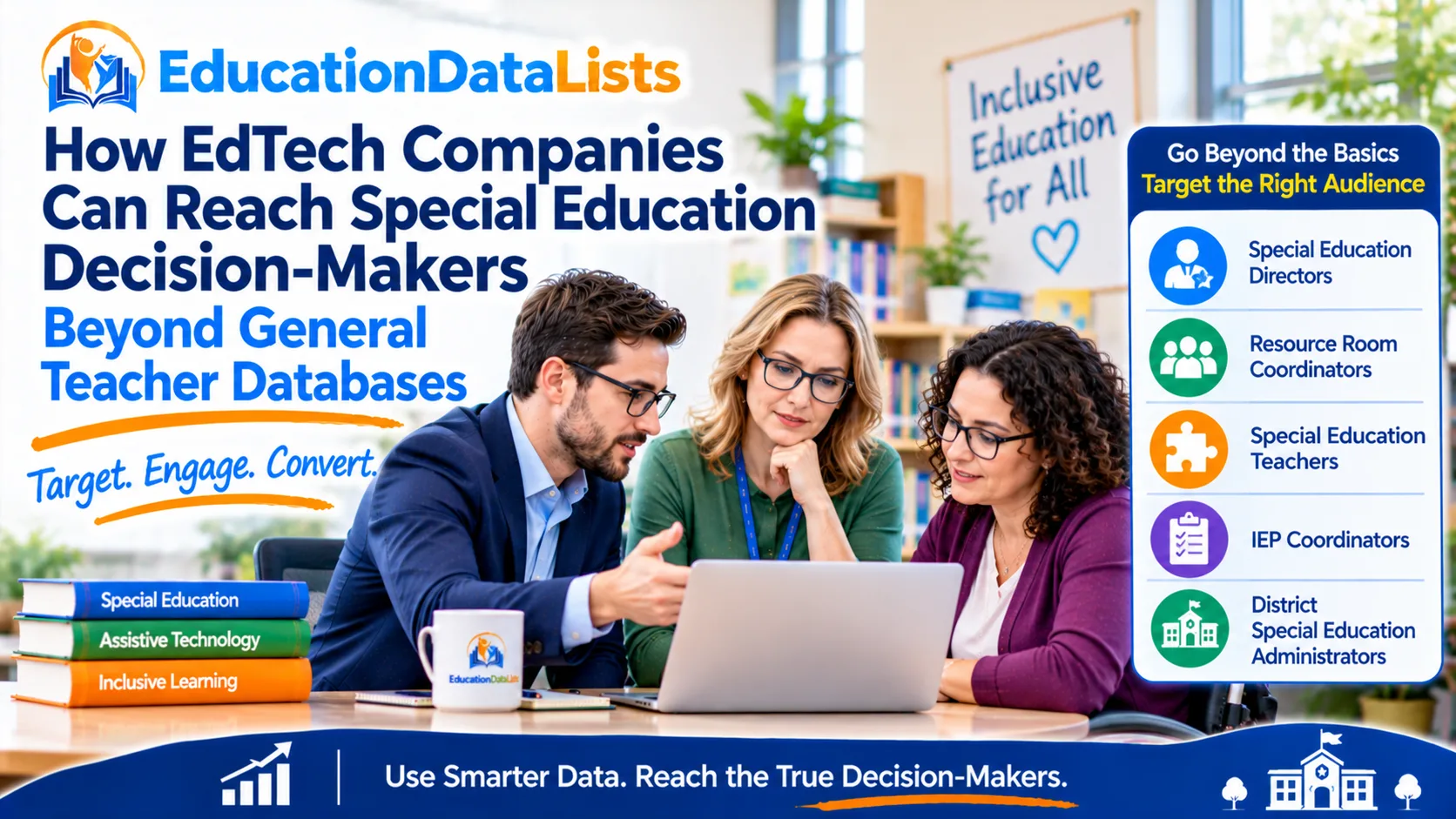
EdTech companies should distinguish among these roles:
- Special education teachers: Evaluate classroom usability, instructional relevance, and student needs.
- Special education directors: Oversee programs, staffing, services, and specialized resource requirements.
- Directors of student services: May coordinate special education, student support, and related services.
- School principals: Influence school-level priorities, implementation, and resource allocation.
- District technology leaders: Evaluate security, integration, infrastructure, and technical support.
- Procurement and finance teams: Review purchasing procedures, budgets, contracts, and vendor requirements.
A Special Education Teacher Email List can help vendors reach classroom professionals, but it should be complemented by contacts responsible for program leadership and institutional purchasing.
2. Target Special Education Administrators Who Understand Program Requirements
Special education administrators are important prospects because they oversee programs that operate under specific educational and legal requirements. They may evaluate whether a proposed platform supports individualized instruction, assessment workflows, accessibility, progress monitoring, or coordination among educators and families.
Staffing pressures make this audience particularly relevant. In a January 2025 Dear Colleague Letter, the U.S. Department of Education's Office of Special Education Programs (OSEP) reported that 45% of schools had vacancies in special education roles and 78% had difficulty hiring special education staff. The letter also highlighted concerns about workload, role clarity, staff morale, and administrative support.
For EdTech providers, these challenges point toward practical conversations about reducing administrative burdens, supporting instructional planning, and helping educators manage specialized responsibilities. They do not mean every district is ready to purchase new software.
Relevant contacts include:
- Director of Special Education
- Assistant Superintendent of Student Services
- Special Education Program Coordinator
- Director of Exceptional Student Education
- Special Services Administrator
- District 504 or Student Support Coordinator, where relevant
A well-segmented Special Education Teacher Mailing List should not be treated as a substitute for these leadership contacts. Marketers should build separate audience segments for classroom users, program administrators, and purchasing stakeholders.
3. Include Technology Leaders in Accessibility and Product Evaluation
Special education technology does not operate independently of a district's wider technology environment. Products may need to integrate with learning management systems, student information systems, identity platforms, classroom devices, and existing accessibility tools.
CoSN's 2026 U.S. State of EdTech report, based on responses from more than 600 education technology leaders across 44 states, highlights a significant procurement gap. Only 26% of respondents said accessibility and WCAG 2.1 AA compliance were regularly considered when purchasing digital content, while just 11% reported formal procurement policies requiring it.
This matters because a product can be instructionally useful but still create barriers if students cannot navigate it with assistive technology or access its content in an appropriate format.
EdTech vendors should identify district-level contacts such as:
- Chief Technology Officer
- Chief Information Officer
- Director of Educational Technology
- Instructional Technology Director
- Digital Accessibility Coordinator
- Assistive Technology Specialist
These professionals may not own the special education budget, but they can influence technical approval, accessibility evaluation, integration, and implementation. A campaign built around a Special Education Teacher Email Database should therefore include relevant technology and accessibility stakeholders when the product requires district-wide approval.
4. Look Beyond Individual Schools to District-Level Decision-Makers
A school-level teacher may recommend a tool, but district-wide adoption often involves administrators who manage budgets, technology standards, and procurement. Companies that target only individual teachers can miss opportunities to reach buyers responsible for approving broader deployments.
The January 2025 OSEP letter emphasized the role principals play in special educator retention and the need for administrators to understand special education personnel responsibilities. This illustrates why outreach should consider both program-level and institutional leadership.
For district-wide EdTech products, relevant contacts may include:
- Superintendent or assistant superintendent
- Director of Special Education
- Executive Director of Student Services
- Chief Academic Officer
- Chief Technology Officer
- District purchasing or procurement director
The appropriate contact depends on the product. An assistive communication tool may first require evaluation by special education and speech-language professionals, while a district-wide accessible learning platform may also require technology, curriculum, accessibility, and procurement approval.
EdTech companies should map the purchasing process rather than assume that a single job title controls every decision.
5. Segment Prospects by Student Needs and Product Application
A general special education contact database may contain relevant professionals, but it does not necessarily reveal whether their institutions serve the students or programs a particular product is designed to support.
For example, a company selling communication technology may need to reach schools with relevant assistive communication programs. A reading intervention platform may be more appropriate for special education leaders and literacy specialists. An assessment provider may need to engage school psychologists, evaluation teams, and special education administrators.
The 2025 IDEA report provides useful context: 67.8% of school-aged students with disabilities spent 80% or more of their school day in regular classrooms in 2023. This demonstrates the importance of solutions that can work across inclusive classroom environments rather than assuming specialized instruction takes place only in separate settings.
Useful segmentation dimensions include:
- Public, private, charter, and specialized schools.
- Elementary, middle, and high-school levels.
- District size and geographic region.
- Special education program structure.
- Assistive technology and accessibility responsibilities.
- Relevant professional role and purchasing influence.
The objective is to match the product's actual application with the institutions and professionals most likely to evaluate it. Avoid inferring that a school serves a particular disability group or has a specific unmet need without reliable evidence.
6. Make Contact Data Part of a Broader Account-Based Outreach Strategy
Even a carefully segmented contact list cannot replace institutional research. EdTech vendors should understand a prospect's technology environment, program priorities, accessibility requirements, and purchasing structure before initiating outreach.
CoSN's 2026 findings show why this preparation matters: accessibility is not yet consistently embedded in district digital-content procurement. A vendor that can explain how its product supports accessible use, integrates with existing systems, and protects student information may have a more relevant conversation with technology and special education leaders.
A reliable Special Education Teacher Email Database should support this strategy with accurate professional details, such as:
- Current job title and institutional affiliation.
- School or district name and location.
- Professional email address.
- Department or program information, where available.
- Relevant role or specialization.
- Verification and update information.
Use this data to build coordinated outreach to classroom users, program leaders, and technical evaluators. Keep messaging specific to each role: teachers need to understand classroom value, administrators need program-level evidence, and technology teams need technical and accessibility documentation.
Practical Takeaways for EdTech Marketers and Sales Teams
To reach special education decision-makers more effectively, companies should move beyond broad teacher targeting and build institution-level prospecting strategies.
- Create separate contact segments: Distinguish special education teachers, program directors, student services administrators, technology leaders, and procurement professionals.
- Map the buying committee: Identify who uses the product, who evaluates it, who approves the budget, and who manages implementation.
- Prioritize accessibility evidence: Prepare clear information about WCAG conformance, assistive technology compatibility, usability, and product limitations.
- Research institutional context: Review district technology plans, special education program information, procurement notices, and publicly available strategic priorities before outreach.
- Maintain accurate contact records: Verify professional email addresses, job titles, and institutional affiliations. Remove duplicate and outdated records and honor applicable opt-out requirements.
EducationDataLists provides education-sector contact data that can help B2B marketers identify relevant professional audiences. Its Special Education Teacher Email List can support targeted prospecting, while additional research and role-based segmentation help vendors reach the wider network involved in evaluating and purchasing special education technology.
Conclusion
Reaching special education decision-makers requires a broader approach than using general teacher databases. Classroom educators provide valuable insight into daily instructional needs, but program directors, student services administrators, technology leaders, and procurement teams can all influence product adoption. Recent IDEA, OSEP, and CoSN findings demonstrate the scale of special education services, the pressure on specialist staffing, and the importance of accessibility in technology purchasing. EdTech companies that map these roles, segment institutions carefully, and prepare evidence-based product information can build more relevant outreach campaigns. A targeted Special Education Teacher Email List is a useful starting point, but successful engagement depends on understanding the full institutional buying process.
Frequently Asked Questions
1. Who are the main decision-makers for special education technology?
Common stakeholders include special education directors, program coordinators, student services administrators, school principals, technology directors, and procurement managers. Special education teachers and assistive technology specialists may also influence product evaluation and classroom adoption.
2. Why are general teacher databases insufficient for special education outreach?
General teacher databases may not distinguish special education professionals from general classroom educators or identify administrators responsible for program budgets and purchasing. They may also lack the role and institutional details needed for account-based targeting.
3. What is a Special Education Teacher Email List used for?
It helps education technology vendors, publishers, and service providers reach special education professionals with relevant business information. Appropriate topics include assistive technology, accessible learning platforms, instructional resources, assessment tools, and professional development.
4. Should EdTech companies contact special education directors or teachers first?
The best starting point depends on the product. Classroom-focused tools may benefit from teacher feedback, while district-wide platforms often require early engagement with special education administrators and technology leaders.
5. Why should technology directors be included in special education campaigns?
Technology directors may evaluate cybersecurity, system integration, accessibility, infrastructure, and technical support requirements. Their involvement can be important when a product needs district-wide approval or integration with existing systems.
6. What information should a Special Education Teacher Email Database contain?
Useful fields include professional name, current job title, school or district, location, professional email address, and relevant department or specialization where available. Buyers should also evaluate verification practices, update frequency, duplicate handling, and permitted use.
7. How can EdTech vendors make special education outreach more relevant?
They should segment prospects by role, institution type, program responsibilities, and product application. Messaging should address a specific educational or operational need and provide clear information about accessibility, usability, data protection, and implementation.