Choosing among the best merchant account providers is one of the first payment decisions a US business has to make. Whether you run an eCommerce store, a SaaS platform, a subscription business, a retail shop, or a growing enterprise, the right payment partner affects how you accept cards, how fast you get paid, and how much of every sale you keep.
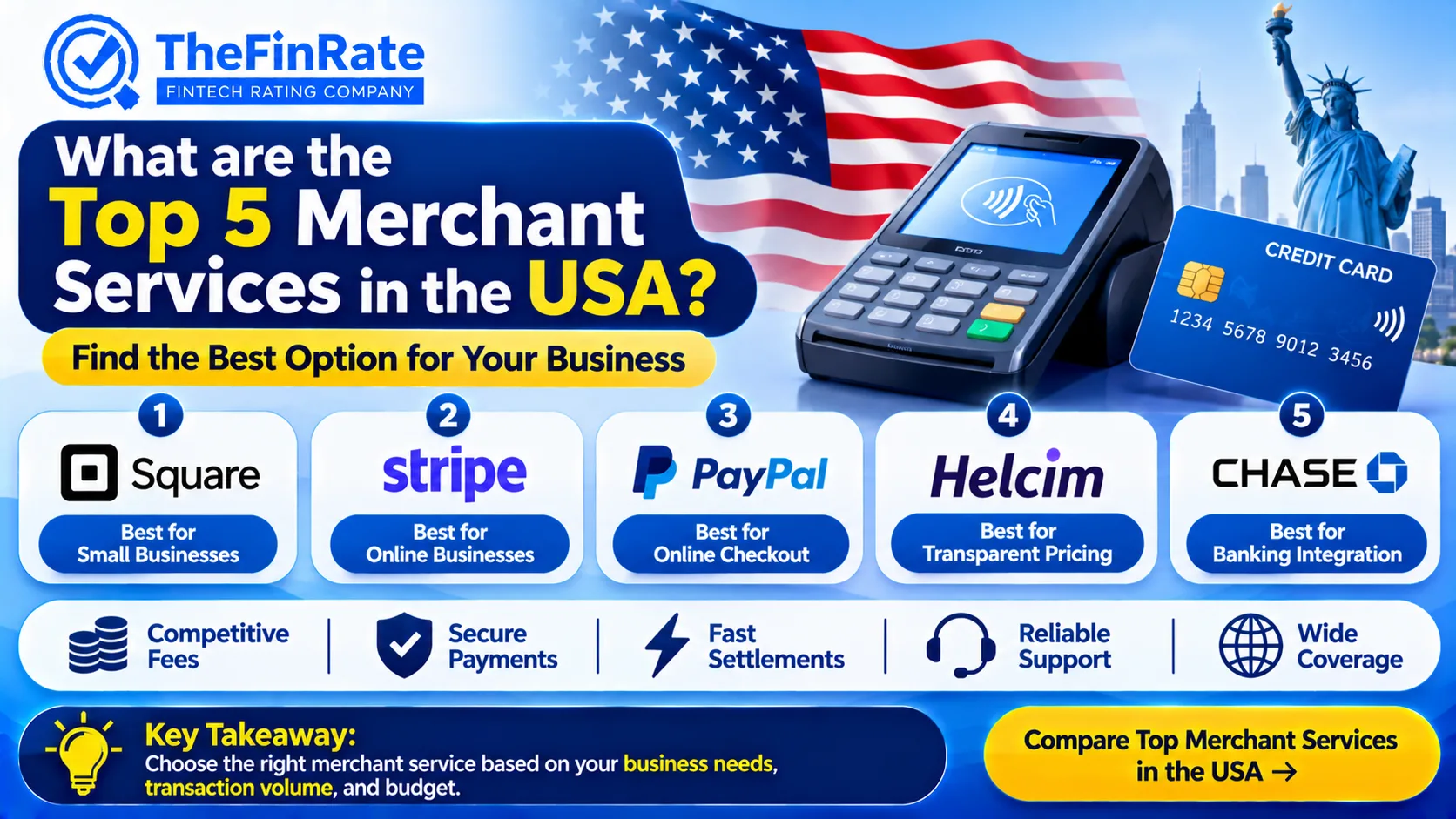
The top 5 merchant services in the USA for 2026, based on how widely they are used, how transparent their published pricing is, and the range of businesses they serve, are Stripe, Square, Clover, Helcim, and Chase Payment Solutions. They are not interchangeable. Some are payment service providers (PSPs) that let you start accepting cards quickly. Others offer dedicated merchant accounts with interchange-plus pricing. Their fees, hardware, settlement terms, and eligibility rules differ.
What Is a Merchant Account Provider?
A merchant account provider is a financial institution or payment service company that helps businesses establish the infrastructure required to accept credit and debit card payments.
These providers facilitate payment processing through acquiring banks, card networks, payment processors, and other financial technology systems.
Depending on the arrangement, merchant account providers may offer:
- Merchant account setup
- Credit and debit card processing
- Online payment gateway integration
- Point-of-sale (POS) hardware and software
- Multi-currency processing
- Fraud prevention tools
- Chargeback management
- Transaction reporting
- Payment settlement services
- Recurring payment processing
In the USA, businesses can obtain merchant services through acquiring banks, independent sales organizations (ISOs), payment service providers, and specialized payment processing companies. The right solution depends on the business model, transaction volume, industry, and payment requirements.
How Do Merchant Account Providers Work?
Merchant account providers connect businesses with the payment infrastructure required to process electronic transactions.
1. Customer Initiates a Payment
A customer buys a product or service using a supported credit or debit card, in person or online.
2. Payment Information Is Submitted
The transaction details are securely sent through the merchant's POS system, payment gateway, or checkout page.
3. Payment Authorization
The request moves through the payment processor and the relevant card network to the customer's issuing bank.
4. Transaction Approval or Decline
The issuing bank evaluates the request and returns an authorization response.
5. Payment Settlement
Approved transactions enter the clearing and settlement process.
6. Merchant Receives Funds
The acquiring institution or payment provider deposits the funds according to the merchant's agreement and settlement schedule.
Customers usually see this process finish in seconds, but several financial institutions and technologies work together behind the scenes. To understand the gateway layer in more detail, read our explainer on how a payment gateway works.
Top 5 Best Merchant Account Providers in the USA (2026)
Finding the right merchant account provider means comparing companies by services, supported business types, pricing structure, and payment capabilities. The table below summarizes the five providers covered in this guide.
Top Merchant Account Providers Comparison
| Provider | Best For | Key Features to Evaluate |
|---|---|---|
| 1. Stripe | Online businesses, SaaS, subscriptions | Developer tools, global payments, recurring billing |
| 2. Square | Small businesses and retail | All-in-one POS, fast onboarding, hardware |
| 3. Clover | Restaurants and customized retail setups | POS hardware, own merchant account, 24/7 phone support |
| 4. Helcim | Growing, higher-volume businesses | Interchange-plus pricing, automatic volume discounts |
| 5. Chase Payment Solutions | Businesses wanting a bank-brand processor | In-person and eCommerce processing, direct processor |
1. Stripe
Best For: Online businesses, SaaS companies, and subscription businesses
Stripe is a payment service provider built primarily for online payments, with in-person acceptance available through Stripe Terminal. It is widely used by businesses that want to customize their checkout and billing flows.
Key Features:
- Online card payments and digital wallets
- Highly customizable checkout options
- Recurring billing and invoicing tools
- Developer-friendly APIs
- In-person payments through Stripe Terminal
- Support for international customers
Advantages:
- Published standard pricing of 2.9% plus 30 cents for online card payments, with no standard monthly fee
- Strong fit for businesses selling internationally
- Flexible integration options for custom platforms
Potential Limitations:
- Standard online pricing is flat-rate, which can cost more than interchange-plus at higher volumes
- Complex setups may require developer resources
Ideal For: Businesses that sell mainly online and need flexible, API-driven payment infrastructure.
2. Square
Best For: Small businesses, retail stores, and service businesses
Square is a payment service provider that lets businesses accept card payments in person, online, and on mobile devices without opening a traditional merchant account.
Key Features:
- Free, Plus, and Premium software plans
- POS hardware and card readers
- In-person, online, and invoice payments
- Built-in business management tools
- Simple onboarding
Advantages:
- Published in-person rate of 2.6% plus 15 cents on the Free plan, with lower rates on the paid Plus and Premium plans
- Easy to set up and manage
- No long-term contract required
Potential Limitations:
- Free plan online rates (3.3% plus 30 cents) are higher than many competitors
- Flat-rate pricing becomes less cost-effective as volume grows
- Businesses with unusual or higher-risk activities should review Square's eligibility restrictions
Ideal For: New and small businesses that want an all-in-one system they can start using quickly.
3. Clover
Best For: Restaurants, retailers, and businesses needing customized POS setups
Clover is a POS and payments platform that allows businesses to set up their own merchant account, which gives it a different structure from fully bundled PSP models.
Key Features:
- Range of POS hardware, including Clover Go, countertop, and Clover Flex devices
- Free plan option for the Clover Go mobile card reader
- Restaurant plans that include online ordering pages
- Customizable POS configuration
- 24/7 phone support
Advantages:
- More customization for specific business needs
- Published online and keyed-in rate of 3.5% plus 10 cents
- Dedicated merchant account structure
Potential Limitations:
- Hardware costs can be significant (the Clover Go reader is priced at $199, the countertop reader at $349, and Clover Flex at $749 in one 2026 comparison)
- Retailers may pay extra to build or integrate an online store
- Rates and terms can depend on how the account is set up
Ideal For: Restaurants and retail businesses that want a customized in-person payment system.
4. Helcim
Best For: Growing businesses with predictable card volume
Helcim is a merchant services provider that uses interchange-plus pricing, passing the card network's wholesale cost through and adding a transparent markup.
Key Features:
- Interchange-plus pricing
- Automatic volume discounts
- Free POS software
- Invoicing and recurring billing
- No monthly fees, long-term contracts, or PCI compliance fees
Advantages:
- Published markup that starts at roughly 0.4% plus 8 cents in person and 0.5% plus 25 cents online, on top of interchange
- Rates decrease automatically as processing volume increases
- Easy to see what you pay for each transaction
Potential Limitations:
- Interchange-plus costs can be harder to predict than flat rates
- Hardware options are more limited than at larger POS providers
- Deposits can take up to two business days, and same-day deposit is not available
Ideal For: Businesses with growing or high card volume that want transparent, lower-markup pricing.
5. Chase Payment Solutions
Best For: Businesses that prefer a processor operating under a major US bank brand
Chase Payment Solutions is a direct payment processor offering in-person and eCommerce card acceptance.
Key Features:
- In-person card processing
- eCommerce payment processing
- Contactless and digital wallet acceptance
- Direct processor relationship
Advantages:
- Published rates of 2.6% plus 10 cents in person and 2.9% plus 25 cents online
- No monthly fee for in-person payments
- Established brand for businesses that value a bank-linked provider
Potential Limitations:
- eCommerce payments carry a monthly fee starting at $9.95
- Final terms and eligibility should be confirmed directly with the provider
Ideal For: Businesses that want a conventional, bank-brand processing relationship for in-person and online sales.
Types of Merchant Account Providers
Merchant account providers operate through different business models. Understanding these categories can help businesses identify the right payment partner.
Traditional Merchant Account Providers
Traditional providers generally establish merchant accounts through acquiring banks or acquiring partnerships.
They may offer dedicated merchant accounts, negotiated processing rates, and different settlement arrangements.
These solutions can suit established businesses with consistent transaction volumes.
Payment Service Providers
Payment service providers combine multiple payment services into an integrated platform.
Their offerings may include payment processing, merchant onboarding, payment gateway technology, reporting, and fraud prevention. Stripe and Square are examples of this model.
They can be useful for businesses looking for simplified payment infrastructure.
High-Risk Merchant Account Providers
High-risk merchant account providers specialize in businesses that may face additional underwriting requirements.
Industries such as iGaming, forex, adult entertainment, travel, and certain subscription businesses may require specialized processing arrangements.
International Merchant Account Providers
International providers support businesses accepting payments from customers across multiple countries.
Depending on their acquiring relationships, services may include multi-currency processing, cross-border transactions, and international settlement options.
Merchant Account Providers for Small Businesses
Small businesses often prioritize affordable processing, straightforward onboarding, accessible support, and easy integration.
Key Features to Compare When Choosing a Merchant Account Provider
Selecting a merchant account provider involves more than comparing transaction fees.
Businesses should evaluate the following capabilities.
1. Payment Processing Fees
Processing fees directly affect business operating costs.
Compare transaction charges, monthly fees, setup fees, gateway fees, and additional service charges.
2. Payment Gateway Integration
Online businesses should confirm that their merchant account supports their preferred payment gateway.
Integration options may include APIs, hosted checkout pages, plugins, and payment links.
3. POS and Hardware Support
In-person businesses should check which card readers and terminals are supported, and what the hardware costs.
4. Settlement Speed
Understand the provider's settlement schedule and whether additional conditions apply.
Consider processing reserves, settlement delays, minimum payout amounts, and supported settlement currencies.
5. Fraud Prevention
Review available fraud monitoring, transaction screening, authentication, and risk management technologies.
6. Chargeback Management
Providers should clearly explain how disputes are monitored and what tools or support they offer for chargeback management.
7. Security and Compliance
Evaluate payment security, encryption, tokenization, authentication, and applicable PCI DSS responsibilities.
8. Customer Support
Reliable support can help businesses resolve payment interruptions, transaction issues, settlement questions, and integration problems.
How Much Do Merchant Account Providers Charge?
Merchant account pricing varies according to the provider, business category, transaction volume, payment methods, and risk profile.
The two most common pricing models in the USA are:
- Flat-rate pricing: A fixed percentage plus a fixed per-transaction fee on every card payment. This is simple and predictable, and suits lower-volume businesses.
- Interchange-plus pricing: The card network's wholesale interchange cost plus a stated markup. This is more transparent and often becomes more cost-effective as volume grows.
Common charges include:
- Transaction Fees: Percentage-based or fixed charges on processed payments.
- Monthly Fees: Recurring account or platform charges.
- Setup Fees: Initial onboarding or account configuration costs.
- Gateway Fees: Charges for payment gateway services.
- Chargeback Fees: Fees associated with disputed transactions.
- Hardware Costs: One-time or recurring costs for card readers and terminals.
- Rolling Reserves: Funds temporarily withheld under certain merchant agreements.
Businesses should compare the total cost of payment acceptance instead of selecting a provider based only on its advertised transaction rate.
Best Merchant Account Providers for Different Business Types
Different businesses have different payment processing requirements.
| Business Type | Important Requirements |
|---|---|
| eCommerce | Online payments, fraud prevention, gateway integration |
| Small Businesses | Affordable pricing, easy onboarding, support |
| SaaS Companies | Recurring billing, APIs, automated payments |
| High-Risk Businesses | Specialized underwriting, chargeback management |
| International Merchants | Multi-currency processing, global coverage |
| Retail Businesses | POS integration, in-person payments |
| Restaurants | Hardware, online ordering, tipping support |
| Growing or High-Volume Companies | Interchange-plus pricing, volume discounts, reporting |
A provider that works well for a retail business may not necessarily be suitable for a high-risk online business.
Therefore, merchants should prioritize providers with experience in their particular industry.
What Factors Affect Merchant Account Approval?
Before approving a merchant account application, providers generally conduct an underwriting review.
They may evaluate:
- Business registration documents
- Ownership information
- Business website
- Products and services offered
- Expected monthly transaction volume
- Average transaction value
- Processing history
- Chargeback history
- Refund policies
- Target countries
- Business banking information
- Compliance documentation
Businesses operating in specialized or higher-risk industries may face additional documentation and underwriting requirements.
Approval timelines and conditions depend on the provider and individual business circumstances.
How to Choose the Best Merchant Account Provider
Choosing the right provider starts with understanding your business requirements.
1. Identify Your Business Model
Determine whether you operate an online store, subscription platform, retail business, restaurant, SaaS company, or another type of business.
2. Understand Your Transaction Volume
Estimate monthly transaction volume, average order value, and expected business growth.
3. Identify Your Target Markets
Check whether the provider supports the countries where your customers are located.
4. Compare Pricing Structures
Review all applicable charges, including transaction fees, monthly costs, gateway fees, hardware costs, and additional processing expenses.
5. Evaluate Payment Methods
Check whether the provider supports the payment methods your customers prefer.
6. Review Settlement Terms
Understand settlement schedules, reserves, payout currencies, and transaction restrictions.
7. Assess Risk Management
Evaluate fraud prevention, chargeback management, and transaction monitoring capabilities.
8. Check Integration Options
Make sure the provider supports your website, shopping cart, payment gateway, or business software.
9. Review Customer Support
Consider support availability, technical assistance, and dispute resolution processes.
10. Evaluate Long-Term Scalability
Choose a provider that can accommodate increasing transaction volumes and potential expansion.
Common Mistakes to Avoid When Selecting a Merchant Account Provider
Businesses sometimes make payment decisions without fully understanding their processing requirements.
Common mistakes include:
- Choosing a provider based only on low transaction fees.
- Ignoring monthly and additional processing charges.
- Staying on flat-rate pricing after volume has grown significantly.
- Overlooking rolling reserve requirements.
- Not reviewing chargeback policies.
- Selecting an incompatible payment gateway or POS system.
- Ignoring customer support quality.
- Failing to review contract termination conditions.
- Choosing a provider without considering future business growth.
Reviewing these factors before signing an agreement can help businesses avoid unexpected payment processing challenges.
Frequently Asked Questions
1. What are the top 5 merchant services in the USA?
Stripe, Square, Clover, Helcim, and Chase Payment Solutions are five widely used options in 2026. The best choice depends on business size, industry, transaction volume, and payment requirements.
2. How do I choose a merchant account provider?
Compare transaction fees, payment methods, settlement terms, security features, integration options, customer support, and industry experience.
3. What is the difference between a merchant account provider and a payment processor?
A merchant account provider helps establish the financial arrangement for accepting card payments, while a payment processor handles the transaction communication and processing between the relevant payment participants. Some companies provide both services.
4. Do small businesses need a merchant account?
Businesses accepting card payments generally need merchant-account infrastructure, either through a dedicated merchant account or an integrated payment service provider such as Square or Stripe.
5. Which is cheaper, flat-rate or interchange-plus pricing?
Flat-rate pricing is simpler and often suits lower volumes. Interchange-plus pricing can become more cost-effective as card volume grows, though costs are harder to predict.
6. How much does a merchant account cost?
Costs vary by provider and business profile. Common charges include transaction fees, monthly fees, gateway charges, hardware costs, chargeback fees, and possible reserve requirements.
7. Can high-risk businesses obtain merchant accounts?
Yes. Some specialized providers support eligible businesses in higher-risk industries, subject to underwriting, documentation, and applicable compliance requirements. Mainstream providers may restrict certain business types, so review eligibility rules first.
8. How long does merchant account approval take?
Approval times depend on the provider, business model, documentation, underwriting requirements, and risk assessment.
9. What documents are required to open a merchant account?
Common requirements include business registration documents, ownership information, bank statements, processing history, website details, and identification documents. Additional documentation may be required.
10. Can I switch merchant account providers?
Businesses can generally switch providers, subject to their existing contract terms. They should review termination conditions, outstanding reserves, settlement arrangements, and integration requirements before making the transition.
Conclusion
Choosing among the best merchant account providers is an important step toward establishing reliable payment infrastructure.
The right provider should align with your business model, transaction volume, payment methods, pricing requirements, and long-term growth plans.
While Stripe and Square suit businesses that want fast setup, Clover offers customizable POS setups, Helcim focuses on transparent interchange-plus pricing, and Chase Payment Solutions serves businesses that want a bank-brand processor.
Rather than focusing only on advertised processing rates, businesses should compare the complete service offering, including settlement terms, fraud prevention, chargeback management, integration capabilities, security, and customer support.
Make informed payment decisions with TheFinRate and find solutions that support your business growth.
About TheFinRate
TheFinRate is a fintech information and provider discovery platform that helps businesses explore, compare, and evaluate payment gateways, merchant account providers, payment processors, acquiring services, and other financial technology solutions.
Through provider listings, industry insights, comparisons, and reviews, TheFinRate helps businesses make more informed decisions about their payment infrastructure.