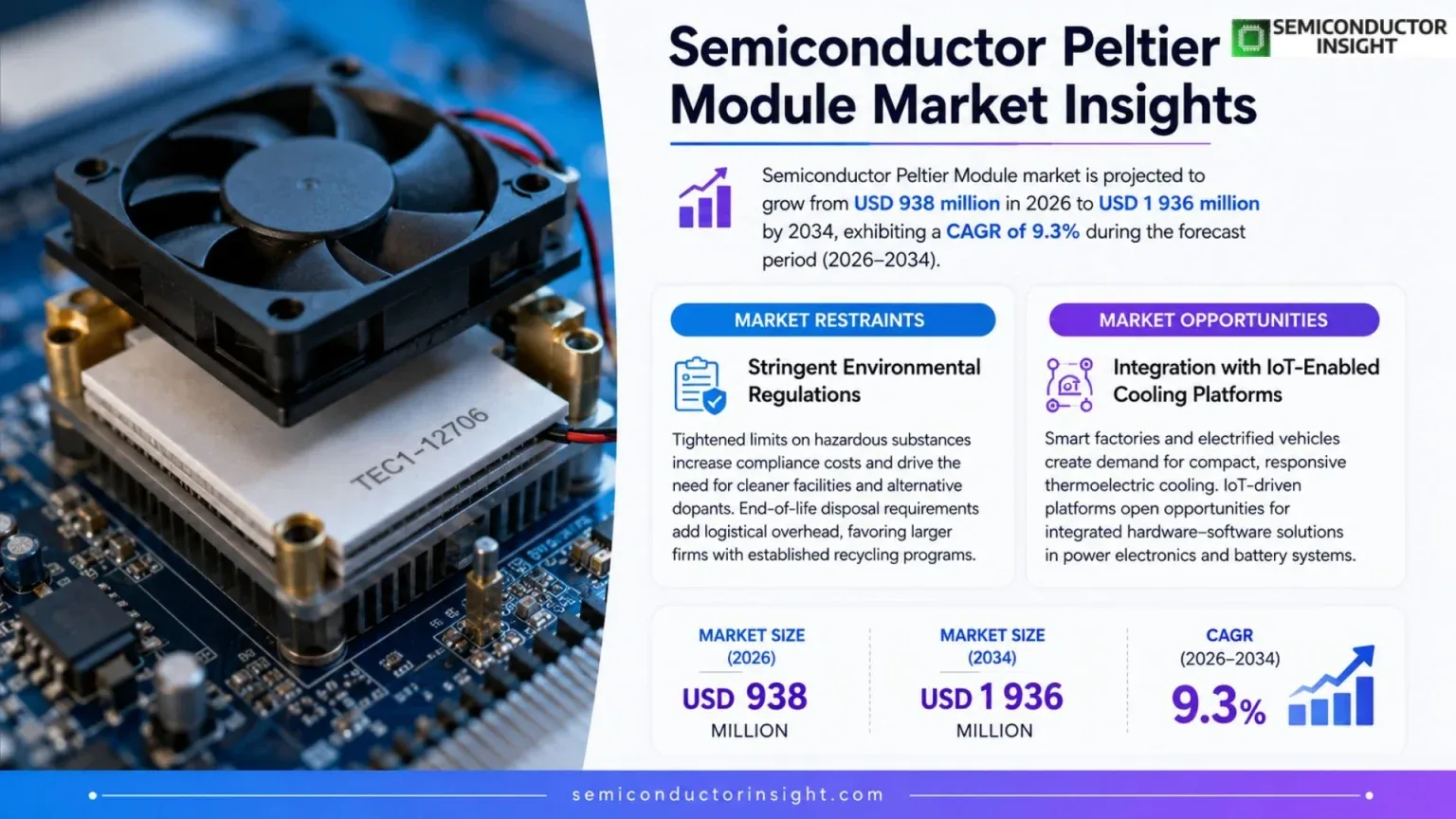
Semiconductor Peltier Module Market is projected to grow from USD 938 million in 2026 to USD 1 936 million by 2034, exhibiting a CAGR of 9.3%
Have Questions About the Report? Feel Free to Ask Here!
Semiconductor Peltier Module Market Insights
Global Semiconductor Peltier Module market size was valued at USD 858 million in 2025. The market is projected to grow from USD 938 million in 2026 to USD 1 936 million by 2034, exhibiting a CAGR of 9.3% during the forecast period.
A Semiconductor Peltier Module is a solid‑state thermal‑management device that exploits the Peltier effect to deliver active cooling and precise temperature control without moving parts or refrigerants. It consists of alternating p‑type and n‑type thermoelectric semiconductor elements bonded to ceramic substrates and equipped with electrodes and thermal interface layers; when direct current passes through, one side absorbs heat while the opposite side dissipates it.
The upward trajectory is driven by expanding demand in optical communications, high‑performance lasers, AI‑enabled data centers, and automotive battery thermal management, where compact size, fast response and reversible heating/cooling are essential.
List of Key Semiconductor Peltier Module Companies Profiled
- Ferrotec Corp.
- KJLP
- Thermion Company
- Same Sky (formerly CUI Devices)
- TE Technology
- Tark Thermal Solutions
- Peltron GmbH
- Sensor Controls Co., Ltd.
- Wakefield Thermal
Click Here to Read More About Report
Segment Analysis:
Segment CategorySub-SegmentsKey InsightsBy Type
- Single-stage Type
- Multi-stage Type
Multi-stage Type offers enhanced heat‑flux capability and is favored for high‑precision thermal management.
- Enables greater temperature differentials, supporting demanding optical and laser applications.
- Provides improved reliability through balanced thermal gradients across multiple stages.
- Facilitates system integration where compactness and low vibration are critical.
By Application
- Consumer Electronics
- Communication
- Medical
- Automotive
- Industrial
- Aerospace & Defense
- Others
Communication drives adoption of Peltier modules for high‑density optical networking and emerging AI data‑center cooling.
- Thermoelectric solutions address fast‑response cooling for 800G/1.6T transceivers.
- Compact modules enable localized temperature control without moving parts.
- Reliability focus aligns with stringent carrier‑grade uptime requirements.
By End User
- Electronics OEMs
- Medical Device Makers
- Automotive Manufacturers
Electronics OEMs prioritize modules that combine miniaturization with rapid thermal response.
- Enables stable operation of high‑performance processors and sensors.
- Supports design trends toward thinner, lighter consumer products.
- Favors low‑vibration cooling for premium audio‑visual equipment.
By Material
- Bismuth Telluride
- Silicon Germanium
- Advanced Ceramics
Bismuth Telluride remains the core material due to its mature processing and high‑efficiency thermoelectric performance.
- Dominates high‑reliability segments such as medical imaging and aerospace.
- Continuous material‑science improvements enhance cycle life and reduce variance.
- Supply chain focus on purity and grain uniformity drives customer confidence.
By Reliability Level
- High Cycle Life
- Moderate Reliability
- Cost‑Optimized
High Cycle Life segment attracts customers requiring extensive thermal cycling, such as laser systems and battery thermal management.
- Designs emphasize low power consumption while sustaining >100,000 cycles.
- Rigorous qualification processes ensure consistency across large production runs.
- Higher upfront cost is justified by reduced field failures and maintenance.
Click Here to Read More About Report
Regional Analysis: Semiconductor Peltier Module Market
Asia‑Pacific
The Asia‑Pacific region commands the most vigorous activity in Semiconductor Peltier Module Market. A confluence of dense electronics manufacturing hubs, aggressive government incentives for energy‑efficient technologies, and a burgeoning consumer‑electronics sector fuels demand. Companies based in China, Taiwan, and South Korea are scaling production lines to meet OEM specifications that emphasize compact thermal management solutions. Simultaneously, Japanese firms are leveraging decades‑long expertise in thermoelectric research to capture premium‑segment contracts.
South America
South American activity revolves around niche agricultural and mining uses where temperature control of sensor arrays is critical. Brazil’s emerging electronics sector is experimenting with Peltier modules for solar‑powered refrigeration units in remote locations. Constraints such as limited local component supply and higher import duties curtail rapid market expansion, but the region’s growing focus on renewable‑energy integration presents a gradual pathway for increased adoption.
Middle East & Africa
In the Middle East and Africa, the market is still embryonic, yet specific climate‑driven needs create pockets of opportunity. Oil‑field equipment providers are trialing thermoelectric cooling to protect monitoring electronics from extreme heat. Meanwhile, South‑African research institutes are exploring low‑cost Peltier solutions for medical diagnostic devices in off‑grid clinics. The primary barrier remains a shortage of skilled assembly facilities, prompting many buyers to source modules from established Asian manufacturers while awaiting local capability development.
Have Questions About the Report? Feel Free to Ask Here!
FREQUENTLY ASKED QUESTIONS:
What is the current market size of Semiconductor Peltier Module Market?
-> Semiconductor Peltier Module market is projected to grow from USD 938 million in 2026 to USD 1 936 million by 2034, exhibiting a CAGR of 9.3%
Which key companies operate in Semiconductor Peltier Module Market?
-> Key players include Ferrotec, KELK Ltd., Kyocera, Coherent Corp, Tark Thermal Solutions, Phononic, Guangdong Fuxin Technology, ARCTIC TEC, and others.
What are the key growth drivers?
-> Key growth drivers include rising demand for precision temperature control in optical modules, lasers, medical testing, automotive battery and seat temperature management, and the expansion of AI computing and high‑density data‑center cooling.
Which region dominates the market?
-> Asia‑Pacific is the fastest‑growing region, with China expanding large‑scale manufacturing, while Japan and Europe retain leadership in high‑end material reliability.
What are the emerging trends?
-> Emerging trends include integration of cold plates and liquid‑cooling systems, development of high heat‑flux, low‑power modules, and increasing deployment of thermoelectric solutions in AI servers, optical networking equipment, and automotive thermal management.