
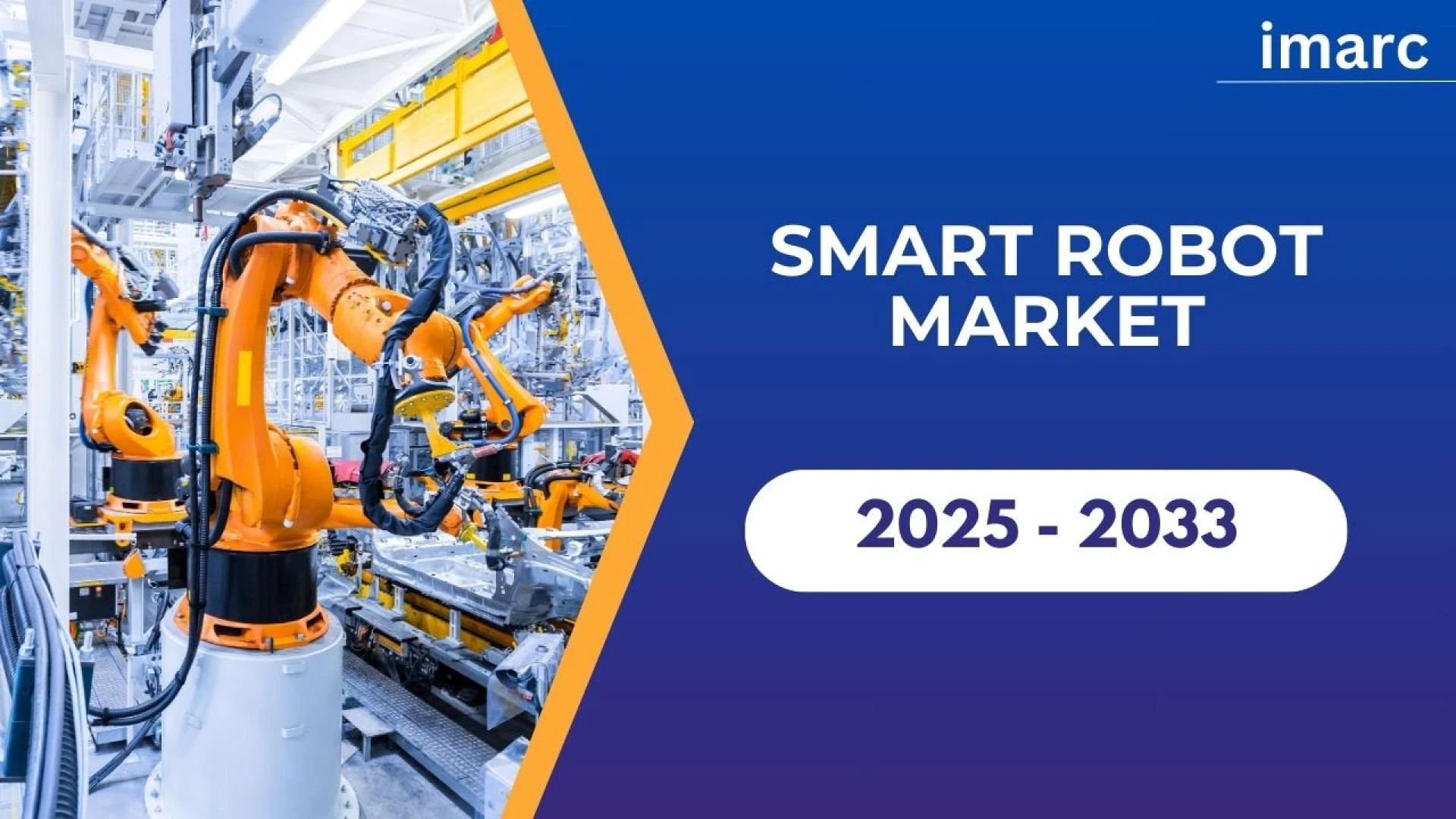
The global smart robot market is experiencing significant growth, reaching a value of USD 14.4 billion in 2024. Projections indicate that the market will expand to USD 53.1 billion by 2033, exhibiting a compound annual growth rate (CAGR) of 14.85% during 2025-2033. This growth is propelled by advancements in artificial intelligence (AI) and machine learning (ML), rising labor costs, and the increasing adoption of industrial automation. North America currently leads the market, driven by substantial investments in technology and automation infrastructure.
Study Assumption Years
- Base Year: 2024
- Historical Years: 2019-2024
- Forecast Years: 2025-2033
Smart Robot Market Key Takeaways
- Market Size and Growth: The smart robot market was valued at USD 14.4 billion in 2024 and is projected to reach USD 53.1 billion by 2033, growing at a CAGR of 14.85% during 2025-2033.
- Regional Leadership: North America dominates the market, attributed to technological advancements, robust industrial infrastructure, and significant investment in automation and robotics.
- Application Segmentation: The market is segmented by application into welding and painting, assembling and disassembling, material handling and sorting, inspection and security, and others.
- Vertical Segmentation: Key verticals include automotive, manufacturing, electrical and electronics, food and beverages, chemical, residential, and others.
- Component Segmentation: The market is divided by component into hardware, software, and services.
- Mobility Segmentation: Smart robots are categorized by mobility into stationary and mobile types.
- Technological Advancements: Continuous evolution in sensors, vision systems, and robotic hardware enhances the functionality and reliability of smart robots.
What Are the Key Factors Fueling the Smart Robot Market's Expansion?
Advancements in Artificial Intelligence and Machine Learning
The convergence of AI and ML technologies has boosted the functions of intelligent robots dramatically. The innovations allow robots to understand masses of data, learn from experiences, and make informed decisions in real-time. Smart robots can then execute intricate operations with high accuracy and efficiency in industries such as manufacturing and healthcare. Advances in AI algorithms and computing capabilities have also enabled more intuitive human-robot interaction, opening up the possibilities of smart robots for use.
Rising Labor Costs and Workforce Shortages
Rising labor expenses and skill shortages are compelling industries to look for cost-effective and efficient alternatives. Smart robots provide a good solution through their capabilities of automating tasks typically performed by humans, including assembly, packaging, and material handling, in a more efficient and cost-effective manner. Their capability to work continuously without fatigue decreases human labor dependency and lessens the effects of skill shortages, especially in manufacturing, logistics, and healthcare industries.
Growth in Industrial Automation and Industry 4.0 Initiatives
The transition to industrial automation, which is best represented by Industry 4.0, is one of the key drivers of the smart robot market. Industry 4.0 focuses on the convergence of advanced technologies, including the Internet of Things (IoT), big data analytics, and robotics, to develop smart manufacturing systems. Smart robots are at the center of this revolution by streamlining different industrial processes, enhancing efficiency, and lowering operational expenses. Their capacity to work continuously with accuracy and speed makes them invaluable in contemporary manufacturing environments.
Market Segmentation
By Component
- Hardware: Includes sensors, actuators, power sources, and control systems essential for robot operation.
- Software: Encompasses programs and algorithms that enable robot functionalities and decision-making processes.
- Services: Covers maintenance, training, and support services related to smart robots.
By Mobility
- Stationary: Robots fixed in one location, typically used in manufacturing settings.
- Mobile: Robots capable of movement, used in applications like logistics and healthcare.
By Application
- Welding and Painting: Robots performing welding and painting tasks in industrial environments.
- Assembling and Disassembling: Robots involved in assembling or disassembling components or products.
- Material Handling and Sorting: Robots managing the movement and organization of materials.
- Inspection and Security: Robots conducting inspections and ensuring security in various settings.
- Others: Includes applications not categorized above.
By Vertical
- Automotive: Use of robots in vehicle manufacturing and assembly processes.
- Manufacturing: Robots aiding in general manufacturing tasks across industries.
- Electrical and Electronics: Robots assisting in the production of electrical and electronic goods.
- Food and Beverages: Robots used in food processing and packaging.
- Chemical: Robots handling chemical production and processing tasks.
- Residential: Robots designed for household tasks and personal assistance.
- Others: Includes other industries utilizing smart robots.
By Region
- North America (United States, Canada)
- Asia Pacific (China, Japan, India, South Korea, Australia, Indonesia, Others)
- Europe (Germany, France, United Kingdom, Italy, Spain, Russia, Others)
- Latin America (Brazil, Mexico, Others)
- Middle East and Africa
Which Region Is Leading the Smart Robot Market?
North America is presently dominating the smart robot market due to technological progress, strong industrial base, and large investments in automation and robotics. The dominance of large tech firms and research and development institutions in the region drives innovation, resulting in the creation and extensive use of state-of-the-art smart robots in industries such as manufacturing, healthcare, logistics, and retail.
What Are the Recent Developments and Innovations in the Smart Robot Market?
Recent developments in the smart robot market include strategic partnerships and technological advancements aimed at improving manufacturing processes. In December 2023, ABB announced a broadening of its partnership with Volvo Cars to supply more than 1,300 robots and functional packages for next-generation electric vehicles (EVs), including energy-efficient robots and OmniCoreTM controllers to help deliver up to 20% energy savings. Apart from this, in October 2023, Fanuc and Volvo Cars signed an agreement to revolutionize car production with green robotics, where Fanuc would provide industrial robots to different units of production within Volvo's auto manufacturing plants.
Who Are the Key Players in the Smart Robot Market?
ABB Ltd., F&P Robotics AG, Fanuc Corporation, Hanson Robotics Limited, Honda Motor Co. Ltd, iRobot Corporation, KUKA AG (Midea Group), Neato Robotics Inc. (Vorwerk), Rethink Robotics GmbH, Samsung Electronics Co. Ltd., Seiko Epson Corporation, SoftBank Robotics Corp, Yaskawa Electric Corporation, etc.
If you require any specific information that is not currently covered within the scope of the report, we will provide the same as a part of the customization.
About Us:
IMARC Group is a global management consulting firm that helps the world’s most changemakers to create a lasting impact. The company provides a comprehensive suite of market entry and expansion services. IMARC offerings include thorough market assessment, considerations studies, company incorporation assistance, factory setup support, regulatory approvals and licensing navigation, branding, marketing and sales strategies, competitive landscape and benchmarking analyzes, pricing and cost research, and procurement research.