
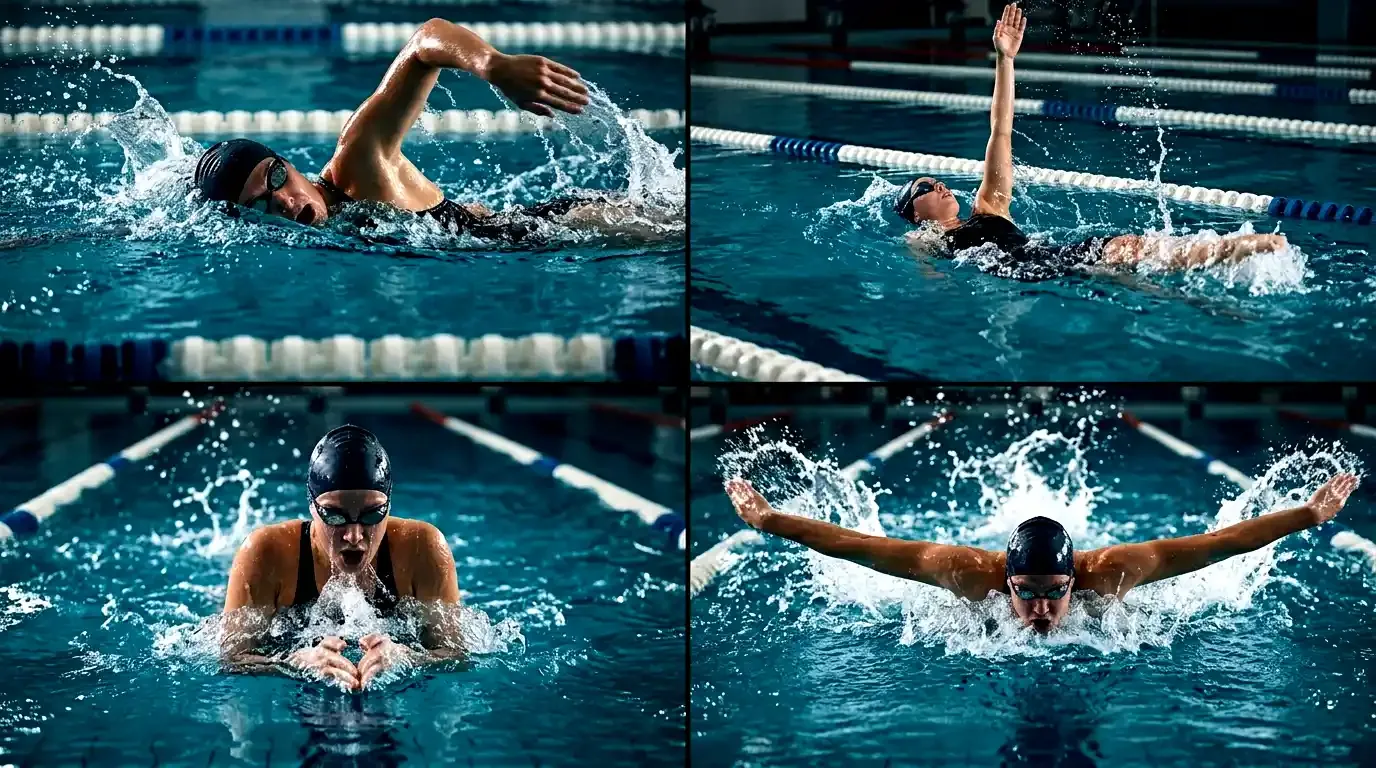
The four basic strokes in swimming are freestyle (front crawl), backstroke, breaststroke and butterfly. These are the strokes recognised by World Aquatics, the sport's international governing body, and they form the basis of competitive swimming, from school galas to the Olympic Games.
If you are a parent choosing lessons for your child, or an adult returning to the water, knowing how each stroke works helps you set realistic goals. This guide covers the technique behind each one, how difficult it tends to be, and which to learn first.
The 4 Swimming Strokes at a Glance
StrokeBody positionDifficultyTypical speedSuited toFreestyleFace downModerateFastestFitness, racing, all-round swimmingBackstrokeFace upModerateFastEasy breathing, relaxed lapsBreaststrokeFace down, head liftsModerateSlowestSteady pace, early learnersButterflyFace downHardestFastStrength, advanced swimmers1. Freestyle (Front Crawl)
What is freestyle?
Freestyle is swum face down, with the arms taking turns and the legs kicking continuously. You will often hear "front crawl" used for the same thing. Strictly speaking, a freestyle race allows any stroke, but swimmers choose front crawl because nothing else is as quick.
How to swim freestyle
Start with a long, flat body, with the hips near the surface. One arm reaches forward and enters the water in line with the shoulder. The hand then begins the catch phase, where the elbow bends, and the fingertips point down so the forearm can grip the water. The pull travels beneath the body and finishes with a push past the hip.
The flutter kick should be small and steady, driven from the hips with relaxed ankles. Breathing happens by rotating the head to the side as the body rolls, keeping one goggle lens in the water. Exhale gently underwater so there is no need to hold your breath. Once a swimmer is comfortable, bilateral breathing (every three strokes) helps balance the stroke on both sides.
Common freestyle mistakes
Lifting the head to breathe is the classic one, because it drops the hips and legs. Others include crossing the hands over the centre line, kicking from the knees, and holding the breath. These usually improve with patient drills and good coaching.
Benefits of freestyle
It works the whole body and is efficient over long distances, which makes it the stroke most people use for fitness. It also feeds into the other strokes, since the body position and breathing habits carry over.
2. Backstroke
What is backstroke?
Backstroke is swum on the back, with the arms moving in an alternating windmill pattern and a flutter kick similar to freestyle. It is the only one of the four strokes where the face stays out of the water, so breathing is simple.
Correct backstroke technique
Keep the body flat, the chin slightly tucked, and the eyes looking up and slightly back. The hips should stay high enough that the swimmer feels almost like lying on the surface. Each arm leaves the water thumb first, travels straight over the shoulder, and enters little finger first. The body rolls gently from side to side as the arms work. The kick comes from the hips, with toes just breaking the surface.
Common backstroke mistakes
Sitting too upright, with the hips sinking, causes the most problems. Other frequent issues include bending the knees too much while kicking and letting the head tilt forward. Swimmers also tend to drift off a straight line, which is why pool lane ropes and the backstroke flags above the water are so useful.
Benefits of backstroke
Many swimmers find it relaxing because breathing is never a concern. It encourages an open chest and good posture, and it strengthens the back and shoulders. Backstroke also gives children a comfortable way to practise floating and kicking.
3. Breaststroke
What is breaststroke?
Breaststroke is the oldest of the competitive strokes and the only one where the arms and legs both work symmetrically beneath the surface. The head rises to breathe on every stroke cycle, which many beginners find reassuring.
Breaststroke technique
The stroke follows a simple rhythm of pull, breathe, kick, glide. The hands sweep outwards and then inwards beneath the chin, the head lifts to breathe, and the hands shoot forward as the legs recover. The kick is a whip-like movement, with the feet turned outwards and then squeezed together. A short glide in a streamlined position finishes each cycle. The order matters. Arms move first, and the legs follow.
Common breaststroke mistakes
A scissor kick, where one leg moves out of sync with the other, is common and does not meet competition rules. Pulling too far back past the shoulders slows the stroke, and so does lifting the head too high, which makes the hips sink. Rushing the glide is another habit worth watching for.
Benefits of breaststroke
It is the slowest of the four strokes, but it is also the most forgiving. The pace suits relaxed lengths, and the head-up breathing makes it popular with newer swimmers. It is also a useful stroke for building leg strength and coordination.
4. Butterfly Stroke
What is butterfly?
Butterfly is the most physically demanding of the four. Both arms move together in a circular pattern while the legs perform a dolphin kick, where they stay together and move as one.
Butterfly technique
The movement starts from the chest and hips, and the body undulates like a wave. Both arms enter the water at shoulder width, pull beneath the body, and then sweep out and forward over the surface. Two kicks occur in each stroke cycle, one as the hands enter and another as they exit. Breathing is forward, with the chin skimming the water, and swimmers usually breathe every one or two strokes.
Common butterfly mistakes
Lifting the head too high, pulling with the arms alone, and mistiming the kicks are the usual culprits. Because the stroke relies on rhythm, a swimmer who tyres will often lose their timing quickly.
Benefits of butterfly
Butterfly builds strength in the shoulders, core and back, and it develops a strong sense of body control. It is rarely the first stroke taught, but swimmers who master it usually find their other strokes improve too.
Which Swimming Stroke Is the Easiest to Learn?
Every swimmer is different, but most coaches find that backstroke and breaststroke feel more approachable at the start. Backstroke keeps the face clear of the water. Breaststroke allows the head to rise on each cycle and lets the swimmer rest in the glide.
Freestyle takes more time because breathing has to be coordinated with the arm movement. Butterfly almost always comes last.
A common learning order is backstroke, then freestyle, then breaststroke, then butterfly. Some swim schools change this to suit the child. A confident swimmer who dislikes having water on their face might lean towards backstroke first, while another child might enjoy breaststroke straight away. Progress depends on age, confidence and experience, so there is no single right sequence.
Which Swimming Stroke Is the Fastest?
At competitive level, freestyle is the fastest, followed by butterfly, then backstroke, then breaststroke. The order is visible in official world records for the same distance.
Freestyle wins because the arms provide continuous propulsion with little resistance. Butterfly is powerful but costs a great deal of energy to sustain. Backstroke is slightly slower because the arm recovery and body position create more drag at the start of each pull. Breaststroke loses speed each time the body slows down during the recovery phase.
Which Stroke Burns the Most Calories?
Butterfly and freestyle generally demand the most effort, so they tend to use the most energy. Exact figures depend on the swimmer's weight, fitness, pace and technique, so it is better to treat any single number with caution. For general fitness, swimming a mix of strokes works different muscle groups and keeps sessions interesting.
Swimming Strokes in Competition
All four strokes appear in the individual medley (IM), where one swimmer completes equal distances in the order butterfly, backstroke, breaststroke and freestyle. In the medley relay, four swimmers each take one stroke, in the order backstroke, breaststroke, butterfly and freestyle.
Each stroke has its own rules. In butterfly, both arms must move together, and the kick must be a dolphin kick. In breaststroke, the hands must stay at or below the surface, apart from the final stroke into the wall. Turns and finishes also differ by stroke, so older swimmers learn these alongside the technique.
Other Swimming Strokes
You may also hear about sidestroke, elementary backstroke and dog paddle. These are useful for water confidence, rescue skills or leisure swimming, but they are not used in competition. That is why they sit outside the four basic strokes.
Tips for Beginners Learning the Strokes
Strong strokes grow from basic water skills. Before worrying about arm technique, children and adults benefit from being comfortable floating, blowing bubbles and moving through the water with the face submerged.
Many children first meet these skills through a structured School Swimming Programme, where lessons are broken into small steps that suit different ages and abilities.
A few habits help along the way:
- Practise one stroke at a time, so that each movement becomes familiar before another is added.
- Use training aids such as kickboards and pull buoys to isolate the legs or arms.
- Short, frequent sessions usually work better than occasional long ones.
- Learn with a qualified coach, who can spot small technique problems early.
Water safety matters at every stage. Beginners should always swim with supervision, and learning a stroke is never a replacement for knowing how to float, tread water and reach safety.
Conclusion
Freestyle, backstroke, breaststroke and butterfly each ask something different of a swimmer, from rhythm and breathing to strength and timing. Starting with water confidence, learning one stroke at a time, and working with a good coach gives learners the best chance of enjoying all four.
FAQs
How many swimming strokes are there?
There are four competitive strokes: freestyle, backstroke, breaststroke and butterfly. Several other recreational strokes exist, including sidestroke and elementary backstroke.
What is the hardest swimming stroke?
Most swimmers find butterfly the hardest because it needs strength, rhythm and stamina together.
What is the best stroke for beginners?
Backstroke and breaststroke are often the easiest places to start, though the right choice varies between swimmers.
What is the fastest swimming stroke?
Freestyle is the fastest over the same distance.
Which stroke is best for weight loss?
No single stroke does it all. Butterfly and freestyle use the most energy, but the best stroke is one you can keep swimming regularly.
What is the difference between freestyle and front crawl?
Freestyle is the name of the event, and front crawl is the stroke most swimmers use in it. In everyday conversation, people use both terms for the same stroke.