In today’s business world, companies need to share information quickly and without mistakes. Every day, they send documents like purchase orders, invoices, and shipping details. When this is done manually, it takes time and can lead to errors.
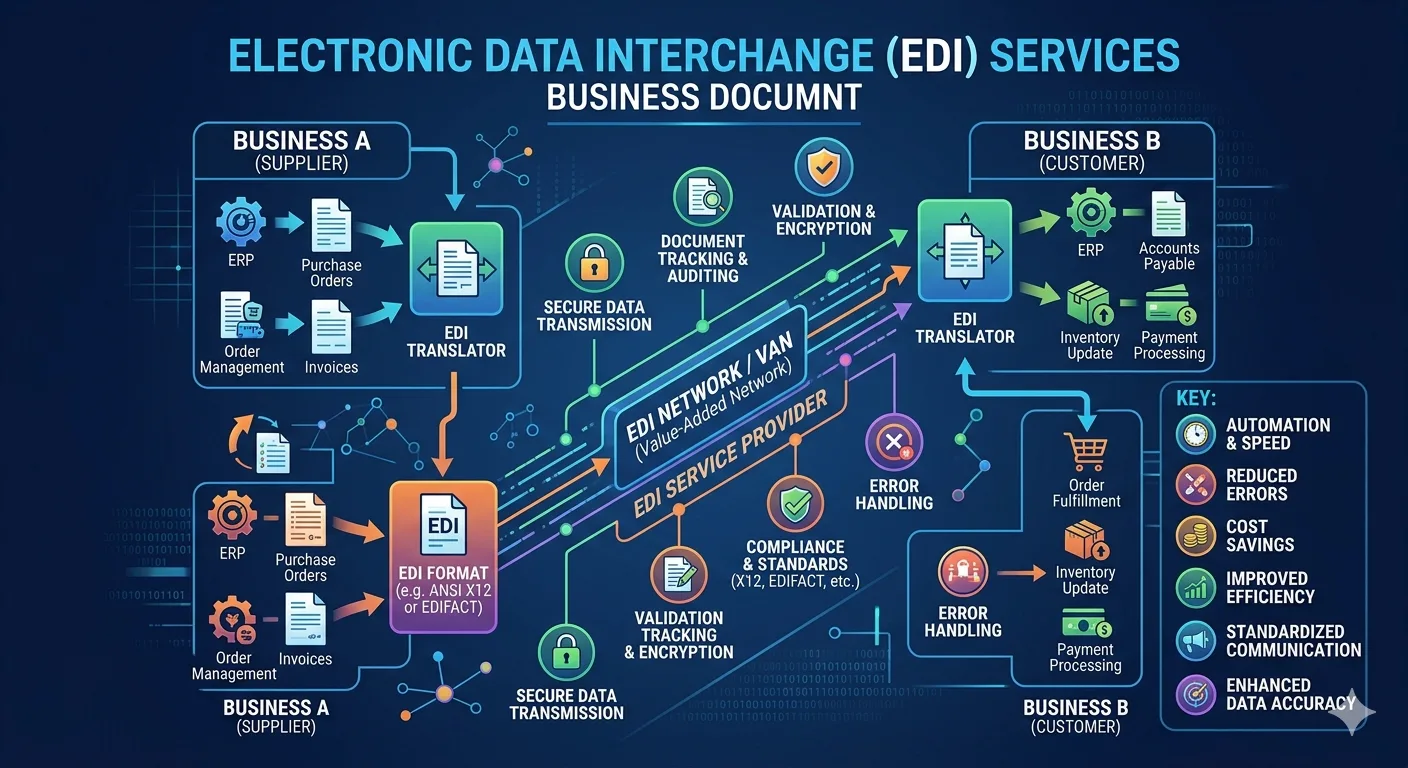
This is where Electronic Data Interchange (EDI) services help. They allow businesses to send and receive data directly between systems, without manual work.
In this blog, you will learn what EDI services are, how they work, and why they are useful—all explained in simple words.
What Are Electronic Data Interchange (EDI) Services?
Electronic Data Interchange, or EDI, is a way for businesses to exchange documents in a digital format.
Instead of:
- Using paper
- Sending emails
- Entering data by hand
EDI allows systems to share data automatically.
Simple Example:
A company wants to order products from a supplier.
Without EDI:
- They create an order manually
- Send it by email
- The supplier enters the details again
With EDI:
- The order is created in the system
- It is sent directly to the supplier’s system
- The supplier processes it instantly
This saves time and reduces mistakes.
Why Are EDI Services Important?
As a business grows, the amount of data also increases. Managing everything manually becomes difficult.
EDI services help by:
- Saving time
- Reducing errors
- Speeding up processes
- Improving communication
For businesses that deal with many customers or suppliers, EDI is very useful.
How Do EDI Services Work?
Even though EDI sounds technical, the process is simple.
Step 1: Create a DocumentThe business creates a document like a purchase order or invoice.
Step 2: Convert the DataThe EDI system converts the document into a format that both systems can understand.
Step 3: Send the DocumentThe document is sent through a secure connection.
Step 4: Receive and ProcessThe receiving system reads the data and updates its records automatically.
All of this happens in seconds.
Common Documents Used in EDI
Businesses use EDI for many types of documents, such as:
- Purchase Orders
- Invoices
- Shipping Notices
- Payment Information
- Inventory Updates
These documents are important for daily operations.
Types of EDI Services
There are different types of EDI services. Businesses can choose based on their needs.
1. Managed EDI ServicesA service provider handles everything. This is helpful if you don’t have a technical team.
2. Cloud-Based EDIThis works online and can be accessed from anywhere. It is flexible and easy to use.
3. On-Premise EDIThis is installed on your own system. It gives more control but needs maintenance.
4. EDI Integration ServicesThese connect EDI with other systems like ERP or CRM.
Benefits of EDI Services
EDI services offer many advantages.
1. Faster WorkDocuments are sent and received instantly.
2. Fewer ErrorsNo manual entry means fewer mistakes.
3. Cost Savings
Less paper, printing, and manual work.
4. Better Use of TimeEmployees can focus on important tasks.
5. Secure DataEDI systems use safe methods to protect data.
Industries That Use EDI
Many industries use EDI services.
RetailFor managing orders and inventory.
HealthcareFor patient data and billing.
LogisticsFor tracking shipments and managing deliveries.
ManufacturingFor working with suppliers and managing production.
When Should You Use EDI Services?
You should consider EDI services if:
- You handle many orders daily
- You work with multiple suppliers
- You face errors in data entry
- You want to save time and effort
EDI becomes more useful as your business grows.
Features to Look for in EDI Services
When choosing an EDI service, look for:
- Easy setup
- Good security
- Ability to grow with your business
- Easy connection with your current systems
- Support when needed
Challenges of EDI Services
EDI has many benefits, but there can be some challenges.
Setup TimeIt may take time to set up.
Solution: Choose managed or cloud-based services.
Cost
Some solutions may cost more at the start.
Solution: Start with a plan that fits your budget.
Technical WorkSome systems need technical knowledge.
Solution: Work with experienced providers.
Future of EDI Services
EDI is becoming more advanced and easier to use.
Some trends include:
- Cloud-based systems
- Faster data exchange
- Better system connections
As businesses go digital, EDI will continue to grow.
How EDI Helps Business Growth
EDI is not just about saving time. It also helps businesses grow.
- Faster orders improve customer satisfaction
- Accurate data helps in better planning
- Automation reduces workload
- Smooth operations support expansion
Simple Real-Life Example
A store needs to restock products.
Without EDI:
- Staff checks stock
- Creates an order
- Sends it by email
- Supplier processes it manually
With EDI:
- System detects low stock
- Sends order automatically
- Supplier processes it instantly
This makes the process faster and easier.
Conclusion
Electronic Data Interchange services make it easy for businesses to share data quickly and accurately. They remove the need for manual work and help improve daily operations.
Whether your business is small or large, EDI services can help you save time, reduce errors, and grow faster.