
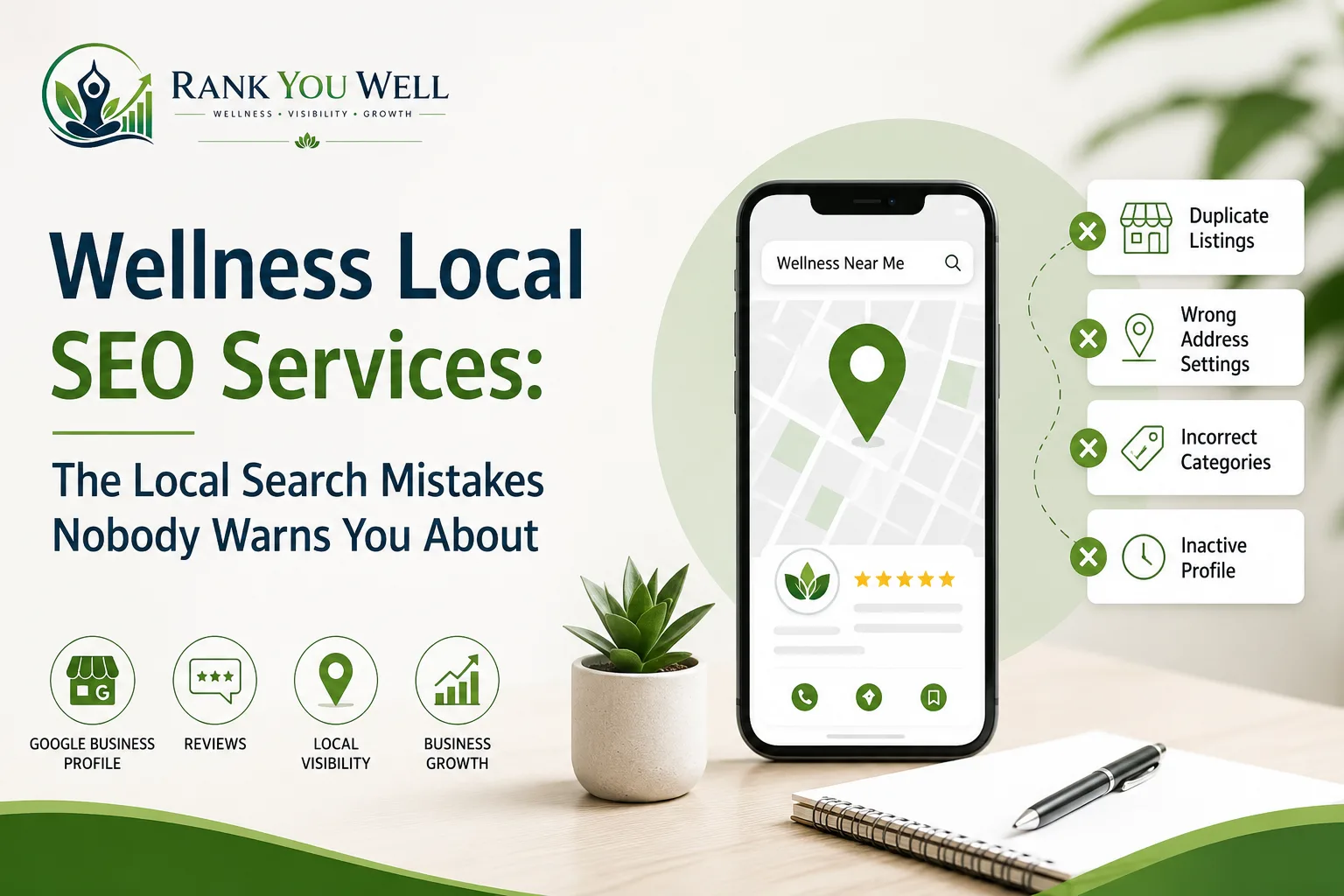
When someone searches "wellness clinic near me" or "massage therapy near me," they're not browsing - they're trying to find a real business they can check out and contact. That's what separates local SEO from ordinary organic SEO. Two wellness businesses can offer near-identical services, yet one shows up on Google Maps and the other barely registers.
Local SEO ties your business, services, location, reputation, and website together so nearby searchers find the right option and actually take the next step. It's not about ranking for a city name - it's about understanding why Google picks one wellness business over another, and closing that gap.
Why does Google favor some wellness businesses over others?
Google weighs three things: relevance, distance, and prominence. For wellness businesses, that plays out across Google Business Profile setup, service pages, location pages, citations, and Wellness Local SEO services, feeding into one path: search a service, compare local providers, check reviews, book.
Why can a business closer to you still outrank yours?
Distance isn't everything. A slightly farther business with clearer service pages and stronger prominence can beat a closer one that doesn't communicate what it does.
A good local strategy answers four questions:
- Can people find you?
- Understand what you offer? Trust you?
- Easily book with you?
Miss any one of those, and visibility alone won't convert.
Does the Google Business Profile category actually matter?
Yes, it tells Google what kind of business you are, and "wellness centre" isn't the same search as "massage therapist" or "yoga studio." Pick the category that reflects your actual business, not whichever one gets the most search volume. Your profile should also carry accurate details, real services, photos, hours, a booking link, and active review responses — not stuffed keywords.
Can a newer business really outrank an older one?
Absolutely, longevity isn't the deciding factor, clarity is. If you genuinely operate in multiple locations, dedicated location pages make sense, but copy-pasted city pages with a swapped name don't build real local relevance. A good location page explains where you are, what's offered there, who runs it, and how to book.
Why does search intent keep shifting under you?
Intent isn't fixed, it moves in real time. The same person searching "massage therapy near me" gets a different answer depending on the time of day, their exact location, what's trending locally, and how Google or an AI Overview is currently interpreting that query. A studio that ranked well last quarter can slip simply because intent signals moved, not because anything on the site broke. This is why local SEO can't be a one-time setup, it has to track how real searchers are behaving right now, not how they behaved when the strategy was written.
Do reviews decide who shows up on Maps?
They matter, but they're not a magic lever, they're one signal among several. People search for specific services ("nutritionist near me," "physiotherapy near me"), so sending them all to a generic homepage undersells you. Route them to a page that actually explains the service they searched for. And build reviews honestly: no buying, no cherry-picking only happy customers, no incentivized testimonials.
Why does my site rank but my Maps listing doesn't?
Because they're different surfaces. Often the culprit is inconsistent business info, your name, address, or phone number written slightly differently across your site and directories. It doesn't need to be identical to the letter everywhere, but it should be accurate and consistent enough that nothing looks off.
How do I find the actual gap?
Diagnose before you act:
ProblemLikely causeFixNot showing on MapsWeak GBP setup/categoryCorrect and optimize the profileService searches underperformNo dedicated service pageBuild oneOne location ranks, another doesn'tWeak local relevanceAdd genuine local detailSite ranks, Maps doesn'tWeak local signalsStrengthen GBPTraffic but no contactWeak conversion pathImprove booking, reviews, photosWhat makes wellness local SEO different?
Trust runs deeper here. People are evaluating practitioner expertise, qualifications, and what to expect - not just proximity. Your website needs to back up what the profile promises, especially where health claims are involved.
What should you measure?
Look past rankings to the full funnel:
- visibility (map views, impressions),
- engagement (clicks, direction requests, calls),
- conversion (bookings, enquiries), and ultimately, new clients.
Conclusion
Local SEO isn't a race to add more pages or citations. It's about making the right business easy to find, understand, trust, and choose - in the market it genuinely serves, at the moment someone's actually searching. As intent keeps shifting in real time, the businesses that stay visible are the ones treating local SEO as an ongoing read on their audience, not a checklist they finished once. The goal isn't to keep doing SEO just to rank you well, it's to build a local presence that helps the right customers find, trust, and choose your brand.
FAQs
What is wellness local SEO?
It's the practice of improving a wellness business's visibility for local, service-specific searches - covering Google Business Profile optimization, service and location pages, citations, reviews, and real-time intent tracking so nearby clients can find, trust, and book with you.
How long does wellness local SEO take to show results?
There's no fixed timeline. Early movement can appear within a few months, but meaningful ranking and traffic growth typically takes 3-6 months, depending on competition, your existing site authority, and how established your Google Business Profile already is.
Does Google Business Profile actually help wellness businesses rank?
Yes, a well-maintained, accurately categorized profile is often the single biggest lever for local visibility, since it directly feeds Google Maps and local pack results. Its impact still depends on relevance, reviews, and competition in your area.
Do wellness businesses need a separate page for every location?
Only where the business genuinely operates. A real, useful location page helps; a templated page with just the city name swapped tends to hurt more than it helps.
Why does my ranking change even when I haven't touched my website?
Because intent and competition move in real time - the time of day, the searcher's exact location, and how AI Overviews are currently interpreting a query can all shift results without anything changing on your end. This is why local SEO needs ongoing monitoring, not a one-time setup.