
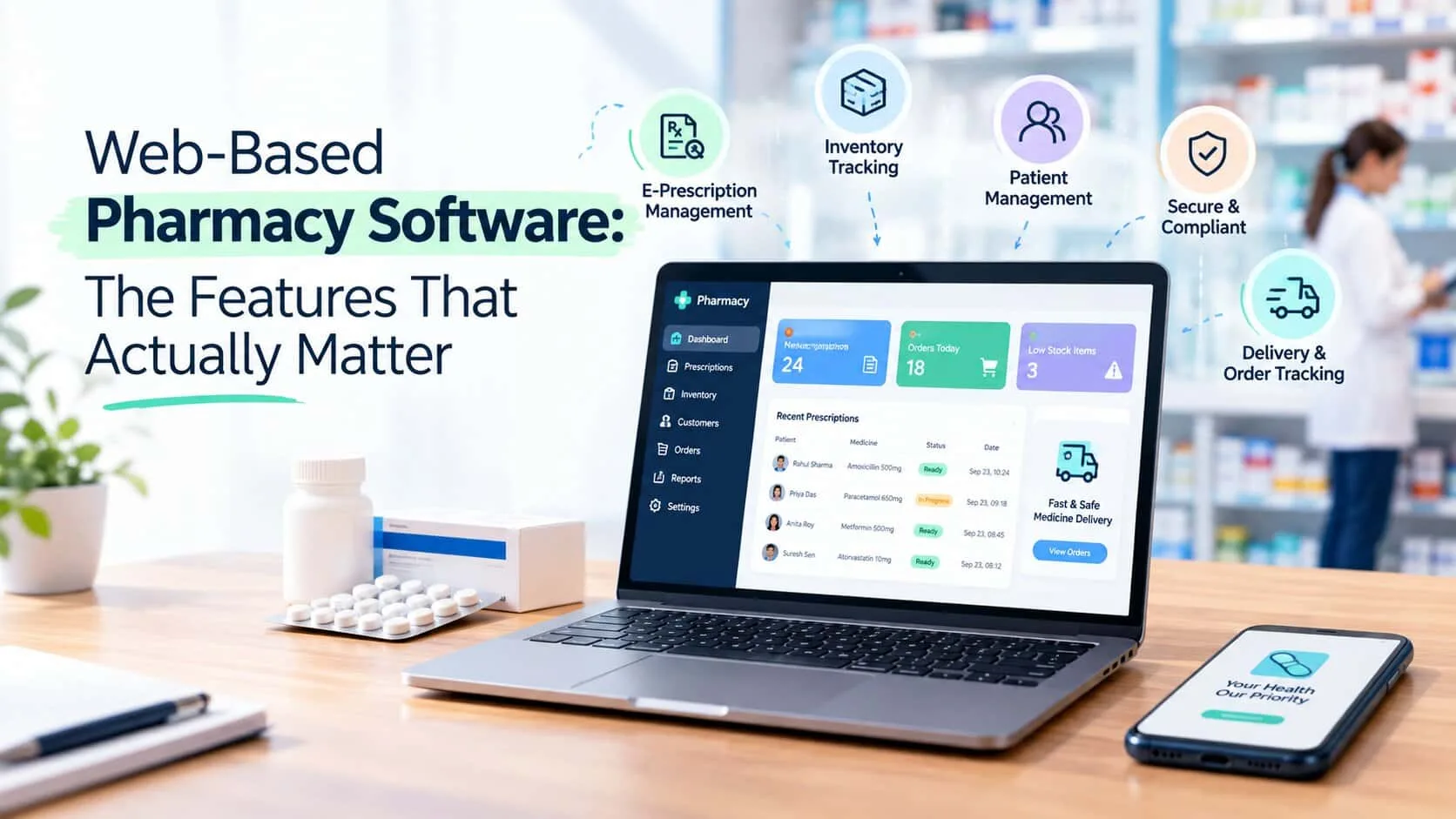
Most pharmacy management systems get built the wrong way. Someone lists features — inventory tracking, billing, prescription records — and developers build exactly what's on the list. The software ships. Six months in, pharmacists are working around it because the daily reality of dispensing medications is messier than a requirements document.
The shift to web-based dedicated ecommerce platforms has changed what's possible. But it hasn't automatically fixed what's missing. A pharmacy platform running in a browser can still be built wrong. This piece goes through the features that genuinely separate a functional pharmacy web application from one that creates more work than it solves.
What Makes a Web-Based Pharmacy Platform Different From Desktop Software?
The answer isn't just "it runs in a browser." The real difference is access model and update cycle.
A desktop pharmacy system ties dispensing to one machine. If a pharmacist is in the back checking an expiry date, they're not at the terminal processing a prescription. A web-based system runs on any device with a browser — a tablet in the consultation room, a phone in the stockroom, a laptop for a pharmacist working across two branches. One login, one live data set, everywhere.
The other difference is deployment. A desktop system needs an IT team on-site every time regulations change, every time a drug database update ships, every time a billing format changes. A web platform gets updated centrally. Every terminal sees the change within hours, not weeks.
That matters a lot in pharmacy, where regulatory requirements shift frequently and a billing error doesn't just cost money — it can trigger a compliance audit.
The Core Features a Pharmacy Web Platform Cannot Compromise On
**Prescription management with e-prescription support**
Paper prescriptions are going away faster than most independent pharmacies are ready for. A web-based system needs to handle digital prescription intake cleanly — validating prescriber credentials, checking drug interaction flags automatically, and flagging anything that looks altered or incomplete before a pharmacist manually reviews it.
The interaction-check module is where a lot of cheaper systems cut corners. It needs to flag drug-drug interactions, drug-allergy conflicts, and duplicate therapy issues — not just at the point of dispensing, but when the prescription enters the queue. Catching a conflict at queue intake is far better than catching it at the counter with a patient waiting.
**Real-time inventory management**
Pharmacy inventory has specific complexity that generic stock-management systems don't handle well. Batch tracking, expiry monitoring, and reorder triggers all need to work together. A batch of paracetamol expiring in three weeks needs a different alert than a batch expiring in three months. The system should know the difference and escalate accordingly.
For multi-branch pharmacies, inventory visibility across locations is essential. A pharmacist should be able to check — in real time — whether a medication unavailable at their branch is in stock two locations away, and initiate a transfer request from the same screen.
**Billing and insurance claim processing**
Billing errors are expensive and slow. A web-based pharmacy platform should handle automatic GST calculation, insurance eligibility verification at the point of dispensing, and electronic claim submission — ideally with pre-built integrations to major insurance networks so claims go out clean the first time.
The rejection queue deserves its own section of the interface. When a claim bounces, the system should explain why in plain language (not just an error code), suggest the correction, and allow resubmission without re-entering the entire claim.
Which Features Are Often Underbuilt — and Shouldn't Be?
**Patient profile and medication history**
A patient profile in a pharmacy system isn't just a demographic record. It's a medication history that needs to persist across visits and across branches. When a patient comes in for a refill of something they picked up six months ago, a pharmacist should be able to pull that history in seconds — not search through paper logs or call a different branch.
Profiles should also carry allergy records, current medications from other providers if entered, and any counseling notes. This is the kind of longitudinal data that turns a dispensing counter into something closer to a care touchpoint.
**Role-based access control**
Not every person on the pharmacy team needs access to everything. A cashier processing an OTC sale doesn't need to see prescription records. A technician preparing medications doesn't need to access financial reports. A pharmacist on duty should see everything relevant to patient safety.
This sounds obvious, but many pharmacy systems ship with two access levels — admin and staff — which is inadequate. A proper role matrix should be configurable by the pharmacy owner without requiring a developer call every time someone's responsibilities change.
**Reporting and analytics that pharmacists actually use**
Sales reports are standard. What's less common, but more useful, is prescription analytics — which medications are being dispensed most, which have the highest return rates, which suppliers are generating the most back-orders. This is the kind of data that lets a pharmacy owner make stock decisions based on their actual dispensing patterns rather than industry averages.
Expiry tracking dashboards — showing what's at risk, by how much, and how fast it's moving — are similarly underbuilt in most systems but have real financial impact.
Does the Platform Support Multi-Location Operations?
For a pharmacy operating more than one branch, this is a non-negotiable question.
Multi-location support means more than copying data between branches. It means a central inventory view with branch-level breakdowns, unified patient profiles accessible across all locations, consolidated billing and reporting at the chain level, and the ability to push updates — price changes, formulary changes, protocol changes — to all branches simultaneously.
A pharmacy chain that manages each branch as a separate system is spending twice the administrative effort for half the visibility. The better-built platforms centralise the data layer while keeping the branch-level interface focused on local workflows.
Some development teams — Originate Soft, for instance, which builds custom healthcare and pharmacy software for multi-location clients — approach this as a layered architecture: a shared database with branch-level views and permissions layered on top, so head-office and branch-level staff see the same data through different lenses.
How Should Patient Communication Be Built Into the Platform?
This is a feature category that most pharmacy software treats as optional. It shouldn't be.
Automated refill reminders — via SMS or email — reduce the number of patients who skip doses because they forgot to order in time. It's a genuine health outcome tied to a software feature. A web-based pharmacy platform is well-positioned to deliver this because it already has the patient contact data, the prescription history, and the refill schedule in one place. Connecting those to a notification engine is not a large build.
Similarly, appointment reminders for vaccination services, prescription-ready notifications, and delivery tracking for courier-based dispensing are all functions that patients now expect. They're not advanced features anymore. They're table stakes for a pharmacy that wants to retain patients beyond a single transaction.
What About Compliance and Audit Readiness?
Pharmacy is a heavily regulated environment. A web platform that doesn't make compliance management straightforward isn't worth the time savings it creates elsewhere.
Audit-ready logging means every dispensing action, every prescription modification, and every user login is timestamped and stored in an immutable record. If a regulatory body asks to see everything that happened to a controlled substance record over a six-month period, the system should be able to produce that in minutes.
The dedicated pharmacy and healthcare software built for web environments today is increasingly designed with audit trails, role-based data segregation, and compliance reporting built into the core — not bolted on as an afterthought.
Closing Thoughts
A web-based pharmacy platform isn't just a modernised dispensing counter. When it's built thoughtfully, it's an operations layer that connects inventory, patient records, billing, compliance, and communication into one auditable system.
The features that matter most aren't always the most visible ones. The interaction-check engine that runs quietly behind every prescription entry. The audit log that no one looks at until a regulator asks for it. The refill reminder that keeps a diabetic patient on schedule between visits. These are the features that determine whether a pharmacy platform is genuinely useful or just technically present.
Builders who treat those things as secondary will ship software that pharmacists learn to work around. The ones who treat them as primary will ship something pharmacists actually rely on.
**Author Bio:** The author writes about custom software development for regulated industries, including healthcare, pharmacy, and fintech. They follow the work of studios like Originate Soft Pvt Ltd (originatesoft.com), a Kolkata-based software development company building custom web and mobile platforms for healthcare providers, multi-location retail businesses, and early-stage founders across India and Southeast Asia.