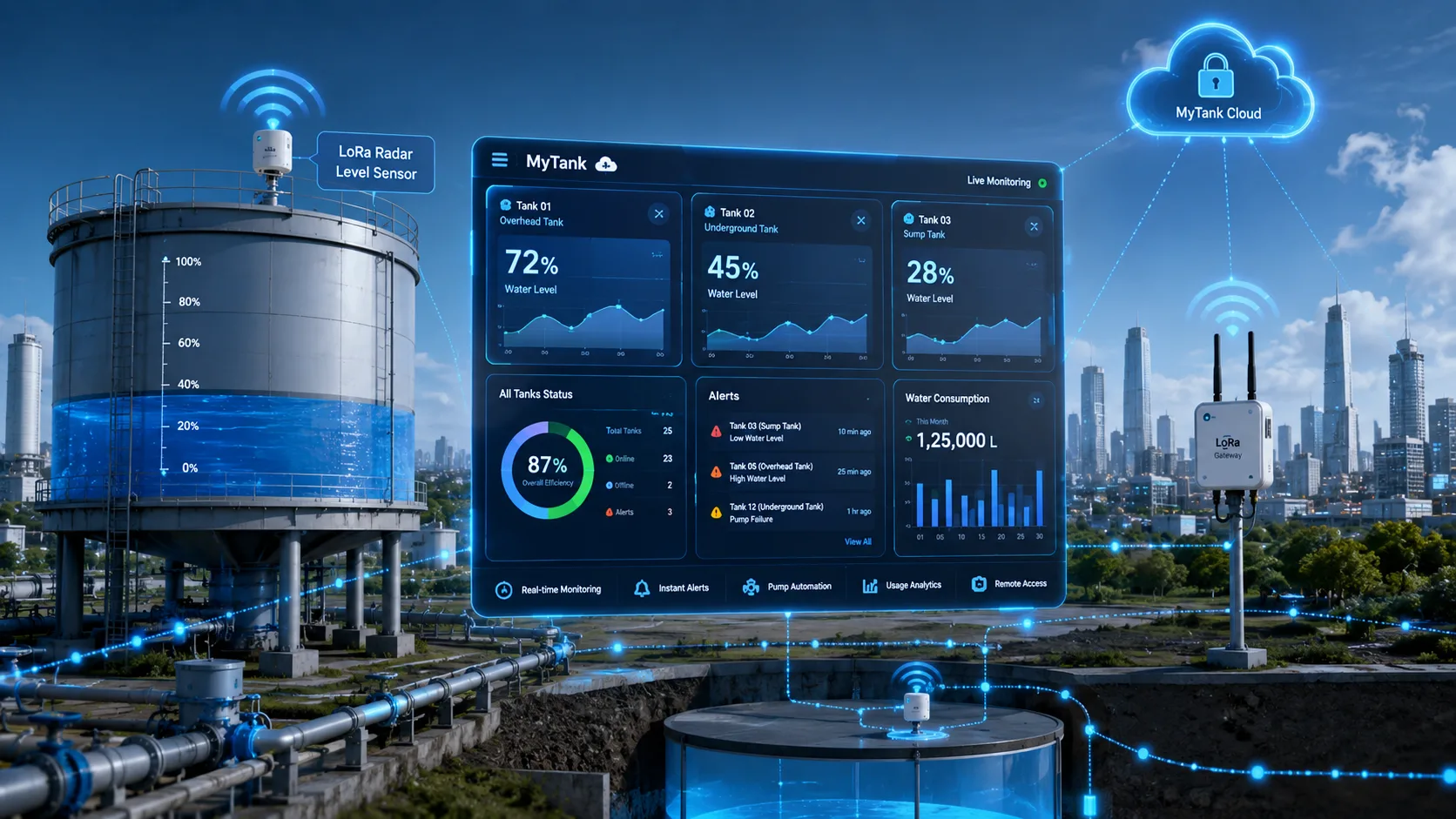
Water management is becoming more challenging for commercial buildings, industries, hospitals, residential complexes, and utilities. Manual tank inspections, delayed alerts, water overflow, and pump failures often lead to water wastage, operational disruptions, and higher maintenance costs. This is why modern water tank monitoring solutions are rapidly replacing traditional methods.
With advancements in IoT and wireless communication, businesses can now monitor water levels in real time using a LoRa radar level sensor, enabling smarter and more reliable water management.
The Limitations of Traditional Water Monitoring
Many facilities still rely on float switches, manual inspections, or basic alarm systems to track water levels. While these methods may seem simple, they come with several drawbacks:
- Inaccurate water level readings
- Delayed detection of overflow or low water levels
- Frequent manual checks requiring manpower
- Pump dry run risks leading to motor damage
- Difficulty monitoring multiple tanks across locations
These challenges make traditional systems inefficient for large-scale operations.
How LoRa Sensors Are Transforming Water Tank Monitoring
Modern water tank monitoring systems use IoT-enabled sensors to provide continuous visibility into tank conditions. One of the most effective technologies today is the LoRa radar level sensor.
LoRa (Long Range) communication enables wireless transmission of sensor data over long distances while consuming very little power. This makes it ideal for remote tanks, underground sumps, rooftop tanks, and multi-site facilities.
A LoRa radar level sensor uses radar technology to measure water levels without physical contact with the liquid. Unlike conventional sensors, radar sensors deliver highly accurate readings even in harsh environments such as dusty, humid, or high-temperature tanks.
Key advantages include:
- Long-range wireless communication
- High measurement accuracy
- Low power consumption
- Minimal maintenance
- Reliable operation in challenging environments
Why Radar-Based Monitoring Works Better
Unlike float or pressure-based systems, radar sensors provide non-contact measurement. This reduces wear and tear while improving reliability.
A LoRa radar level sensor helps facilities detect:
- Tank overflow before water spills
- Low water levels before supply disruption
- Sudden drops indicating leakage
- Abnormal consumption patterns
- Pump dry run conditions
This proactive monitoring prevents costly downtime and unnecessary water loss.
Centralized Monitoring with My Tank
Sensor data becomes even more valuable when paired with an intelligent monitoring platform like My Tank.
My Tank is a smart IoT platform designed to simplify water tank monitoring by providing centralized access to real-time tank data. Instead of physically inspecting tanks, facility managers can monitor everything from a single dashboard.
With My Tank, users can:
- View live water level status
- Receive instant alerts for overflow or low levels
- Track historical usage trends
- Monitor multiple tanks from one dashboard
- Improve pump scheduling and automation
This enables faster decision-making and better operational control.
Benefits for Commercial and Industrial Facilities
Modern water monitoring is especially valuable for facilities managing large or distributed water storage systems.
Industries benefiting from smart monitoring include:
- Commercial buildings
- Hospitals
- Hotels
- Factories
- Residential communities
- Water utilities
By combining water tank monitoring, a LoRa radar level sensor, and the My Tank platform, organizations gain complete visibility over their water infrastructure.
The Future of Smart Water Management
Water management is no longer just about measuring tank levels—it is about using data to improve efficiency, reduce waste, and prevent failures before they occur.
As businesses move toward digital infrastructure, technologies like LoRa radar level sensor solutions and platforms such as My Tank are redefining what smart water tank monitoring looks like.
The future belongs to intelligent, connected, and predictive water monitoring systems—and that future is already here.