A procurement head once told me his Water Cooled Chiller quote looked “too clean to be true.” He signed anyway. Three months later, his electrical bills spiked 18.7%, and suddenly that “cheapest option” wasn’t cheap anymore. That’s the problem—pricing in this space rarely reflects lifecycle cost, and most buyers only realise it after installation.
Most buyers compare base quotes. Few calculate operating reality.
The Pricing Structure Most Quotations Don’t Break Down
Compressor Type Changes Everything
Start with the core: Water Cooled Screw Chiller vs reciprocating or scroll. Screw compressors dominate industrial setups because they handle load variation better. A 120 TR screw unit might cost 22–28% more upfront, but it typically cuts part-load energy consumption by 12–15% annually.
And yet, suppliers still push cheaper alternatives without discussing load profiles.
Glycol vs Standard Water Systems
Here’s where it gets tricky. A Water Cooled Glycol Screw Chiller introduces antifreeze protection, but also reduces heat transfer efficiency slightly—usually 8–10%. Which means you’ll need a slightly larger capacity machine to achieve the same cooling output.
Nobody tells you that sizing error upfront can cost ₹1.8–₹2.4 lakh extra in electricity annually for mid-scale plants.
Heat Exchanger Material Matters More Than You Think
Copper tubes with aluminium fins are common. Stainless steel or titanium upgrades? Expensive—but necessary in corrosive environments like chemical processing.
Which means if your supplier doesn’t ask about water quality, they’re guessing. And guessing shows up later as scaling, fouling, and reduced efficiency.
The Overlooked Detail: Approach Temperature
This is the spec buyers skip.
Lower approach temperature (say 2.5°C instead of 5°C) improves efficiency but increases equipment cost by 6–9%. Most quotes don’t even mention it. But it directly impacts compressor workload and long-term power usage.
What You Should Actually Evaluate Before Choosing a Supplier
1. How They Handle Load Variability
A good answer: clear data on part-load performance curves.
A bad answer: “It works efficiently at all loads.”
That’s not an answer. That’s a sales line.
2. Control System Transparency
Modern Water chiller System units rely on PLCs and microprocessors. Ask what happens during sensor failure.
If the reply is “we’ll fix it under warranty,” you’re already exposed. You need redundancy or fallback logic—not promises.
3. Installation Scope Clarity
Many Water Chiller Manufacturers exclude piping, insulation, and commissioning tweaks.
And yet, those “excluded” items can add 14–19% to your project cost. A vague quotation here is a future dispute waiting to happen.
4. After-Sales Response Time
Ask for actual service logs. Not claims.
If a supplier says “we respond quickly” but can’t show records with timestamps, expect delays when your plant goes down at 2 AM.
5. Spare Parts Availability
A strong Water Cooled Chiller Manufacturers setup keeps critical spares locally stocked.
A weak one imports on demand—which can mean 3–5 weeks downtime.
Where the Real Savings Come From
Energy Efficiency That Shows Up Monthly
Electricity accounts for nearly 70% of a chiller’s lifecycle cost. A 1% efficiency gain can translate into ₹70,000–₹90,000 annual savings for mid-size units.
Reduced Downtime Risk
Every hour of downtime in a processing plant can cost ₹25,000 to ₹2 lakh depending on industry. Reliable Glycol Chiller systems reduce that risk significantly.
Longer Equipment Life
Better metallurgy and proper system design can extend lifespan from 8 years to 13+ years.
That gap alone changes your ROI calculation.
Lower Maintenance Frequency
High-quality Air Cooled Glycol Chiller and water-cooled systems with proper filtration reduce maintenance cycles by up to 30%.
Consistent Process Output
Temperature fluctuation of even ±1.5°C can ruin batches in pharma or food processing. Stability isn’t a luxury—it’s margin protection.
Availability Across India — And Why It Matters
Most Water Cooled Screw Chiller Manufacturers cluster around Gujarat, Maharashtra, and Tamil Nadu. That’s not random—it’s logistics.
Rajkot, in particular, has become a hub for Water chiller System Manufacturers due to its fabrication ecosystem and supplier network. Which means faster production cycles and easier access to components.
But here’s the catch: buyers from North India often ignore freight and service delays. A unit shipped from western India to Uttar Pradesh can add 4–6 days in transit and more in coordination.
That delay matters when installation timelines are tight.
About Us — What We’ve Learned the Hard Way
We’ve been building chillers at Aquatech Plus long enough to know where things go wrong—not in design, but in assumptions.
Back in 2019, we had a client reject a batch because their cooling water TDS was far higher than declared. We redesigned the heat exchanger spec mid-project. Costly? Yes. Necessary? Absolutely.
We don’t skip those conversations anymore.
Let’s Talk Numbers — And Not Just Quotes
If you’re evaluating a Water Cooled Glycol Screw Chiller Manufacturers shortlist, send us your load data, operating hours, and site conditions.
We’ll respond within 24 working hours.
Our MOQ starts at one unit. Always has.
And we’ll tell you upfront if your spec is overkill—or worse, under-designed.
The Cost of Getting It Wrong Stays Longer Than the Savings
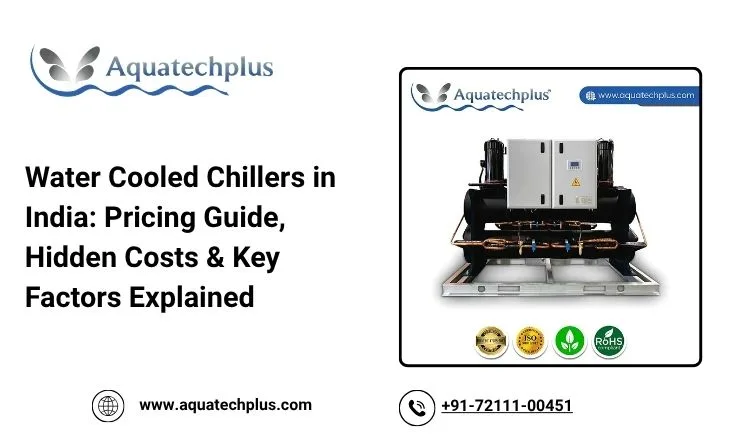
A Water Cooled Chiller is not a line item—it’s an operational backbone. Price matters, but performance over 5–10 years matters more. The right decision now reduces surprises later, and that’s where real savings live.
FAQs
What factors affect Water Cooled Screw Chiller pricing the most?
Compressor type, capacity, and control system complexity drive most of the cost. Among Water Cooled Screw Chiller Manufacturers, pricing can vary by 18–25% for similar specs due to component quality differences.
How do Water Cooled Glycol Screw Chiller Manufacturers differ from standard suppliers?
They design for low-temperature applications and fluid viscosity changes. Not all Water Cooled Glycol Screw Chiller Manufacturers account for efficiency losses properly—that’s where problems begin.
Are Water Chiller Manufacturers responsible for installation?
Some are, some aren’t. Many Water Chiller Manufacturers exclude piping and electrical integration. Always clarify scope before signing.
What is the difference between Water Cooled Chiller Manufacturers and Air Cooled Glycol Chiller Manufacturers?
Water-cooled systems rely on cooling towers, while Air Cooled Glycol Chiller Manufacturers build standalone units. Air-cooled units are easier to install but typically consume 10–15% more power.
How long does a Water chiller System last?
A properly maintained unit from reliable Water chiller System Manufacturers can last 10–15 years. Poor water treatment can cut that nearly in half.
Is a Glycol Chiller always necessary?
Not always. Glycol Chiller Manufacturers are needed when freezing risk exists or sub-zero cooling is required. Otherwise, standard water systems are more efficient.
Do Air Cooled Glycol Chiller Manufacturers offer lower maintenance units?
Yes, but there’s a trade-off. Units from Air Cooled Glycol Chiller Manufacturers avoid cooling towers, reducing maintenance—but they run hotter and consume more power in peak summer conditions.