A decade ago, buying a car meant walking into three or four showrooms, kicking tyres, sitting in driver's seats you had no intention of buying, and slowly narrowing things down through sheer physical effort. That process is disappearing, and not because people got lazier. It's disappearing because the technology finally caught up to what buyers actually wanted: to know almost everything about a car before they ever touch it.
Virtual test drives and AR showrooms aren't a gimmick anymore. They're becoming standard parts of how dealerships and marketplaces operate, from Munich to Mumbai to Dubai. The reasons are practical, not flashy, and once you look at what's driving the shift, it makes a lot of sense.
Why Physical Showrooms Stopped Being Enough
Traditional showrooms have one big limitation: space. A dealer can only display so many cars at once, and if a customer wants to see a trim or colour that isn't on the floor, they either wait or walk away. That's a real cost, especially in markets like the UAE where premium buyers expect to see exact configurations before committing.
Digital tools solve this without adding a single square foot of floor space. Audi's showroom concept in London, for instance, replaced most physical inventory with floor-to-ceiling displays where customers browse the entire model range, choose colours, and configure trims on a touch table, guided by a sales expert standing right next to them. No warehouse full of unsold stock required. Just data, screens, and a proper product database.
This matters even more in dense urban markets across the GCC and India, where real estate is expensive and dealer margins are tight. A virtual showroom lets a business show fifty configurations in the same space it used to take to show five cars.
What a Virtual Test Drive Actually Looks Like Now
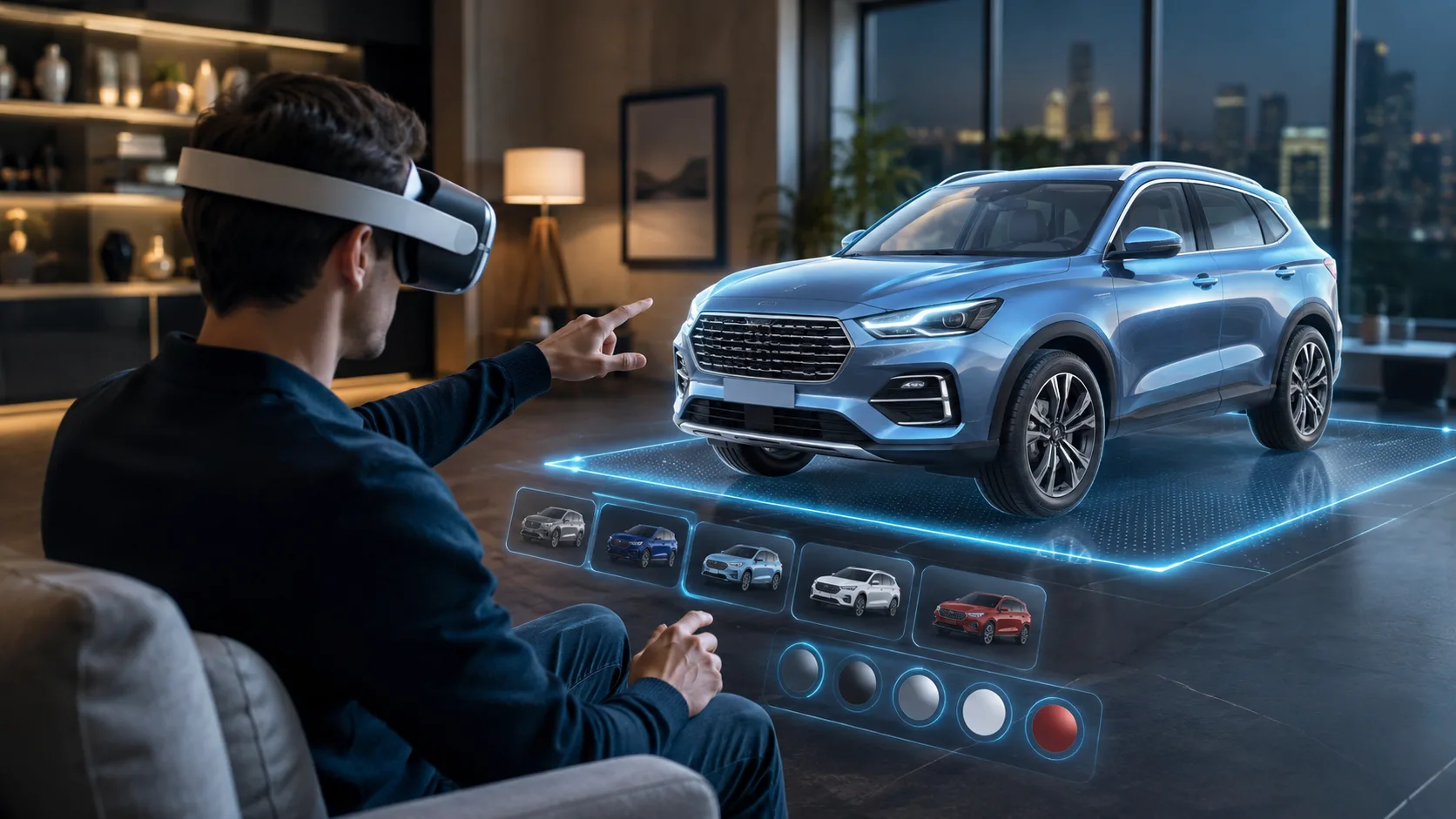
People hear "virtual test drive" and picture something clunky, like an old racing game. That's not where things stand anymore. Modern setups use high-fidelity 3D models rendered directly in a browser or app, letting someone rotate the car, open the doors, sit in the driver's seat virtually, and inspect the dashboard layout without downloading anything or owning special hardware.
Some platforms go further and simulate actual driving conditions. You can experience how a vehicle handles on a highway, through city traffic, or on rougher terrain, complete with matched engine sound and road noise. For someone comparing an SUV against a sedan for family use, that kind of detail actually changes the decision. It's not about the thrill of a simulation. It's about removing guesswork before a real test drive even happens.
Automakers like Volvo, BMW, and Mercedes-Benz have folded this into their sales funnels directly, letting people explore models and features from home before booking an in-person visit. The result isn't fewer showroom visits. It's more focused ones, where the buyer already knows what they want and just needs to confirm it.
Where AR Actually Adds Value
Augmented reality does something virtual reality can't: it puts the car in your world instead of putting you in the car's world. Using a phone camera, a buyer can place a life-size 3D model of a vehicle in their own driveway or garage and see exactly how it fits, what it looks like against their house, and whether it's the right size for their space.
This single feature solves a problem that's existed forever in car buying: photos and videos never quite convey scale. A crossover looks compact online and suddenly feels enormous in person, or the opposite. AR removes that surprise. For someone in Bareilly comparing a hatchback against a compact SUV for narrow city lanes, or a buyer in Dubai checking if a Land Cruiser will actually clear their apartment's parking bay, that's not a novelty. That's useful information delivered before a single call to a salesperson.
The Business Case, Not Just the Buyer Experience
Dealers aren't adopting this because it looks modern. They're adopting it because it moves numbers. Automotive News research found that dealerships combining virtual showrooms with AR test drives saw conversion rates jump by roughly 20 percent. Cox Automotive's dealer survey found nearly eight in ten dealers believe in-store digital tools make the sales process more efficient, not less personal.
There's also a data angle that dealers care about quietly but heavily. Every interaction inside a virtual showroom, which colours someone views, how long they spend on a trim comparison, which features they click into, becomes usable data for retargeting and lead qualification. A buyer who spends ten minutes configuring a diesel SUV in white is a very different lead than someone who bounced off the homepage in four seconds. That distinction used to be invisible. Now it's tracked and actionable.
The Global Picture vs. the GCC and India Reality
Globally, the shift toward digital-first car buying is well underway, but the exact form it takes depends heavily on the market. In mature Western markets, VR headsets and immersive showroom experiences get more attention because the infrastructure and buyer expectations support it.
In the GCC, the picture is shaped by a different set of forces. The UAE's used car market alone is projected to hit close to 23 billion dollars this year, and a huge share of that growth is tied to digital platforms replacing walk-in-only sales. With expatriates making up around 88 percent of the UAE's population, and many of them rotating vehicles every few years due to shorter residency cycles, speed and remote-friendly buying tools aren't optional extras. They're the baseline expectation. Someone relocating to Dubai wants to configure and shortlist a vehicle before they've even landed.
India tells a related but distinct story. The online car buying market crossed roughly 12.8 billion dollars last year and is expected to more than double by the early 2030s. What's notable is who's driving that growth: nearly half of online car purchases in India now come from women buyers, drawn largely by the transparency and reduced pressure that digital tools offer compared to a traditional dealership floor. Add in Tier-2 city demand, where physical dealer density is lower but internet access is high, and virtual showrooms aren't a luxury add-on. They're often the only realistic way a dealer reaches that buyer at all.
Platforms like Cars24 and CarDekho built entire businesses around this exact gap, combining AI-based pricing, virtual inspection tools, and omnichannel reach to serve buyers who'd otherwise have no organized dealer nearby.
What Still Requires a Human
None of this replaces the actual test drive or the conversation with a knowledgeable salesperson, and most industry data backs that up. Digital tools are excellent at narrowing a list from ten cars to two. They're far less reliable at replicating the feeling of a car under real acceleration, the noise it makes on a rough road, or how the seats feel after forty minutes. Buyers still want that final physical confirmation before signing anything, and dealers who understand this are using virtual tools to filter interest, not eliminate the in-person step entirely.
The dealerships getting this right treat digital and physical as one connected journey rather than two separate channels. A buyer browses a virtual showroom, configures a vehicle, checks it against their driveway with AR, then walks into the dealership already decided on ninety percent of the details. The salesperson's job shifts from persuasion to confirmation, which tends to make the whole process shorter and less stressful for everyone involved.
Where This Is Heading
The next stretch of development is less about flashier visuals and more about integration. Expect AI-driven virtual assistants inside these showrooms that can answer specific questions about financing, trim differences, or ADAS features on the spot, without waiting for a human rep to log on. Expect AR to move from a novelty feature to a standard listing option on marketplaces, the same way photo galleries became standard fifteen years ago.
For markets like the GCC and India, where buyer bases are geographically spread out and digital adoption is already high, this isn't a bet on future technology. It's closing a gap that's existed for a while: the distance between what a buyer can learn from their phone and what they used to have to drive across town to find out. That distance is shrinking fast, and the dealers who figure out how to shrink it fastest are the ones pulling ahead.
For more such informative blogs, keep following AutoVoB.