Businesses today handle enormous amounts of sensitive information. From financial statements and contracts to intellectual property and corporate records, important documents often need to be reviewed by investors, lawyers, buyers, auditors, and other external parties.
Email attachments and ordinary cloud folders may work for everyday files, but complex transactions require stronger control.
That's where a Virtual Data Room can make a difference.
What Is a Virtual Data Room?
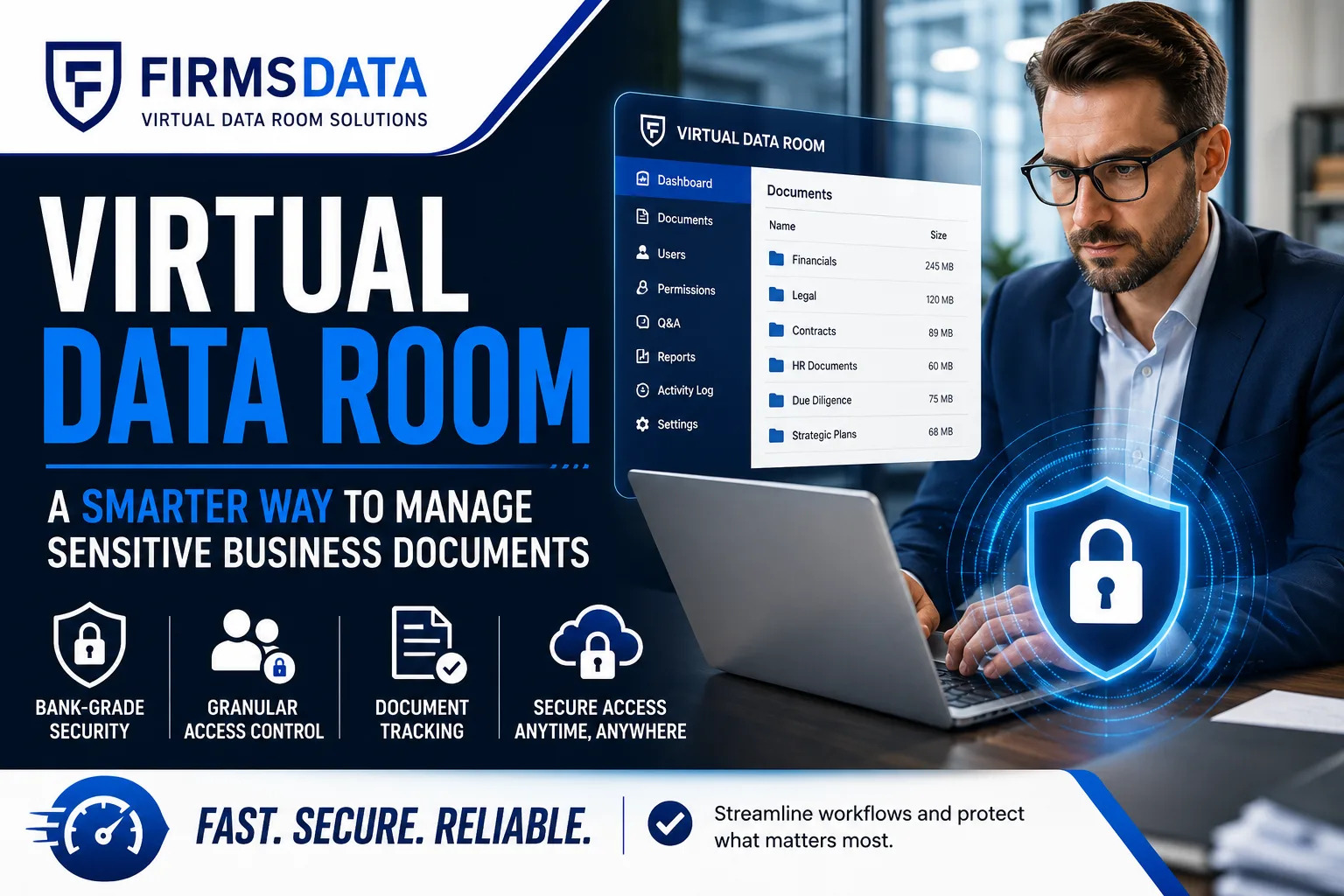
A Virtual Data Room (VDR) is a secure online platform used to store, organize, share, and monitor access to confidential business documents.
Unlike a conventional cloud-storage folder, a VDR is specifically designed for situations where information needs to be shared with multiple parties while maintaining detailed control over permissions and document activity.
Typical VDR documents include:
- Financial records
- Business plans
- Contracts
- Tax documents
- Legal agreements
- Corporate records
- Intellectual property documents
- Compliance information
- Due diligence materials
Why Is a Virtual Data Room Important?
Confidential information needs to remain accessible to authorized people without becoming unnecessarily exposed.
A VDR can help businesses establish a centralized environment where administrators control who can access specific information.
Secure Document Sharing
Instead of sending sensitive files through multiple email threads, organizations can provide authorized participants with controlled access to a centralized repository.
Better Organization
A structured data room makes it easier to categorize documents and locate information during large transactions.
Greater Visibility
Audit trails and activity reporting can provide insight into document access and user activity, depending on the platform.
Easier Collaboration
Investors, advisors, lawyers, buyers, and internal teams can review relevant information within the same environment.
Virtual Data Rooms for M&A
One of the most common applications of a VDR is mergers and acquisitions.
An M&A transaction can require the seller to provide extensive documentation for due diligence. These documents may cover finances, legal matters, operations, employees, intellectual property, contracts, and more.
A VDR can help the transaction team:
- Create organized document folders.
- Assign appropriate user permissions.
- Upload and manage confidential files.
- Respond to due diligence questions.
- Monitor document activity.
- Maintain control throughout the transaction.
This can make a complicated document-review process easier to coordinate.
Virtual Data Rooms for Fundraising
Startups and established businesses raising capital may also use VDRs.
Potential investors may need access to financial information, corporate documents, market research, intellectual property records, and other confidential materials before making an investment decision.
A centralized data room allows companies to share relevant information without giving every participant unrestricted access to their entire document collection.
Key Virtual Data Room Features
When evaluating a VDR, businesses should look beyond basic storage.
Granular Permissions
Administrators should be able to define what different users can view, download, print, or otherwise access.
Audit Trails
Activity logs can help organizations maintain visibility into document interactions throughout a transaction.
Document Watermarking
Watermarks can help identify documents and discourage unauthorized distribution.
Multi-Factor Authentication
MFA adds another layer of account protection by requiring users to provide additional verification.
Document Search
Advanced search can save significant time when users need to locate specific information among hundreds or thousands of files.
Q&A Management
A dedicated Q&A feature can centralize questions from investors, buyers, or advisors and keep responses organized.
How Secure Is a Virtual Data Room?
Security is one of the main reasons organizations choose specialized VDR software.
Depending on the provider, security features may include:
- Encryption
- Multi-factor authentication
- Role-based access controls
- Document-level permissions
- Audit logging
- Watermarking
- Download restrictions
- Access expiration
- Backup and recovery systems
However, security isn't determined by features alone. Organizations should review a provider's security documentation, infrastructure, certifications, policies, and contractual terms before selecting a platform.
Choosing the Right Virtual Data Room
Before selecting a provider, consider your specific transaction requirements.
Security Requirements
Determine which security controls are necessary for your organization and the information being shared.
Data Residency
Understand where your documents will be stored and processed, particularly if your organization has regulatory or contractual data-location requirements.
Pricing
VDR providers can use different pricing models. Compare the complete cost, including storage, users, transaction duration, support, and additional services.
Ease of Use
A VDR should be straightforward for administrators and external participants to navigate. A complicated interface can slow down due diligence and create unnecessary support requests.
Scalability
The platform should be able to accommodate the number of documents and users expected during your transaction.
FirmsData Virtual Data Room
FirmsData provides a Virtual Data Room designed for confidential business transactions and document management.
The platform supports use cases such as:
- Mergers and acquisitions
- Due diligence
- Fundraising
- IPO preparation
- Legal disclosures
- Joint ventures
- Corporate transactions
FirmsData highlights features including granular permissions, audit trails, dynamic watermarking, document search, access controls, and secure collaboration.
For organizations evaluating an India-focused VDR, FirmsData also emphasizes India-hosted infrastructure and security controls in its published documentation.
Final Thoughts
A Virtual Data Room is more than an online file-storage solution. It provides a controlled environment for managing sensitive information when multiple parties need secure access to important documents.
Whether you're preparing for an M&A transaction, raising capital, conducting due diligence, or managing another confidential business process, the right VDR can improve organization, security, transparency, and collaboration.
When comparing providers, focus on security, permissions, auditability, data residency, usability, pricing, and transaction-specific features. The best solution is ultimately the one that matches your organization's risk profile and workflow requirements.
For businesses exploring a dedicated VDR, FirmsData's Virtual Data Room is one option worth evaluating.