

The role of the Chief Financial Officer (CFO) is evolving rapidly. With the dynamic nature of business and the increasing need for agility, many companies are turning to Virtual CFO and Fractional CFO to meet their financial leadership needs. These modern solutions offer flexibility, affordability, and access to seasoned expertise without the commitment of a full-time hire.
What is a Virtual CFO (vCFO)?
- Definition and Roles
A Virtual CFO is a remote, outsourced finance professional who provides strategic financial guidance to businesses. They typically work with small to mid-sized businesses that need CFO-level insight but don’t have the resources to employ a full-time executive.
-Support for Growing Businesses
Virtual CFOs handle budgeting, financial reporting, forecasting, cash flow analysis, and more. They offer high-level financial strategy, guiding business owners through critical decisions without the overhead of an in-house CFO.
What is a Fractional CFO?
- Key Differences from vCFO
A Fractional CFO is also an outsourced financial expert, but often works part-time on-site or remotely with a deeper engagement in the business. While vCFOs are usually remote consultants, Fractional CFOs may integrate more with the internal team.
- Ideal Scenarios
They are perfect for businesses undergoing transitions—mergers, acquisitions, expansions—or those preparing for investment rounds.
Virtual CFO vs. Fractional CFO: A Comparative Analysis
FeatureVirtual CFOFractional CFOMode of WorkRemoteOn-site or hybridEngagement LevelAdvisory & flexiblePart-time executiveBest ForStartups, SMEsGrowing or transitioning businessesCostLowerModerateScopeStrategic oversightDeeper, operational involvement
Understanding Financial Forecasting
- Definition and Importance
Financial forecasting is the process of estimating future revenues, expenses, and capital needs. It serves as a financial roadmap for businesses.
- Key Components
Forecasts typically include:
- Revenue projections
- Cost of goods sold
- Operating expenses
- Cash flow
- Profit margins
Why Financial Forecasting is Crucial for Businesses
- Strategic Planning
Forecasts help businesses plan for growth, allocate resources efficiently, and set measurable goals.
- Risk Management
By identifying potential shortfalls or surpluses, companies can prepare for uncertainties.
- Investor Confidence
A well-prepared forecast shows professionalism and strategic thinking, essential when attracting investors or lenders.
Financial Forecasting Services Provided by vCFOs and Fractional CFOs
These experts bring clarity to numbers and convert data into insights. Key services include:
- Budgeting and Financial Modeling
- Scenario Planning and What-if Analysis
- Real-time Reporting Dashboards
Their expertise turns raw data into actionable strategies, ensuring that every decision is financially sound.
Tools and Technology Used in Financial Forecasting
Top tools used by outsourced CFOs include:
- QuickBooks, Xero, and NetSuite
- Forecasting Software: Float, Fathom, Jirav
- Analytics Dashboards: Power BI, Tableau
- Cloud Collaboration Tools: Google Sheets, Excel with automation
These tools enable seamless financial planning and reporting, enhancing visibility and control.
Building a Financial Forecast: Step-by-Step
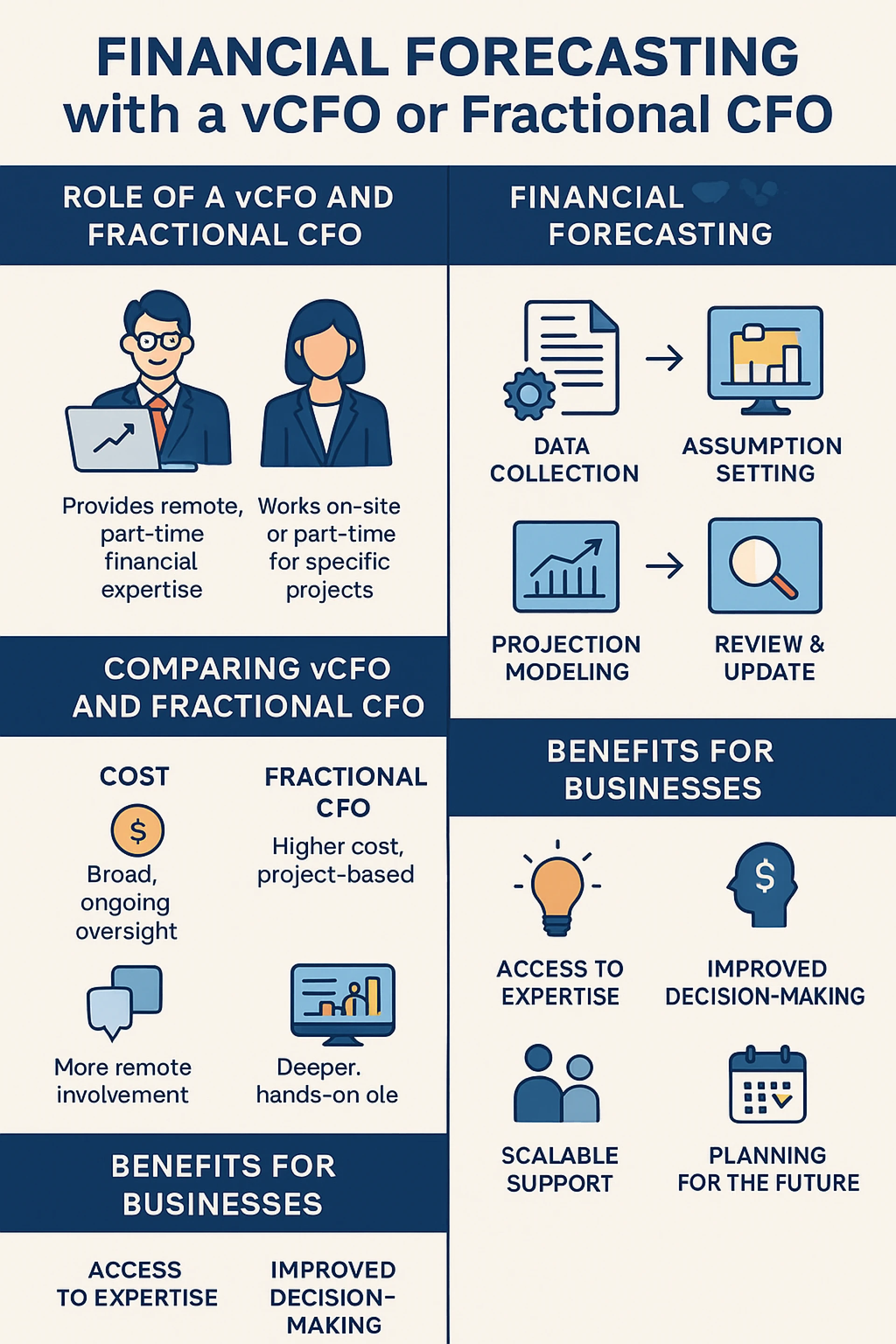
- Data Collection – Historical financials, market data, and sales pipelines.
- Assumption Setting – Economic conditions, seasonality, and cost variations.
- Projection Modeling – Using tools to forecast revenues, expenses, and profits.
- Review and Update – Regular reviews to reflect actual results and adjust projections.
Benefits of Hiring a Virtual or Fractional CFO
- Access to Top Talent Without Full-Time Cost
- Improved Financial Clarity and Strategy
- Scalable Solutions for Growing Businesses
- Enhanced Investor Readiness
- Strategic Guidance in Critical Phases
Industries Benefiting Most from Outsourced CFOs
- Startups and SMEs – Budget control and investor pitch preparation.
- E-commerce and SaaS – Subscription forecasting and margin analysis.
- Healthcare and Nonprofits – Grant management, compliance, and cost control.
How to Choose Between a vCFO and a Fractional CFO
Consider the following:
- Size of Business and Revenue
- Nature of Financial Challenges
- Need for On-site Presence
- Budget and Cost Constraints
- Strategic vs. Operational Needs
Challenges in Financial Forecasting and How to Overcome Them
ChallengeSolutionData InaccuracyRegular audits and software integrationMarket VolatilityFlexible scenario planningSkill GapsLeverage experienced CFO professionals
Case Studies: Success Stories with Outsourced CFOs
- A SaaS Startup Scales Faster with vCFO Support
With precise forecasts, they secured funding and expanded to 3 new markets.
- A Manufacturing SME Saves Costs with a Fractional CFO
Reorganized finances, improved cash flow, and avoided over-leverage.
Infographic: Financial Forecasting with a vCFO or Fractional CFO
FAQs on Virtual CFOs, Fractional CFOs, and Financial Forecasting
- What's the difference between a vCFO and a full-time CFO?
A vCFO works remotely and part-time, making it cost-effective for small businesses.
- How do I know if I need a CFO at all?
If you struggle with cash flow, planning, or financial strategy, a CFO can add value.
- Can outsourced CFOs help with investor decks?
Yes, they often prepare pitch decks, financial models, and due diligence materials.
- How often should financial forecasts be updated?
Quarterly is standard, but high-growth companies may update them monthly.
- Is forecasting software necessary?
While not mandatory, it greatly enhances accuracy and efficiency.
- Do outsourced CFOs offer tax planning?
Many do, or they collaborate with tax professionals to ensure compliance.
Conclusion
In a fast-paced world, businesses need strategic financial insight without excessive overhead. Virtual and Fractional CFO services offer the perfect balance of expertise and flexibility. With robust financial forecasting, companies can navigate uncertainty, seize opportunities, and plan for sustainable success.