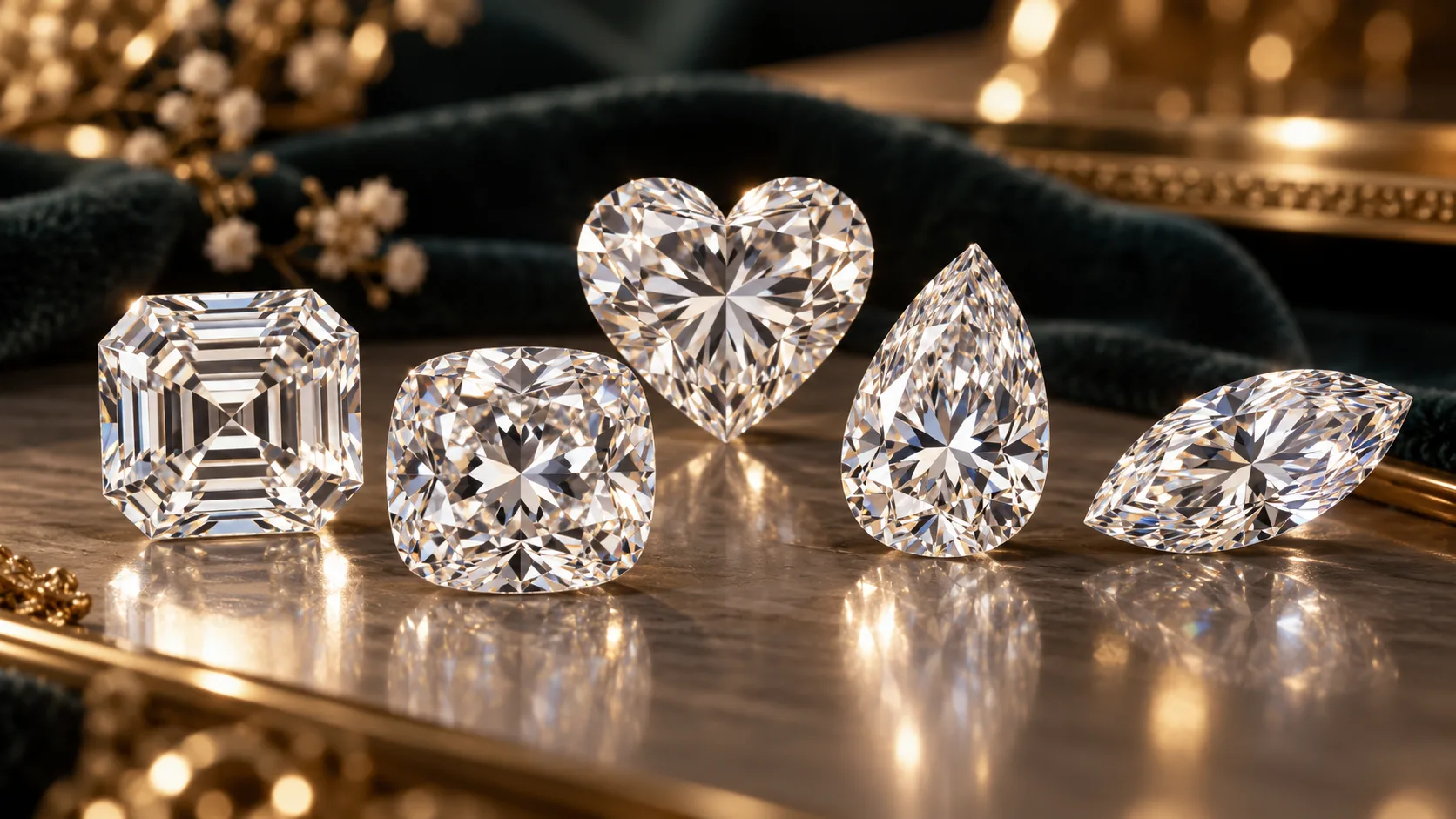
Vintage Elegance Meets Modern Style: A Guide to Asscher, Cushion, Heart, Pear and Marquise Diamonds
Diamond jewellery has always reflected personal taste, but there is far more to choosing a diamond than selecting its carat weight. The shape of a stone can influence everything from the way it catches the light to how it looks in an engagement ring, pendant or pair of earrings.
While round brilliant diamonds remain a familiar choice, fancy-shaped diamonds offer something different. Some are inspired by traditional jewellery designs, while others appeal to those looking for unusual proportions and contemporary styling.
Asscher and cushion cuts are particularly associated with vintage elegance. Heart and pear-shaped diamonds offer contrasting interpretations of romantic design, while marquise diamonds combine historical character with a striking elongated silhouette.
Understanding these five shapes can help buyers choose a diamond that suits their style, proportions and intended jewellery setting.
Asscher vs Cushion-Cut Diamonds: Two Interpretations of Vintage Elegance
Asscher and cushion-cut diamonds are both popular with people who appreciate traditional jewellery.
Although they share a vintage-inspired character, their outlines, facet patterns and visual effects are quite different.
What Makes an Asscher-Cut Diamond Distinctive?
An Asscher-cut diamond is generally square with cropped corners and a step-cut facet arrangement.
Its geometric outline is closely associated with Art Deco jewellery, where symmetry, clean lines and architectural details became important design features.
Unlike brilliant-cut diamonds, which produce numerous small flashes of light, Asscher cuts are known for broader reflections created by their stepped facets.
This produces the distinctive hall-of-mirrors effect, where light and dark reflections appear to extend towards the centre of the stone.
Asscher diamonds often appeal to buyers who prefer understated sophistication rather than maximum sparkle.
Their balanced square proportions also make them suitable for engagement rings featuring geometric settings, tapered side stones and vintage-inspired metalwork.
Why Cushion-Cut Diamonds Have Lasting Appeal
Cushion-cut diamonds feature a square or rectangular outline with rounded corners.
Their softer shape resembles a pillow, which explains the name.
Cushion cuts have a long history in diamond jewellery, and their rounded silhouette has helped maintain their appeal across changing design trends.
Modern cushion diamonds can feature different facet arrangements, producing anything from broad flashes of light to a more closely textured, crushed-ice appearance.
This variety allows buyers to choose a diamond that suits either a vintage-inspired or contemporary jewellery design.
A cushion-cut diamond can look particularly attractive in a delicate halo setting, where smaller surrounding diamonds complement its gently curved outline.
Asscher vs Cushion: Which Offers More Sparkle?
The main difference between these shapes is how their facets interact with light.
An Asscher cut uses a step-cut arrangement, creating a measured pattern of broad reflections.
A cushion cut generally uses brilliant-style faceting, often producing more numerous flashes of sparkle.
Neither effect is necessarily better.
Someone who appreciates the clean geometry and reflective depth of an Asscher diamond may find its appearance more appealing than the lively sparkle of a cushion cut.
Conversely, buyers looking for a romantic shape with noticeable brilliance may prefer a cushion diamond.
Which Shape Is Better for an Engagement Ring?
Asscher-cut diamonds complement structured designs, particularly settings inspired by Art Deco jewellery.
They can look elegant in a simple solitaire or between tapered baguette side stones.
Cushion cuts are more versatile in terms of visual character. Their rounded corners work well with solitaires, halos and detailed vintage-style settings.
There is also an important practical consideration.
Because Asscher diamonds have broad, open facets, inclusions may be easier to notice than in some brilliant-cut stones.
Clarity and overall transparency therefore deserve careful attention when comparing individual Asscher diamonds.
Heart vs Pear-Shaped Diamonds: Understanding Their Proportions
Heart and pear-shaped diamonds are both recognised for their distinctive outlines.
However, they create very different effects when worn.
A heart-shaped diamond is immediately associated with affection and sentiment, while a pear-shaped diamond provides an elongated, asymmetrical silhouette.
Choosing between them often comes down to the meaning, proportions and visual style the buyer wants to achieve.
Heart-Shaped Diamonds: A Romantic Statement
Heart-shaped diamonds are among the most recognisable fancy diamond cuts.
Their outline features two rounded lobes at the top, a central cleft and a pointed lower end.
Creating a visually balanced heart requires precise cutting and careful attention to symmetry.
If the lobes are uneven or the point is incorrectly positioned, the shape can appear unbalanced.
The depth of the cleft also affects the diamond's character.
A shallow cleft may make the outline look less recognisably heart-shaped, while an excessively deep cleft can alter its proportions.
A well-proportioned heart diamond should have balanced lobes, a clearly defined cleft and a point aligned with the centre of the stone.
Pear-Shaped Diamonds: Graceful and Elongated
Pear-shaped diamonds combine a rounded end with a tapered point.
Often described as teardrop diamonds, they create an elegant outline that can appear particularly flattering in rings and pendant jewellery.
The elongated shape draws attention along the length of the stone.
This can make a pear-shaped diamond appear larger or more elongated than certain other diamond shapes of the same carat weight.
However, the exact visual effect depends on its measurements and proportions.
Some pear diamonds have a wider, fuller appearance, while others are noticeably longer and narrower.
Neither proportion is automatically superior. The ideal outline depends on personal preference and the intended setting.
Comparing Their Length-to-Width Ratios
The length-to-width ratio is calculated by dividing a diamond's length by its width.
This measurement helps describe whether a diamond appears broad, balanced or elongated.
For heart-shaped diamonds, many buyers prefer a ratio close to 1.00, although slightly wider or longer hearts can also look attractive.
Pear-shaped diamonds typically have more elongated proportions.
Ratios around 1.45 to 1.75 are common starting points when comparing pear diamonds, although visually appealing examples can fall outside this range.
The ratio alone does not establish quality.
Buyers should also examine symmetry, overall shape, facet arrangement and the appearance of the diamond when viewed from above.
Which Shape Works Better in Jewellery?
Heart-shaped diamonds are particularly suitable for romantic engagement rings, meaningful pendants and anniversary jewellery.
They make a distinctive statement without requiring an elaborate setting.
Pear-shaped diamonds are more versatile in orientation.
A pear diamond can be positioned vertically in a classic engagement ring, suspended with its point facing downward in a pendant or arranged in a contemporary jewellery design.
Both shapes have pointed areas that need appropriate protection.
A well-positioned V-prong or a suitably designed bezel can help protect the vulnerable tip of the diamond.
Why Marquise Diamonds Are Returning to Modern Jewellery
The marquise diamond is one of the most distinctive shapes in traditional diamond jewellery.
Its elongated outline features curved sides that taper towards pointed ends.
Historically associated with elaborate and romantic jewellery, the marquise cut is also well suited to modern minimalist designs.
Its visual character makes it a compelling alternative to more conventional shapes.
A Diamond Shape with Historical Character
Marquise-cut diamonds are commonly associated with eighteenth-century French jewellery.
Their long, pointed outline became a distinctive feature of decorative rings and other fine jewellery designs.
Over time, the shape appeared in a variety of styles, including vintage engagement rings and elaborate cluster jewellery.
Today, the same silhouette can be incorporated into much simpler designs.
A marquise diamond set on a narrow, polished band creates an elegant modern appearance, while an east-west setting places the diamond horizontally across the finger for a more unusual look.
This flexibility is one reason the shape continues to attract attention in contemporary jewellery.
Why Marquise Diamonds Can Look Larger
One of the main attractions of the marquise cut is its substantial face-up length.
Because the diamond extends towards two pointed ends, it can occupy more visible space along the finger than a round diamond of the same carat weight.
This may create the impression of a larger centre stone.
However, carat weight measures mass rather than visible surface area.
Two marquise diamonds with identical carat weights can also look different depending on how their weight is distributed.
A well-balanced marquise should have symmetrical curves and pointed ends that align with its central axis.
The Importance of Marquise Diamond Proportions
Marquise diamonds can vary considerably in their length-to-width ratios.
Some have a broad, rounded middle, while others are narrow and dramatically elongated.
Ratios around 1.75 to 2.25 are commonly considered when comparing marquise diamonds, but personal preference remains important.
An excessively narrow diamond may look less substantial through its centre, while a broader stone can appear fuller and softer.
Marquise diamonds may also display a bow-tie effect.
This appears as a darker area across the middle of the stone and can vary depending on the cutting proportions and lighting conditions.
A subtle bow-tie may be acceptable, but a strong dark area can distract from the diamond's brilliance.
Examining photographs or videos is particularly useful when comparing marquise stones.
Modern Settings for Marquise Diamonds
Marquise diamonds work well in several jewellery styles.
A traditional north-south solitaire emphasises the diamond's length and can create an elegant appearance on the finger.
An east-west setting offers a contemporary alternative by positioning the stone horizontally.
Marquise diamonds can also be used as side stones, particularly in three-stone engagement rings.
Their pointed ends require careful protection.
V-shaped prongs are often used to cover the tips, while a properly constructed bezel can offer additional coverage around the stone's edges.
Choosing Between Vintage and Modern Diamond Shapes
These five diamond shapes offer different combinations of geometry, sparkle and visual presence.
Diamond shapeDistinctive featureSuitable jewellery styleAsscherSquare outline and step-cut reflectionsArt Deco and vintage-inspired ringsCushionRounded corners and brilliant-style sparkleRomantic solitaires and halo ringsHeartRecognisable romantic silhouetteSentimental rings and pendantsPearElongated teardrop outlineElegant rings, earrings and pendantsMarquiseLong outline with two pointed endsStatement rings and modern minimal designsThe most suitable shape depends on the buyer's priorities.
Someone who values symmetry and geometric detail may prefer an Asscher cut.
A cushion diamond provides a softer appearance, while a heart diamond is ideal for a distinctly symbolic design.
Pear-shaped diamonds offer graceful elongation, and marquise diamonds provide a particularly dramatic silhouette.
Rather than selecting a shape purely because it is fashionable, it is better to consider how it complements the wearer's individual style.
What to Consider When Buying Fancy-Shaped Lab-Grown Diamonds
The growing selection of lab-grown diamonds gives buyers the opportunity to compare different shapes, sizes and quality characteristics.
Lab-grown diamonds have essentially the same chemical, physical and optical properties as their mined counterparts, making cut quality, colour, clarity and carat weight important considerations regardless of origin.
However, fancy-shaped diamonds require more detailed visual inspection than simply checking a grading report.
Unlike round brilliant diamonds, fancy shapes do not all have one universally accepted proportion system that guarantees attractive light performance.
A diamond's measurements, facet arrangement and symmetry should therefore be considered together.
When researching different cuts, buyers can explore the certified lab-grown diamond collection at Diamonds By Post, which provides a starting point for comparing shapes and diamond specifications before selecting a suitable jewellery setting.
It is also useful to consider how a diamond will look once mounted.
A square Asscher diamond and a cushion diamond may have similar measurements but create completely different visual effects.
Similarly, a heart, pear or marquise diamond may require more carefully positioned prongs than a rounded stone.
Reviewing the diamond and the intended setting together can help avoid choosing a beautiful loose stone that does not suit the final jewellery design.
Practical Considerations for Everyday Wear
A diamond's shape can influence how vulnerable its edges are to accidental impacts.
Although diamonds are highly resistant to scratching, they can still chip or fracture when struck in certain ways.
Pointed diamonds need particular attention.
Heart and pear-shaped diamonds each have a vulnerable point, while marquise diamonds have two.
Asscher diamonds have cropped corners, and cushion diamonds generally have rounded corners, but all shapes still require secure settings.
For jewellery worn regularly, buyers should consider:
- Secure prongs: Ensure the diamond is properly supported and pointed areas are protected.
- Setting height: Lower-profile settings may reduce the likelihood of accidental knocks.
- Metal quality: Choose a suitable precious metal and a well-constructed mount.
- Regular inspections: Have prongs and settings checked periodically for movement or wear.
- Cleaning: Keep jewellery free from accumulated oils and residue that can affect its appearance.
- Lifestyle: Consider how frequently the ring will be worn during physical activities.
The most attractive setting is not necessarily the most practical for every wearer.
A carefully designed ring should balance appearance, comfort and security.
Frequently Asked Questions
Are Asscher or cushion-cut diamonds better for vintage engagement rings?
Both are suitable for vintage-inspired jewellery. Asscher cuts are associated with geometric Art Deco designs, while cushion cuts offer a softer, more romantic appearance.
Do cushion diamonds sparkle more than Asscher diamonds?
Cushion diamonds generally produce more numerous flashes of light because of their brilliant-style facets. Asscher diamonds create broader reflections through their step-cut arrangement.
Are heart-shaped diamonds suitable for engagement rings?
Yes. Heart-shaped diamonds are particularly appealing for romantic or personalised engagement rings. Their symmetry and pointed tip should be carefully assessed before selecting a setting.
Do pear-shaped diamonds make fingers look longer?
An elongated pear-shaped diamond can create the visual impression of longer fingers when positioned vertically. The effect depends on the stone's proportions and ring design.
Why do marquise diamonds appear larger?
Their elongated outline often provides substantial face-up length relative to carat weight. This can create the impression of a larger diamond, although actual measurements vary between stones.
Are marquise diamonds suitable for modern jewellery?
Yes. Marquise diamonds can be used in minimalist solitaires, horizontal east-west settings, contemporary pendants and distinctive earrings.
Which fancy diamond shape is the easiest to wear every day?
Cushion diamonds have rounded corners and can be practical in well-made settings. Asscher cuts have cropped corners, while heart, pear and marquise shapes need particular attention to the protection of their points. The setting's construction matters as much as the shape.
Final Thoughts
Fancy-shaped diamonds demonstrate how much variety exists beyond the traditional round brilliant cut.
Asscher and cushion diamonds offer two interpretations of vintage elegance, one defined by geometric reflections and the other by softer curves and lively sparkle.
Heart and pear-shaped diamonds provide distinctive romantic silhouettes, while marquise diamonds combine historical character with striking proportions that suit contemporary jewellery.
Each shape has its own strengths, and none is automatically the best choice for every buyer.
By comparing proportions, light performance, clarity and setting requirements, buyers can select a diamond that reflects their personal taste while remaining suitable for its intended use.
Whether the preference is a vintage Asscher ring, a romantic heart-shaped pendant or a modern marquise solitaire, the right combination of diamond and setting can create jewellery with lasting appeal.