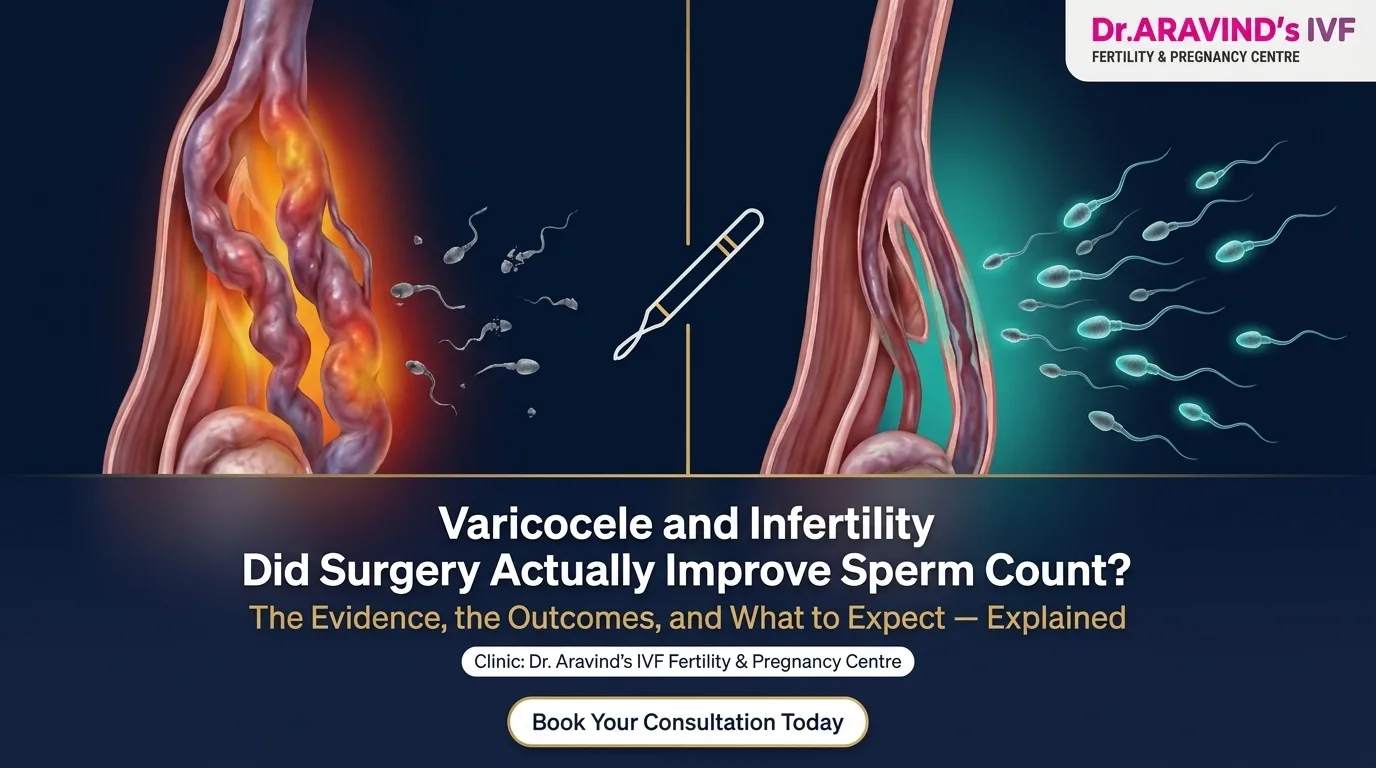
Varicocele and Infertility — Did Surgery Actually Improve Sperm Count?
It is one of the most searched questions among men dealing with male infertility: does varicocele surgery actually work? The honest answer is yes — for the right patient, with the right diagnosis, at the right time. But understanding what varicocele does to sperm health, who benefits most from surgery, and what realistic outcomes look like is essential before making any treatment decision.
At Dr. Aravind's IVF Fertility & Pregnancy Centre, a trusted name in male fertility specialist in Chennai care, varicocele is one of the most commonly identified and most successfully treated causes of male infertility seen in clinical practice.
What Is Varicocele and Why Does It Affect Fertility
Varicocele refers to enlarged, twisted veins in the scrotum — similar to varicose veins that can appear in the legs. These enlarged veins disrupt normal blood drainage from the testicles, causing blood to pool and raising the local temperature around the sperm production environment.
Sperm production is temperature-sensitive by design. The testicles sit outside the body specifically to maintain a temperature approximately two degrees cooler than core body temperature. Varicocele disrupts this cooling mechanism, and the sustained heat exposure directly damages sperm count, sperm motility, and sperm DNA integrity over time.
Varicocele is present in approximately fifteen percent of all men and in up to forty percent of men presenting with male infertility. It is the single most common correctable structural cause of male infertility — and importantly, it is frequently entirely asymptomatic. Most men with varicocele have no pain, no swelling visible to the naked eye, and no awareness that anything is wrong until a fertility evaluation identifies it.
How Varicocele Damages Sperm Health
The damage from varicocele is not limited to count alone. Men with varicocele consistently show elevated levels of reactive oxygen species in semen — a form of oxidative stress that fragments sperm DNA. This is why some men with varicocele show normal or near-normal sperm count on a basic semen analysis yet still face significant fertility challenges. The count looks acceptable. The DNA integrity does not.
Sperm DNA fragmentation caused by varicocele-related oxidative stress affects fertilisation rates, embryo development quality, and early pregnancy loss risk — even when IVF or ICSI is used. This is why treating the underlying varicocele before assisted reproduction, rather than proceeding directly to IVF, often produces better outcomes at lower cost and with fewer cycles.
Does Varicocele Surgery Actually Improve Sperm Count?
The clinical evidence is clear and consistent. Microsurgical varicocelectomy — the gold standard surgical approach — produces measurable improvements in sperm count, sperm motility, and sperm DNA fragmentation in the majority of appropriate candidates.
Research consistently shows improvements in sperm parameters within three to six months following successful varicocele repair. Natural conception rates improved significantly in couples where varicocele was the primary contributing factor. Even for couples proceeding to IVF or ICSI, treating varicocele beforehand improves embryo quality and reduces the number of cycles needed.
The degree of improvement varies by individual. Men with more severe varicocele, younger age, and shorter duration of infertility tend to show the most pronounced response to surgical correction. Men with additional fertility factors alongside varicocele — hormonal imbalances, genetic issues, or significant female factors — may still require assisted reproduction even after successful surgery, though typically with better outcomes than they would have achieved without treatment.
Who Should Consider Varicocele Surgery
Not every man with varicocele needs surgery. A varicocele that is not affecting sperm parameters and is not causing discomfort does not require treatment. Surgery becomes appropriate when varicocele is clinically significant — meaning it is palpable on examination or visible on ultrasound, and sperm parameters or sperm DNA fragmentation are measurably affected.
The ideal candidate for varicocelectomy is a man with a clinically significant varicocele, abnormal sperm parameters or elevated DNA fragmentation, a female partner with no significant fertility issues, and a realistic expectation of natural conception or improved IVF outcomes following recovery.
For men with azoospermia — complete absence of sperm — varicocele repair has shown genuine benefit in selected cases, sometimes restoring sperm production sufficiently to attempt natural conception or proceed to IVF with ejaculated sperm rather than surgical retrieval.
What the Recovery and Timeline Look Like
Microsurgical varicocelectomy is typically performed as a day procedure under local or general anaesthesia. Recovery involves approximately one week of reduced activity, with full return to normal function within two to three weeks.
Because sperm takes approximately seventy-two to ninety days to complete its maturation cycle, the full benefit of varicocele repair on sperm parameters becomes measurable around three months after surgery. A repeat semen analysis and sperm DNA fragmentation test at this point gives the clearest picture of how much improvement has occurred and what the next steps should be.
Conclusion
Varicocele surgery works — for the right patient, diagnosed correctly, at the right stage of their fertility journey. It is not a guaranteed solution for every man, and it is not necessary for every man with varicocele. But for couples where varicocele is contributing to male infertility, surgical correction remains one of the most evidence-backed, cost-effective interventions available in reproductive medicine today.
As a trusted male fertility specialist in Chennai and the best IVF centre in Tanjore, Dr. Aravind's IVF Fertility & Pregnancy Centre evaluates every varicocele case with the clinical depth it deserves — determining whether surgery, assisted reproduction, or a combination of both gives each couple the best possible path forward.
FAQ
Q1. Does varicocele always cause infertility?
No. Many men with varicocele conceive naturally without any difficulty. Treatment is only indicated when varicocele is clinically significant and measurably affecting sperm parameters or DNA fragmentation.
Q2. How long after varicocele surgery does sperm count improve?
Measurable improvement in sperm count, motility, and DNA fragmentation typically becomes apparent around three months after surgery, aligning with the sperm regeneration cycle.
Q3. Should I have varicocele surgery before trying IVF?
This depends on the severity of the varicocele and the female partner's fertility profile. In many cases, treating varicocele first improves IVF outcomes and reduces the number of cycles needed — making it a worthwhile step before proceeding to assisted reproduction.
Q4. Can varicocele repair restore sperm in men with azoospermia?
In selected cases, yes. Varicocele repair has been shown to restore detectable sperm production in some men with non-obstructive azoospermia, though outcomes vary significantly by individual case.