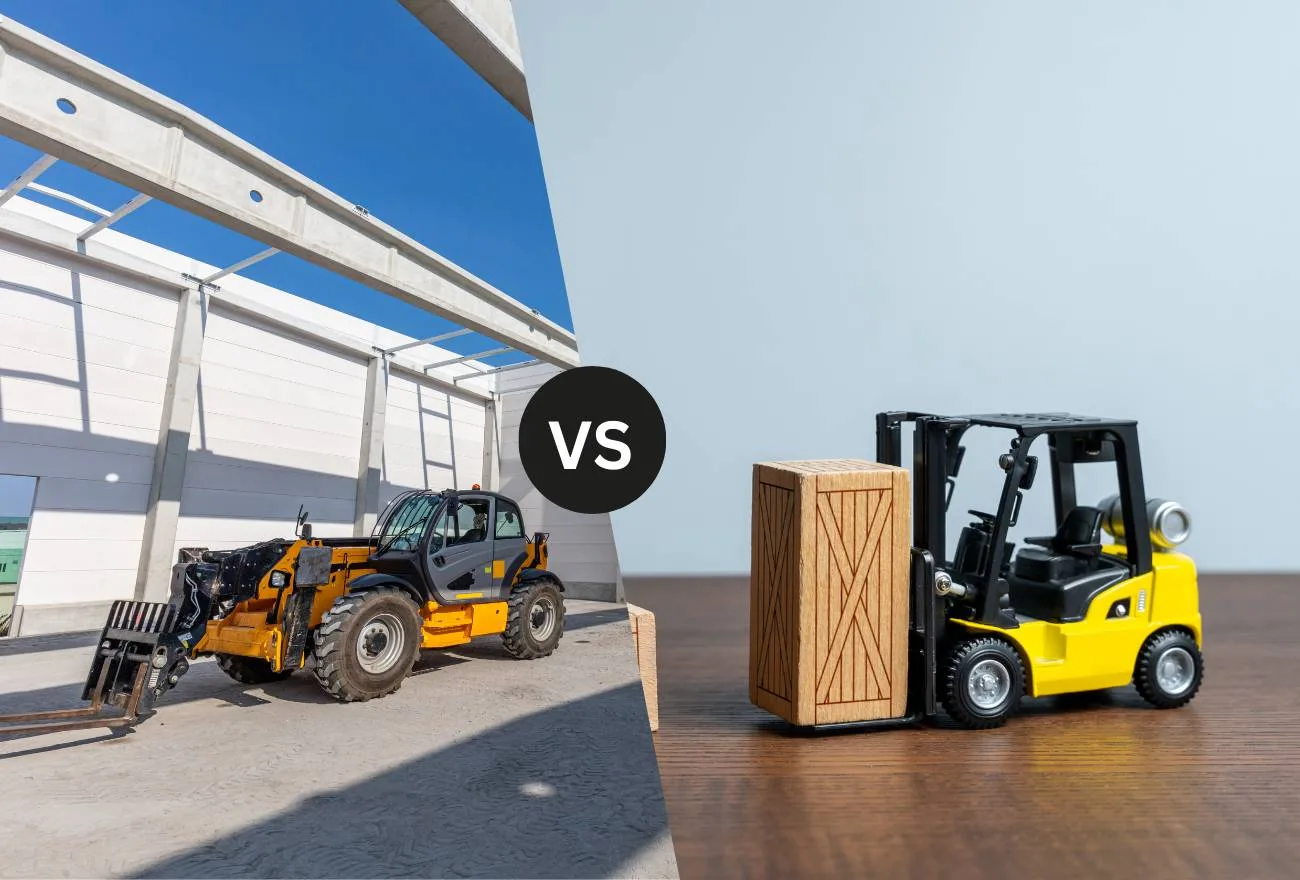
When it comes to moving, lifting, and positioning heavy materials, telehandlers and forklifts are two commonly used machines across construction sites, warehouses, farms, and industrial facilities. Although they may appear similar at first glance, these machines are designed for different working conditions and offer distinct capabilities. Understanding the key variations between a telehandler and a forklift can help businesses select the right equipment for a particular job.
Visit Us:- Variations Between a Telehandlers and a Forklift: What You Need to Know
A forklift is primarily designed for lifting and transporting loads over relatively short distances. It uses a vertical mast with forks that move up and down, making it particularly useful for warehouses, loading areas, manufacturing plants, and storage facilities. Forklifts are generally compact and highly maneuverable, allowing operators to work efficiently in narrow aisles and confined spaces. Different forklift models can handle various load capacities, but their lifting reach is typically more limited than that of a telehandler.
A telehandler, also known as a telescopic handler, is built with a boom that extends forward and upward. This telescoping arm gives the machine greater reach and flexibility when handling materials at height or over obstacles. Telehandlers are widely used in construction, agriculture, landscaping, and other outdoor environments where conventional forklifts may have difficulty operating. Depending on the attachment fitted to the boom, a telehandler can handle tasks beyond basic material lifting.
One of the biggest differences between these machines is attachment versatility. Forklifts usually rely on forks, although specialized attachments are available for certain applications. Telehandlers can accommodate forks, buckets, lifting hooks, work platforms, and other compatible attachments, allowing one machine to perform multiple types of tasks.
Terrain is another important consideration. Forklifts are commonly optimized for smooth, stable surfaces such as concrete warehouse floors and paved yards. Telehandlers are generally better suited to uneven outdoor terrain, especially models equipped with appropriate tires, stabilization systems, and four-wheel steering.
Visibility, operating dimensions, load capacity, and lift height can also vary considerably between models. A forklift may be the practical choice for repetitive pallet handling and indoor operations, while a telehandler can provide greater flexibility for projects requiring extended reach, elevated placement, or work across uneven ground.
Ultimately, choosing between a telehandler and a forklift depends on the specific application, working environment, load requirements, lifting height, and available space. Understanding these differences before selecting equipment can improve productivity, operational efficiency, and workplace safety.