For fiber artists, quilters, and professional tailors, the creative process is too often bound by physical limitations. Historically, setting up a proper, visually safe workstation meant anchoring yourself to the nearest wall outlet to power heavy, rigid desk lamps. While dedicated studio spaces are wonderful, true creative inspiration often strikes in the comfort of a living room armchair, on a sunlit porch, or during a collaborative weekend quilting retreat. Unfortunately, taking your work on the go traditionally meant severely compromising on visual clarity.
Today, however, optical engineering has successfully severed the power cord. By upgrading your mobile toolkit with the best lights for sewing, you can protect your ocular health and achieve clinical-grade precision absolutely anywhere. The modern solution lies in integrating a high-performance battery powered desk lamp that refuses to compromise on lumen output, color accuracy, or ergonomic flexibility.
The Restrictive Reality of Traditional Craft Lighting
Textile arts are incredibly demanding on human vision. Threading needles, counting 32-count linen weaves, and guiding dark fabric through a high-speed presser foot require your eyes to constantly resolve microscopic, high-contrast details over prolonged periods.
When crafters travel to classes, guild meetings, or simply move to a different room in their own home, they are usually forced to rely on standard ambient lighting. This results in severe, rapid visual fatigue and drastically impacts the quality of the final project.
- The Contrast Crisis: Standard room lighting forces the pupils to overwork. The lack of concentrated intensity causes tension headaches and muscular eye strain within minutes of starting a highly detailed project.
- Color Distortion: Hotel conference rooms and living room floor lamps typically cast a muddy, yellow hue. This completely alters the perception of subtle thread colors, leading to disastrous color-matching errors in complex embroidery or quilting patterns.
- Shadow Casting: Overhead lighting inevitably casts the crafter's own shadow directly over their embroidery hoop or sewing machine needle, completely obscuring the work area.
The Evolution of the Battery Powered Desk Lamp
In the past, cordless lighting options were woefully inadequate for serious textile artists. Early portable models relied on standard alkaline AA batteries, offering dismal lumen output that quickly dimmed to useless levels after just an hour of use. They were frustrating novelties, not professional-grade tools.
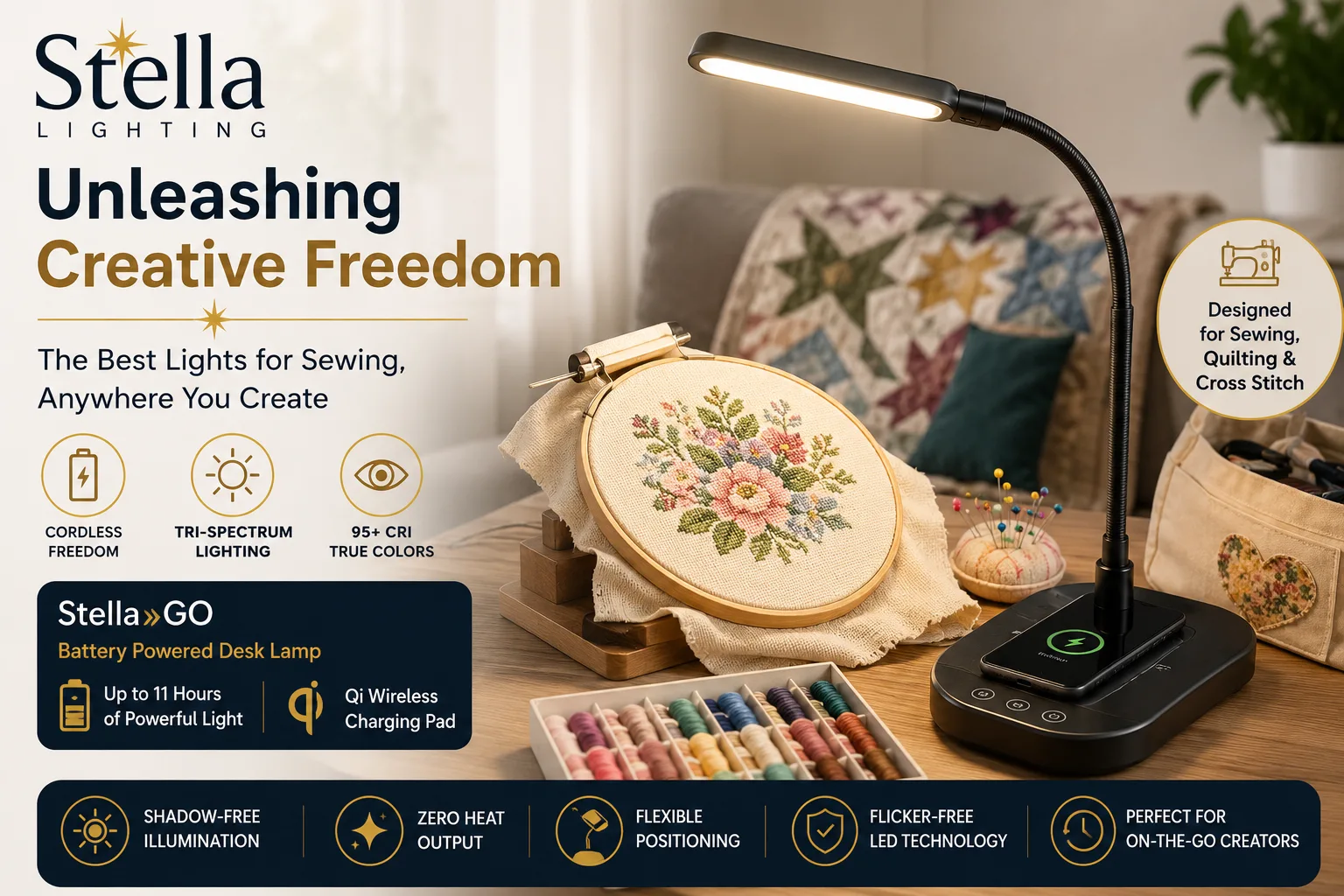
The introduction of high-capacity lithium-ion technology combined with high-efficiency LED arrays has completely revolutionized the mobile crafting landscape. A modern, clinical-grade battery powered desk lamp like the Stella»GO now rivals—and frequently exceeds—the optical performance of traditional heavy-duty plug-in fixtures.
The Stella»GO completely redefines mobile illumination by offering up to 11 hours of continuous, brilliant, flicker-free light on a single charge. Furthermore, the heavy-duty base of the lamp integrates a Qi wireless charging pad. This allows you to seamlessly charge your smartphone while you stitch, ensuring your digital patterns, community podcasts, or video tutorials remain accessible without cluttering your limited workspace with extra charging cables and adapters.
Essential Optical Criteria for Mobile Task Lighting
Even when cutting the cord, professional crafters must demand strict optical specifications to qualify a fixture as one of the best lights for sewing. True mobility should never mean sacrificing medical-grade clarity. When evaluating portable lighting, demand these three non-negotiable features:
1. Uncompromising Color Accuracy (95+ CRI)
The Color Rendering Index (CRI) is the single most important metric for textile artists. It measures how accurately a light source replicates the full natural spectrum of sunlight. Standard portable lamps hover around 70 to 80 CRI, which washes out vibrant fabrics and distorts greens and blues. A premium fixture mandates a 95+ CRI rating, ensuring that the deepest navy blues are easily distinguishable from blacks, and subtle color gradients in your floss palette remain perfectly true to life.
2. Dynamic Tri-Spectrum Control
Your lighting needs dictate different spectrums depending on the time of day and the specific fabric you are manipulating. The ideal mobile lamp features Tri-Spectrum technology, allowing you to cycle through specific color temperatures instantly:
- Cool White (5500K): Delivers intense, high-contrast daylight simulation. This is mandatory for working with dark-on-dark materials or counting tiny threads on evenweave fabrics.
- Natural White (4000K): A balanced, versatile spectrum perfect for general piecing, rotary cutting, and tracing apparel patterns.
- Warm White (2800K): A softer, amber-toned output designed specifically for evening stitching sessions. It significantly reduces harsh blue-light exposure, allowing your eyes to relax and protecting your natural sleep cycle.
3. Articulation and Zero Thermal Output
A highly articulated, flexible gooseneck is crucial for a portable lamp. You must be able to angle the light head precisely over your work, whether the lamp is sitting on a low coffee table, a high cutting counter, or a folding table at a retreat. Additionally, high-output Philips Lumiled LEDs operate with incredible thermal efficiency, meaning they generate absolute zero radiant heat. You can pull the light head within an inch of your fabric without sweating or risking thermal damage to delicate synthetic threads and silks.
Best Practices for Mobile Crafting Ergonomics
To extract the maximum optical benefits from your cordless lighting setup during retreats or living room sessions, strictly adhere to these professional ergonomic guidelines:
- Strategic Shadow Management: Always place your portable lamp on the side opposite your dominant hand. If you hold a needle in your right hand, position the lamp base to your left. This ensures your moving hand never eclipses your light source.
- Close the Distance: Because premium LED arrays remain entirely cool to the touch, bend the flexible neck as close to your active workspace as physically comfortable. Light intensity degrades over distance; closer proximity exponentially sharpens the visual contrast of your fabric's weave.
- Balance the Periphery: Avoid the common temptation to stitch in a pitch-black room illuminated only by your task light. This creates extreme micro-contrast that forces your eyes to constantly adjust when looking away from your hoop. Maintain a soft, ambient room light to minimize ocular stress and extend your stitching stamina.
Conclusion
True artistic freedom means having the ability to practice your craft wherever inspiration takes you, without ever sacrificing your visual health or the uncompromising quality of your work. By abandoning weak, restrictive wall-plug fixtures and investing in a premium, clinical-grade battery powered desk lamp, you instantly elevate your mobile studio capabilities. The Stella»GO exemplifies this cordless revolution, proving that the best lights for sewing are those that seamlessly adapt to your dynamic lifestyle. By delivering true-color accuracy, shadow-free articulation, and relentless brilliance on demand, you empower your creativity, protect your eyesight, and experience the transformative joy of flawless stitching—no matter where your creative journey leads.